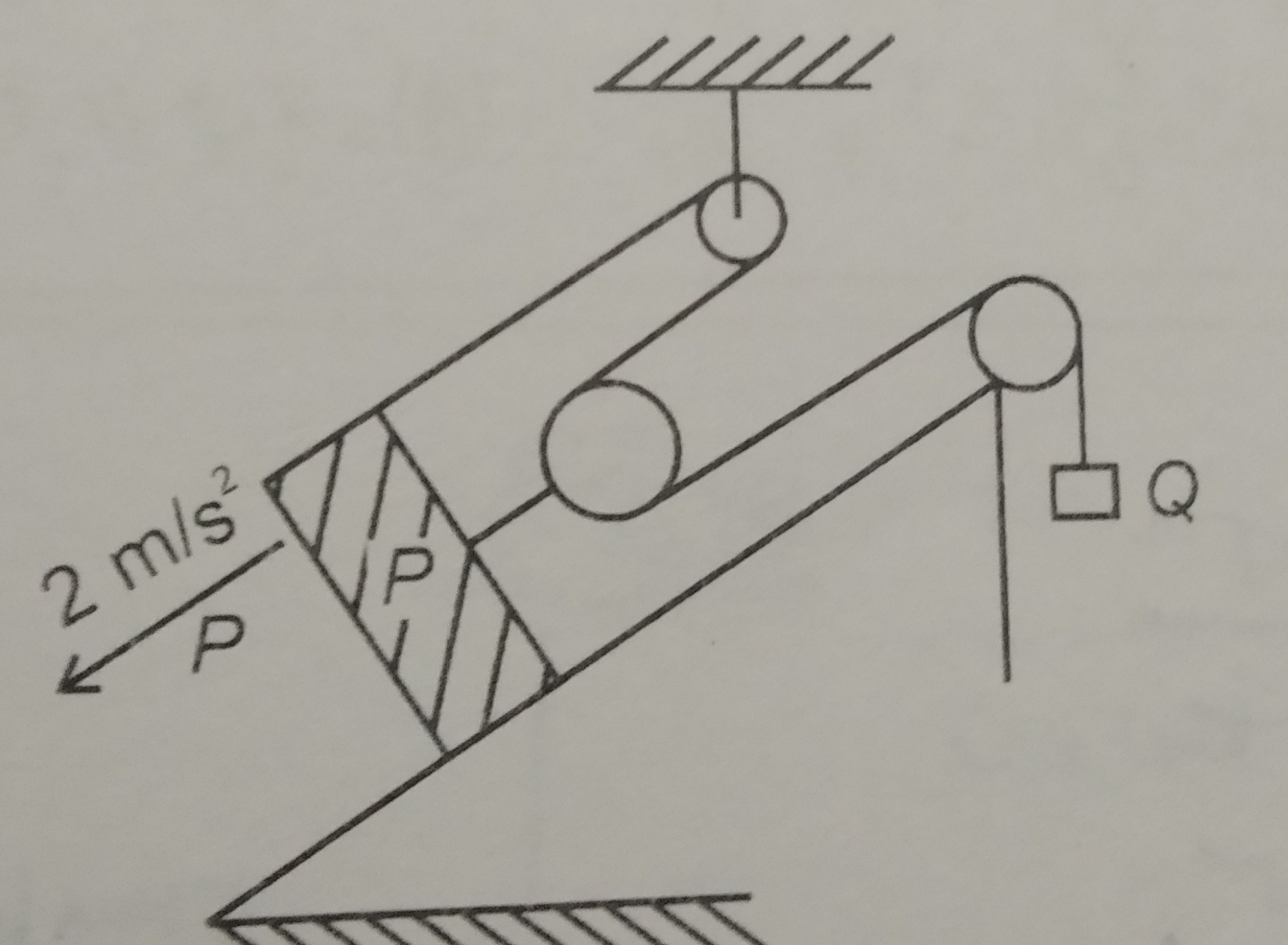
To determine the acceleration of block Q when block P has an acceleration of 2 m/s², we first need to understand how pulleys work in a system involving multiple blocks. In this scenario, we assume that the pulley is ideal and massless, which simplifies our calculations significantly.
Understanding the System
In a typical pulley system, the acceleration of one block is directly related to the acceleration of the other block(s) connected by the rope. If we have two blocks, P and Q, connected by a single rope over a pulley, the relationship between their accelerations can be derived from the constraints of the rope.
Acceleration Relationship
When block P accelerates downward, block Q will accelerate upward, and the relationship between their accelerations depends on how the rope is configured. For a simple system where both blocks are connected by a single rope, the accelerations are related as follows:
- If block P moves down by a distance \(d\), block Q moves up by the same distance \(d\) because the length of the rope remains constant.
- This means that the acceleration of block Q will be equal in magnitude but opposite in direction to the acceleration of block P.
Calculating the Acceleration of Block Q
Given that the acceleration of block P is 2 m/s² downward, we can express the acceleration of block Q as follows:
- Let \(a_P = 2 \, \text{m/s}^2\) (acceleration of block P).
- Then, the acceleration of block Q, \(a_Q\), will be \(a_Q = -a_P\).
Substituting the value we have:
a_Q = -2 \, \text{m/s}^2
Conclusion
Thus, the acceleration of block Q is 2 m/s² upward. This relationship holds true as long as the pulley is ideal and massless, ensuring that the tension in the rope is uniform and that there are no additional forces acting on the system. Understanding these principles allows us to analyze more complex pulley systems effectively.