

Grade 9Mechanics
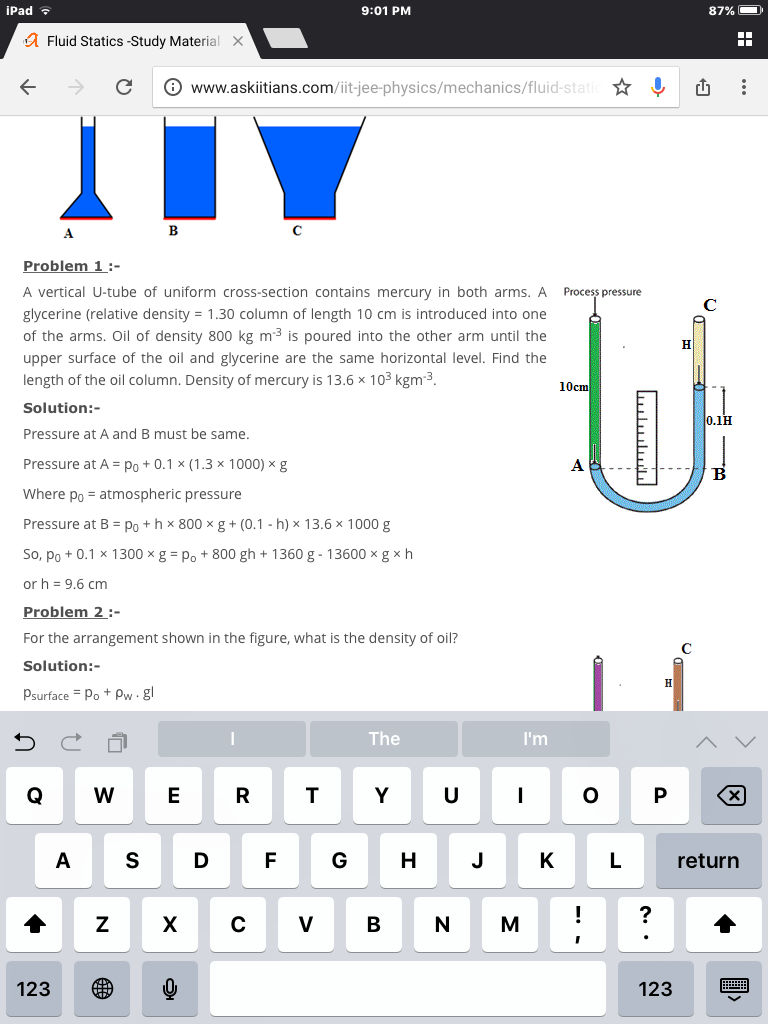
Pressure at c in example problem no 1 in this page fluid statics??
Pressure at c in example problem no 1 in this page fluid statics??


 Approved Tutor Answer11 Months ago
To determine the pressure at point C in a fluid statics problem, we need to consider the principles of hydrostatics, which govern how fluids behave at rest. The pressure at a specific point in a fluid is influenced by the height of the fluid column above that point, as well as the density of the fluid. Let’s break this down step by step.
In fluid statics, the pressure at a given depth in a fluid is given by the equation:
P = P₀ + ρgh
To find the pressure at point C, we first need to identify the height of the fluid column above point C. Let’s say, for example, that point C is located at a depth of 5 meters in a water column. The density of water is approximately 1000 kg/m³.
Using the formula, we can substitute the values:
P = P₀ + (1000 kg/m³)(9.81 m/s²)(5 m)
Assuming atmospheric pressure (P₀) is about 101,325 Pa (or 101.3 kPa), we can calculate:
P = 101325 Pa + (1000)(9.81)(5)
P = 101325 Pa + 49050 Pa
P = 150375 Pa
The pressure at point C, therefore, would be 150,375 Pa, or 150.4 kPa. This value indicates the total pressure exerted at that depth, combining both the atmospheric pressure and the pressure due to the water column above it.
Think of it like stacking books on a table. The weight of the books (analogous to the water column) adds pressure to the table (the point where we measure pressure). The deeper you go, the more books (or water) are stacked above, increasing the pressure you feel at the bottom.
In summary, to find the pressure at point C, you need to know the height of the fluid above it and the fluid's density. By applying the hydrostatic pressure formula, you can easily calculate the pressure at any point in a fluid at rest.

Three identical balls are placed on a frictionless
horizontal surface touching each other. They stick to
each other because of adhesive. Another ball of same
radius and mass m is placed over the void created by
the three balls. Find the forces applied by the balls
kept on the floor to each other if the system remains
in equilibrium.
Last Activity: 9 Months ago
A car loaded with water having total mass 1000 kg moves on a straight horizontal Road starting from rest under the action of a force of 100 Newton. The water spills throw a small hole in the bottom at a rate of 0.1 KG per second the velocity of cart after 300 seconds is nearly.
11
21
31
41
Last Activity: 9 Months ago
Last Activity: 3 Years ago
Last Activity: 3 Years ago