

Grade 12th passMechanics
Plz tell me how to approach this question i cant understand what happens after collision of rod and block..
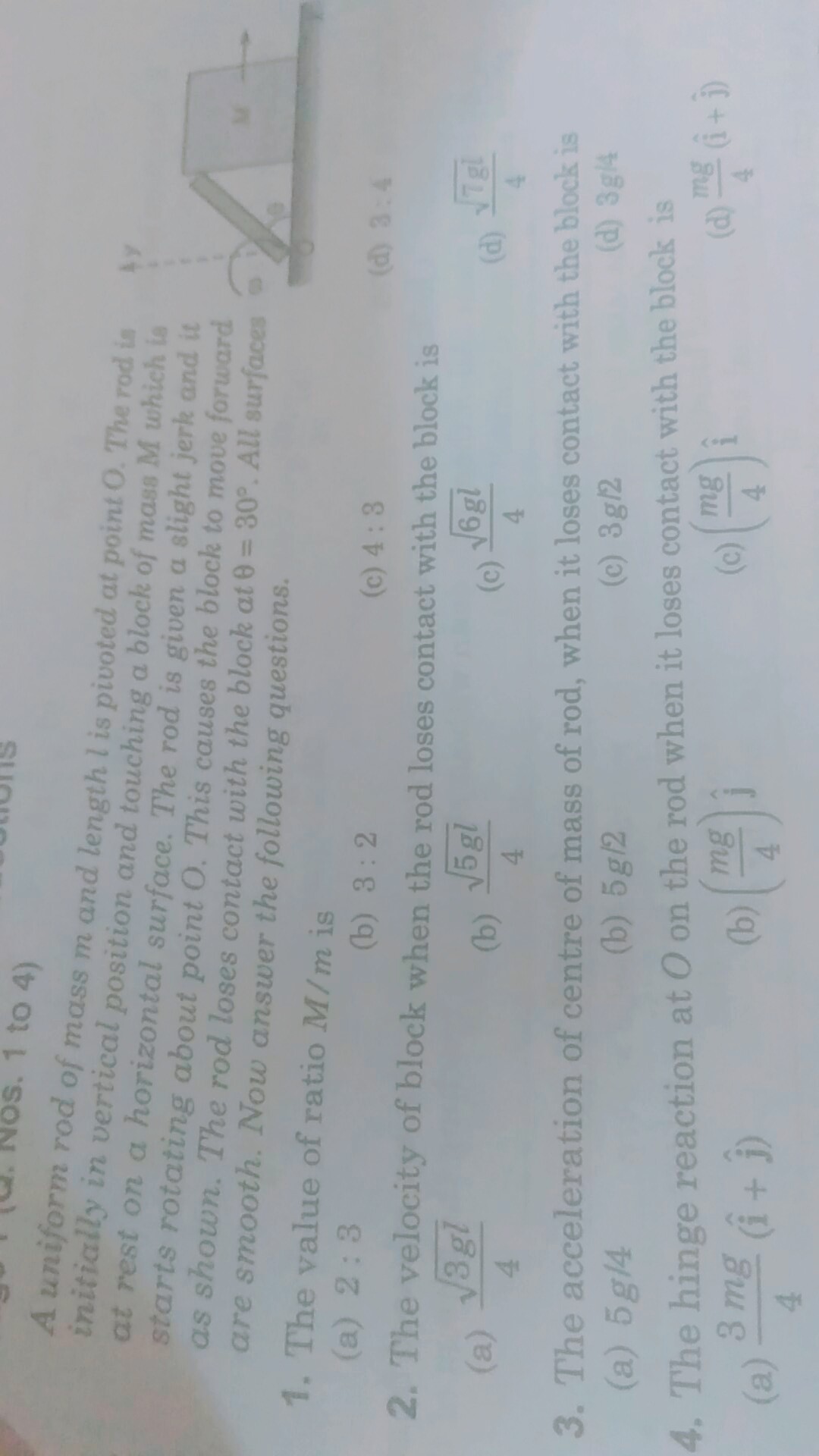


 Approved Tutor Answer1 Year ago
When analyzing the collision between a rod and a block, it's essential to break down the problem step by step. Understanding the mechanics involved can clarify what happens after the collision. Let's explore the key concepts and steps to approach this scenario effectively.
Collisions can be categorized into two main types: elastic and inelastic. In an elastic collision, both momentum and kinetic energy are conserved, while in an inelastic collision, momentum is conserved, but kinetic energy is not. Knowing the type of collision is crucial for solving the problem.
First, determine the masses of the rod and the block, as well as their initial velocities. For instance, if the rod is stationary and the block is moving towards it, you need to note these initial conditions. Let's say:
In any collision, the total momentum before the collision equals the total momentum after the collision. This can be expressed mathematically as:
m1 * v1 + m2 * v2 = m1 * v1' + m2 * v2'
Here, v1' and v2' are the velocities of the block and rod after the collision, respectively. If the rod is fixed at one end and can rotate, you may also need to consider rotational motion.
Determine whether the collision is elastic or inelastic. If it’s elastic, you will also need to apply the conservation of kinetic energy:
0.5 * m1 * v1² + 0.5 * m2 * v2² = 0.5 * m1 * v1'² + 0.5 * m2 * v2'²
If it’s inelastic, you can skip this step, as kinetic energy will not be conserved.
Now, you have a system of equations to solve for the unknowns (v1' and v2'). You can use substitution or elimination methods to find the final velocities after the collision. If the rod rotates, you may also need to consider angular momentum.
After the collision, think about how the rod might behave. If it’s free to rotate, it will start spinning due to the impact. You can analyze this using the principles of rotational dynamics, considering the moment of inertia and angular velocity.
Imagine a block of mass 2 kg moving at 3 m/s colliding with a stationary rod of mass 4 kg. If the collision is perfectly inelastic, the block and rod stick together after the collision. You would set up your momentum equation:
2 kg * 3 m/s + 4 kg * 0 = (2 kg + 4 kg) * v'
Solving this gives:
6 kg*m/s = 6 kg * v'
Thus, v' = 1 m/s. This means both the block and rod move together at 1 m/s after the collision.
By systematically analyzing the collision using these steps, you can gain a clearer understanding of what happens after the rod and block collide. Remember to consider both linear and rotational dynamics if applicable, as they can significantly affect the outcome of the collision. Practice with different scenarios to strengthen your grasp of these concepts!

Three identical balls are placed on a frictionless
horizontal surface touching each other. They stick to
each other because of adhesive. Another ball of same
radius and mass m is placed over the void created by
the three balls. Find the forces applied by the balls
kept on the floor to each other if the system remains
in equilibrium.
Last Activity: 9 Months ago
A car loaded with water having total mass 1000 kg moves on a straight horizontal Road starting from rest under the action of a force of 100 Newton. The water spills throw a small hole in the bottom at a rate of 0.1 KG per second the velocity of cart after 300 seconds is nearly.
11
21
31
41
Last Activity: 10 Months ago
Last Activity: 3 Years ago
Last Activity: 3 Years ago