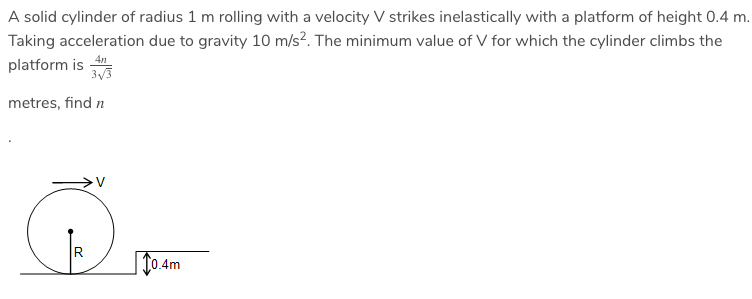
To determine the minimum velocity \( v \) at which a solid cylinder of radius 1 meter must roll to successfully climb onto a platform that is 0.4 meters high, we can apply the principles of energy conservation and dynamics. Let’s break this down step by step.
Understanding the Problem
The cylinder is rolling, which means it has both translational and rotational kinetic energy. When it strikes the platform, it will need to convert some of this kinetic energy into potential energy to climb the height of the platform. The key here is to find the minimum velocity required for the cylinder to reach the top of the platform without falling back down.
Energy Conservation Principle
Initially, the cylinder has kinetic energy due to its motion. When it climbs the platform, this kinetic energy is converted into gravitational potential energy. The equation for kinetic energy (\( KE \)) and potential energy (\( PE \)) is as follows:
- Kinetic Energy: \( KE = \frac{1}{2} mv^2 + \frac{1}{2} I \omega^2 \)
- Potential Energy: \( PE = mgh \)
Where:
- \( m \) = mass of the cylinder
- \( v \) = linear velocity of the cylinder
- \( I \) = moment of inertia of the cylinder
- \( \omega \) = angular velocity
- \( g \) = acceleration due to gravity (approximately \( 9.81 \, m/s^2 \))
- \( h \) = height of the platform (0.4 m)
Moment of Inertia for a Solid Cylinder
The moment of inertia \( I \) for a solid cylinder about its central axis is given by:
\( I = \frac{1}{2} m r^2 \)
For our cylinder, the radius \( r \) is 1 meter, so:
\( I = \frac{1}{2} m (1^2) = \frac{1}{2} m \)
Relating Linear and Angular Velocity
Since the cylinder is rolling without slipping, the relationship between linear velocity \( v \) and angular velocity \( \omega \) is:
\( v = r \omega \)
Thus, \( \omega = \frac{v}{r} = v \) (since \( r = 1 \)).
Setting Up the Energy Equation
Now, substituting \( I \) and \( \omega \) into the kinetic energy equation:
\( KE = \frac{1}{2} mv^2 + \frac{1}{2} \left(\frac{1}{2} m\right) v^2 \)
Combining these terms gives:
\( KE = \frac{1}{2} mv^2 + \frac{1}{4} mv^2 = \frac{3}{4} mv^2 \)
Equating Kinetic and Potential Energy
At the height of the platform, all kinetic energy must be converted to potential energy:
\( \frac{3}{4} mv^2 = mgh \)
We can cancel \( m \) from both sides (assuming \( m \neq 0 \)):
\( \frac{3}{4} v^2 = gh \)
Substituting \( g = 9.81 \, m/s^2 \) and \( h = 0.4 \, m \):
\( \frac{3}{4} v^2 = 9.81 \times 0.4 \)
Calculating the right side:
\( \frac{3}{4} v^2 = 3.924 \)
Solving for Velocity
Now, isolate \( v^2 \):
\( v^2 = \frac{3.924 \times 4}{3} \)
\( v^2 = 5.232 \)
Taking the square root gives:
\( v = \sqrt{5.232} \approx 2.29 \, m/s \)
Final Result
Therefore, the minimum velocity \( v \) required for the cylinder to successfully climb onto the platform is approximately \( 2.29 \, m/s \). This calculation shows how energy conservation principles can be applied to solve real-world physics problems involving motion and height. If you have any further questions or need clarification on any part of this process, feel free to ask!