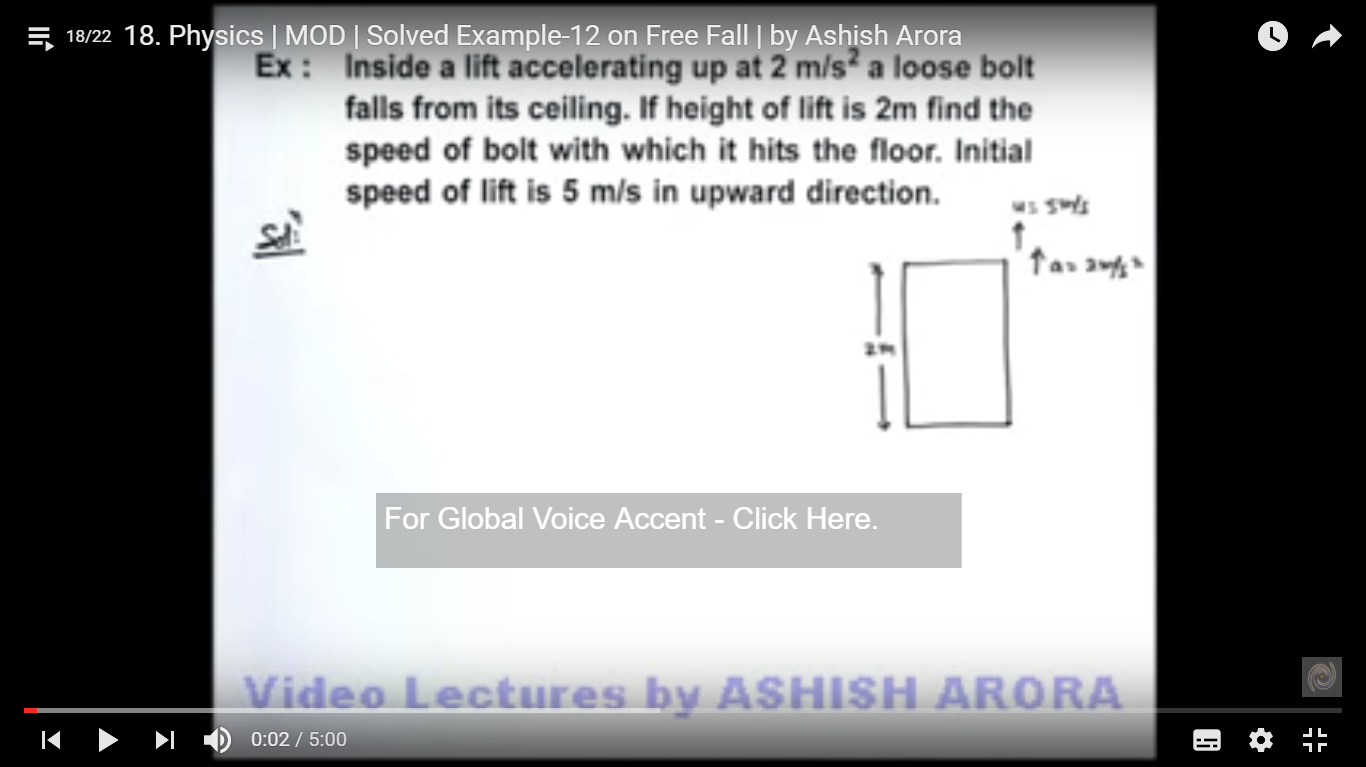
To understand why the initial velocity of a bolt from the lift's frame is considered to be zero and why the acceleration of the lift is neglected from the ground frame, we need to delve into the concepts of relative motion and the effects of acceleration in different reference frames.
Initial Velocity of the Bolt in the Lift's Frame
When we analyze the situation from the perspective of the lift, we treat the lift as our reference frame. In this frame, if the bolt is at rest relative to the lift when it is released, its initial velocity is indeed zero. This is because, in the lift's frame of reference, both the lift and the bolt are moving together at the same speed. When the bolt is released, it does not have any additional velocity imparted to it from the lift; it simply falls due to gravity.
Understanding Relative Motion
To illustrate this, think of being in a moving car. If you toss a ball straight up while the car is moving at a constant speed, the ball will appear to go straight up and down to you, even though it is also moving forward with the car. Similarly, in the lift's frame, the bolt behaves as if it has no initial velocity because it shares the same motion as the lift.
Acceleration of the Lift from the Ground Frame
Now, let's consider the scenario from the ground frame. Here, the lift is accelerating upwards. However, when we analyze the motion of the bolt after it is released, we often simplify the situation by neglecting the lift's acceleration. This is because, once the bolt is released, it is no longer influenced by the lift's motion; it is only subjected to the force of gravity.
Why Neglect Acceleration?
From the ground frame, the bolt will start to fall downwards with an acceleration of approximately 9.81 m/s² (the acceleration due to gravity). The lift, on the other hand, continues to accelerate upwards. The key point here is that the bolt's motion is independent of the lift's acceleration after it has been released. Thus, while the lift is accelerating, the bolt's motion can be analyzed purely under the influence of gravity, making it simpler to neglect the lift's acceleration in this context.
Putting It All Together
In summary, the initial velocity of the bolt is zero from the lift's frame because it is at rest relative to the lift at the moment of release. From the ground frame, we can neglect the lift's acceleration when analyzing the bolt's motion after it has been released, as the bolt is only affected by gravity. This approach simplifies our calculations and helps us focus on the essential forces acting on the bolt.
Understanding these concepts of relative motion and the independence of the bolt's motion from the lift's acceleration is crucial in physics, especially when dealing with problems involving different reference frames.