
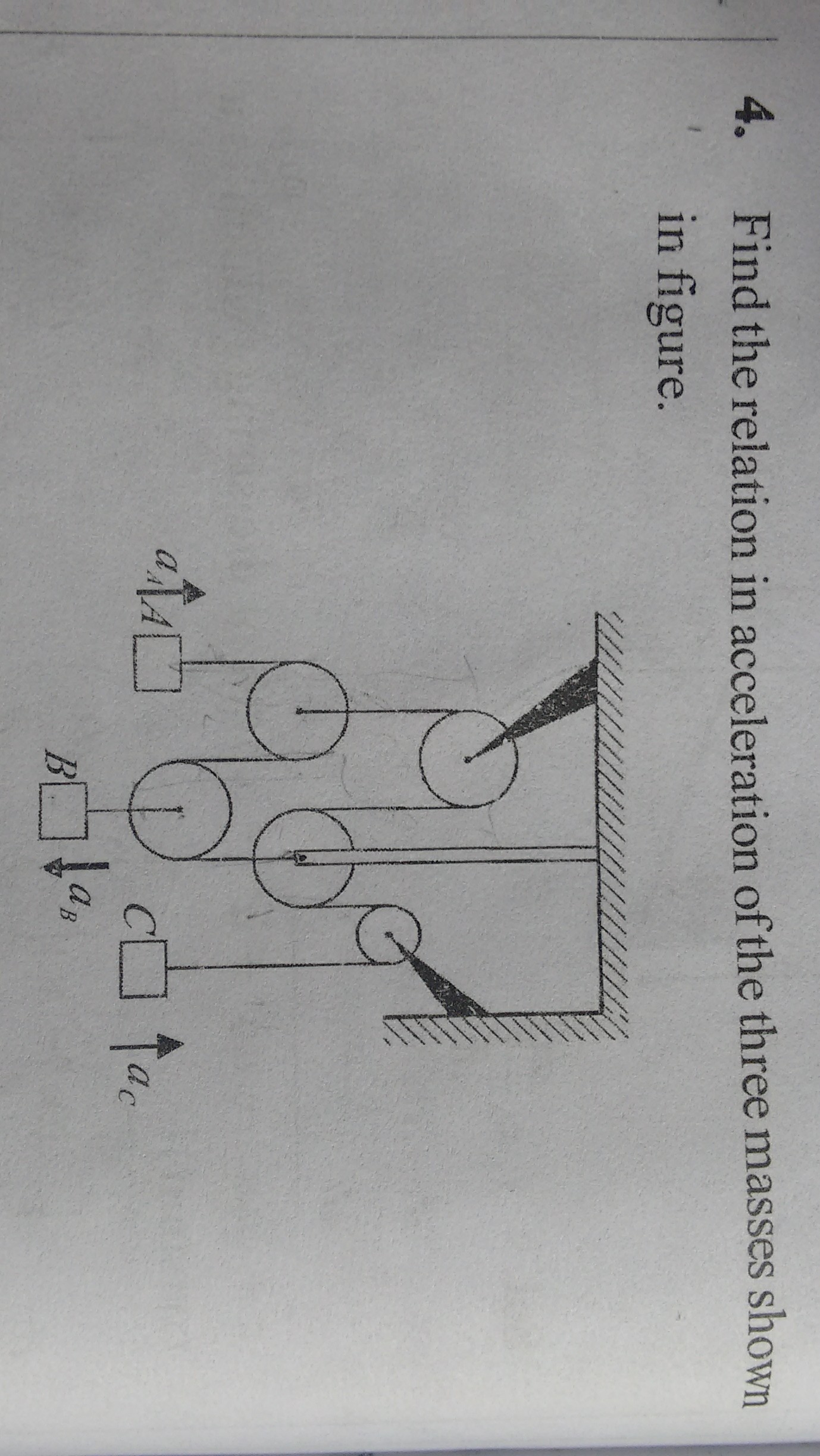
Pls help me with this question...I tried solving using constraint equation but I'm not getting the answer
Pls help me with this question...
I tried solving using constraint equation but I'm not getting the answer

Amruta , 8 Years ago
Grade 12
 Mechanics> Pls help me with this question... I tried...
 1 Answers
It sounds like you're grappling with a challenging problem involving constraint equations. Let's break it down step by step to clarify the concepts and find a solution together.
Constraint equations are often used in various fields, such as physics and engineering, to describe the relationships between different variables in a system. These equations help us understand how one variable affects another and can be crucial for solving problems involving optimization or equilibrium.
To assist you effectively, it would be helpful to know the specific problem you're working on. However, I can guide you through a general approach to solving problems with constraint equations.
Let’s consider a simple example involving a constraint equation. Imagine you have a scenario where you need to maximize the area of a rectangle with a fixed perimeter. The perimeter \( P \) of a rectangle is given by the equation:
P = 2(l + w)
where \( l \) is the length and \( w \) is the width. If the perimeter is fixed, say \( P = 20 \), you can express one variable in terms of the other:
w = 10 - l
Now, you can substitute this into the area equation \( A = l \times w \):
A = l(10 - l) = 10l - l²
This is a quadratic equation that you can maximize using calculus or by completing the square. The maximum area occurs when \( l = 5 \) and \( w = 5 \), giving you a square.
By following these steps, you should be able to tackle your problem more effectively. If you can share the specific details of your constraint equation, I can provide more tailored guidance. Remember, practice is key in mastering these concepts, so don’t hesitate to work through similar problems to build your confidence!
 Approved
Prepraring for the competition made easy just by live online class.

Full Live Access

Study Material

Live Doubts Solving

Daily Class Assignments

Three identical balls are placed on a frictionless
horizontal surface touching each other. They stick to
each other because of adhesive. Another ball of same
radius and mass m is placed over the void created by
the three balls. Find the forces applied by the balls
kept on the floor to each other if the system remains
in equilibrium.
Last Activity: 7 Months ago
A car loaded with water having total mass 1000 kg moves on a straight horizontal Road starting from rest under the action of a force of 100 Newton. The water spills throw a small hole in the bottom at a rate of 0.1 KG per second the velocity of cart after 300 seconds is nearly.
11
21
31
41
Last Activity: 8 Months ago
Last Activity: 3 Years ago
Last Activity: 3 Years ago
Last Activity: 3 Years ago