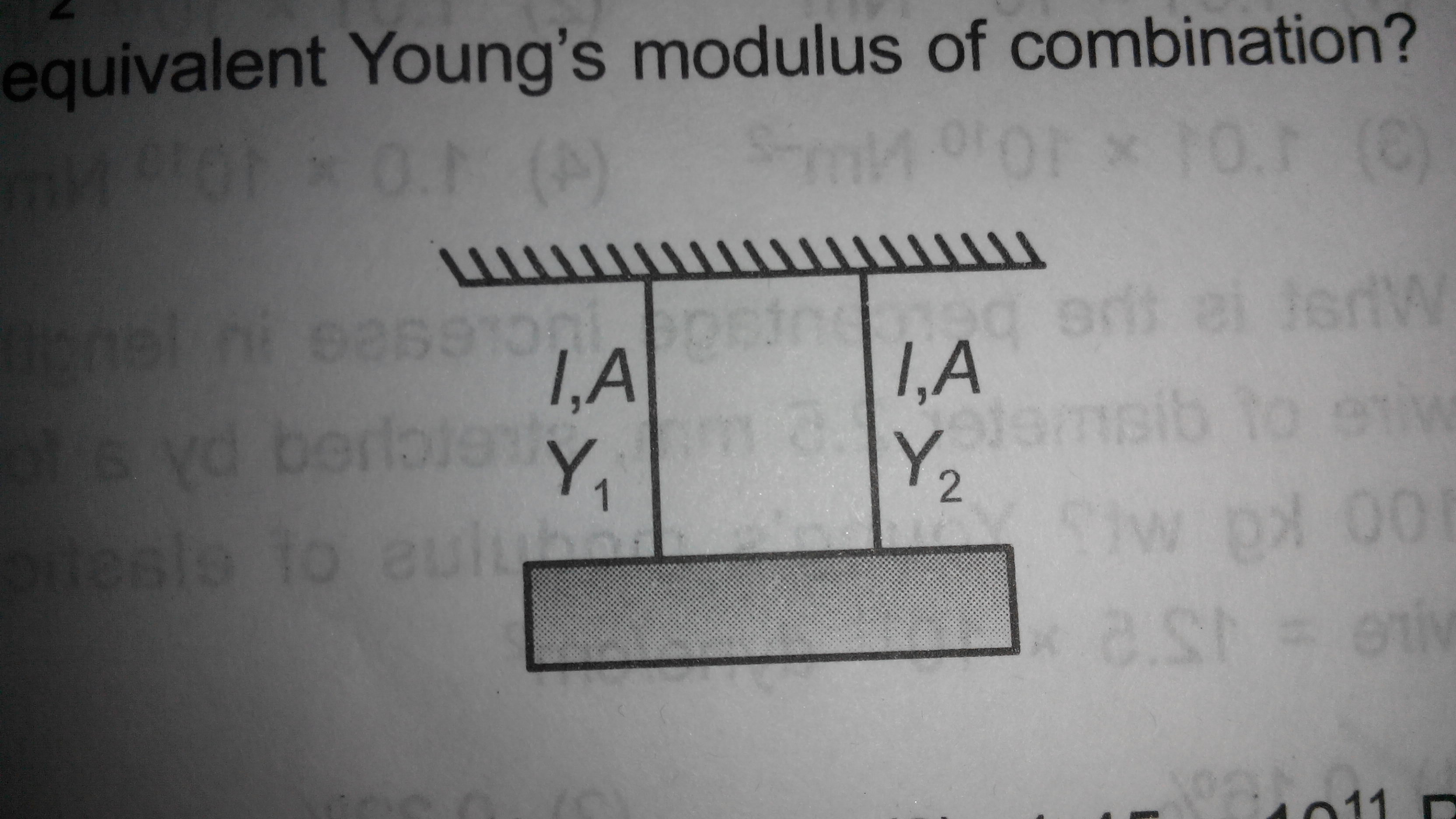
To determine the equivalent Young's modulus of two wires with different Young's moduli, we need to consider how they are arranged. Since you mentioned that the wires are suspended, I'll assume they are in parallel. For two wires in parallel, the equivalent Young's modulus can be calculated using the formula:
Understanding Young's Modulus in Parallel Arrangement
When two materials are combined in parallel, the total extension of the system is the same as the extension of each individual wire. The stress in each wire is proportional to its Young's modulus. The relationship can be expressed mathematically as follows:
Formula for Equivalent Young's Modulus
The formula for the equivalent Young's modulus (Y_eq) for two wires in parallel is given by:
Y_eq = (Y1 * A1 + Y2 * A2) / (A1 + A2)
Here, A1 and A2 are the cross-sectional areas of the two wires. Since both wires have the same length and cross-sectional area, we can simplify our calculations. Let's denote the cross-sectional area of each wire as A.
Substituting Values
- Y1 = 2 x 10¹¹ Pa
- Y2 = 0.90 x 10¹¹ Pa
- A1 = A
- A2 = A
Substituting these values into the formula:
Y_eq = (Y1 * A + Y2 * A) / (A + A)
Simplifying this, we get:
Y_eq = (Y1 + Y2) / 2
Now, let's plug in the values of Y1 and Y2:
Y_eq = (2 x 10¹¹ Pa + 0.90 x 10¹¹ Pa) / 2
Y_eq = (2.90 x 10¹¹ Pa) / 2
Y_eq = 1.45 x 10¹¹ Pa
Final Result
Thus, the equivalent Young's modulus for the combination of the two wires is 1.45 x 10¹¹ Pa. This value represents the effective stiffness of the combined system when subjected to the same load. In practical terms, it tells us how much the combined wires will stretch or compress under a given force, taking into account the properties of both materials.