

Grade 12th passMechanics
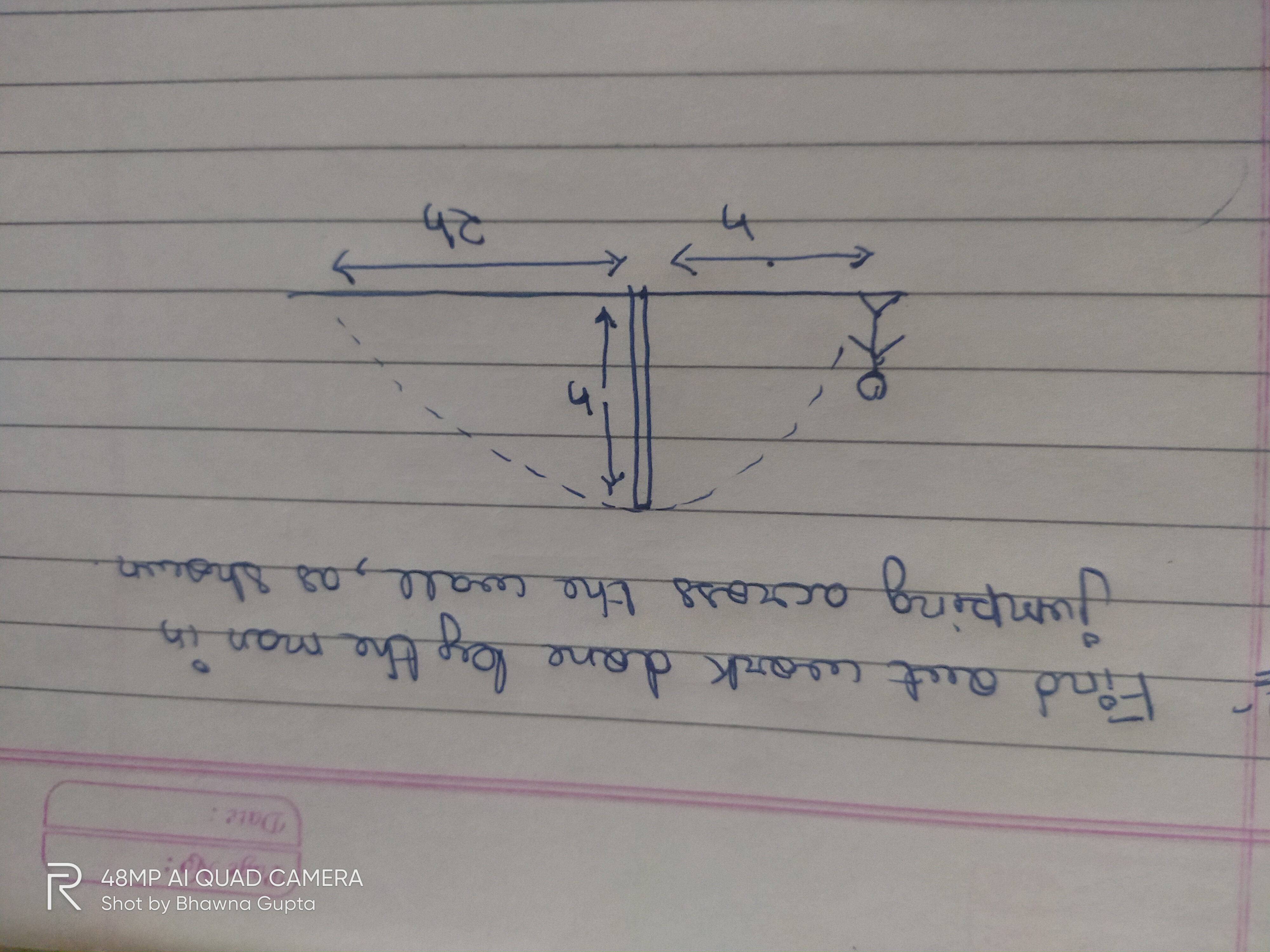
Please Solve This...... Work Done by the man to jump across the wall of height H and cover total range 2H
Please Solve This......
Work Done by the man to jump across the wall of height H and cover total range 2H


 Approved Tutor Answer0 Years ago
To determine the work done by a man to jump across a wall of height H and cover a total horizontal range of 2H, we need to analyze the physics involved in the jump. This involves concepts from mechanics, particularly the work-energy principle and projectile motion.
When a person jumps, they convert chemical energy from their muscles into kinetic energy, which is then transformed into gravitational potential energy as they ascend. The work done can be calculated based on the energy required to reach a certain height and the distance covered horizontally.
When the man jumps to a height H, he gains gravitational potential energy (PE), which can be calculated using the formula:
PE = m * g * H
Where:
The work done (W) by the man to jump over the wall is equal to the gravitational potential energy gained, as he must exert energy to reach that height. Therefore, the work done can be expressed as:
W = m * g * H
In addition to the vertical component, the man also needs to cover a horizontal distance of 2H. The horizontal motion can be analyzed using the projectile motion equations. The horizontal range (R) of a projectile is given by:
R = (v^2 * sin(2θ)) / g
Where:
To achieve a range of 2H, the initial velocity and angle must be appropriately calculated. However, for the purpose of calculating work done, we primarily focus on the vertical component since the work done against gravity is the most significant factor in this scenario.
In summary, the work done by the man to jump over the wall of height H is primarily determined by the gravitational potential energy gained, which is given by:
W = m * g * H
This formula encapsulates the energy required to overcome the gravitational force acting on him as he jumps. The horizontal range, while important for understanding the jump's trajectory, does not directly affect the work done against gravity in this context.

Three identical balls are placed on a frictionless
horizontal surface touching each other. They stick to
each other because of adhesive. Another ball of same
radius and mass m is placed over the void created by
the three balls. Find the forces applied by the balls
kept on the floor to each other if the system remains
in equilibrium.
Last Activity: 9 Months ago
A car loaded with water having total mass 1000 kg moves on a straight horizontal Road starting from rest under the action of a force of 100 Newton. The water spills throw a small hole in the bottom at a rate of 0.1 KG per second the velocity of cart after 300 seconds is nearly.
11
21
31
41
Last Activity: 9 Months ago
Last Activity: 3 Years ago
Last Activity: 3 Years ago