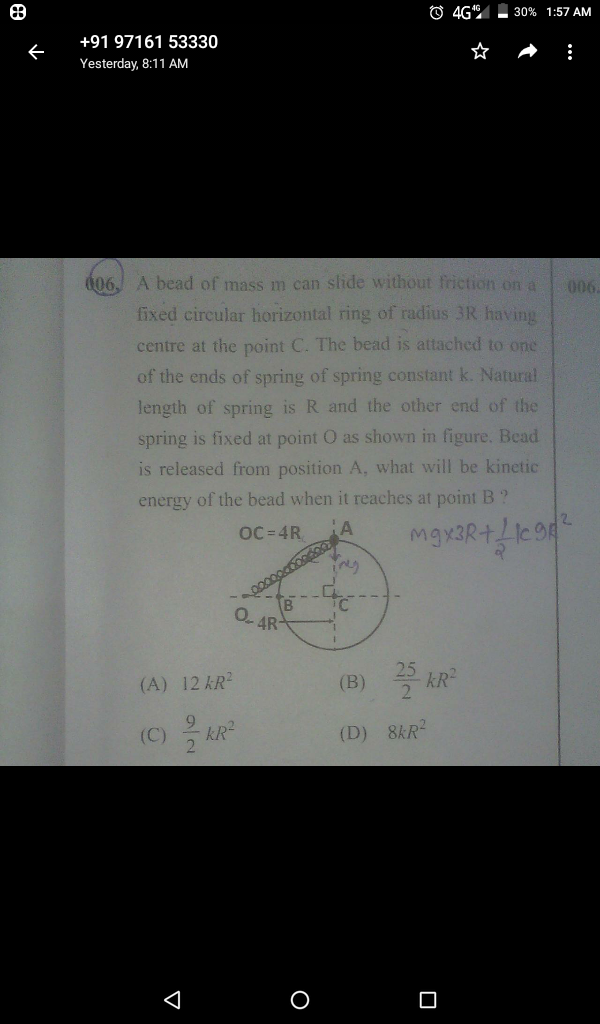
To tackle problems involving the work-energy theorem, it’s essential to understand the fundamental concepts behind it. The work-energy theorem states that the work done on an object is equal to the change in its kinetic energy. This principle can be applied in various scenarios, such as objects in motion, collisions, or even objects moving up and down a slope. Let’s break down the steps to solve a typical problem using this theorem.
Understanding the Work-Energy Theorem
The work-energy theorem can be expressed mathematically as:
W = ΔKE
Where:
- W is the work done on the object.
- ΔKE is the change in kinetic energy, calculated as KE_final - KE_initial.
Steps to Solve a Problem
Let’s go through a structured approach to solve a problem using the work-energy theorem:
1. Identify the Given Information
Start by noting down all the information provided in the problem. This may include the mass of the object, initial and final velocities, and any forces acting on the object.
2. Calculate Initial and Final Kinetic Energy
The kinetic energy (KE) of an object is given by the formula:
KE = 0.5 * m * v²
Where:
- m is the mass of the object.
- v is the velocity of the object.
Calculate the initial kinetic energy using the initial velocity and the final kinetic energy using the final velocity.
3. Determine the Work Done
Using the work-energy theorem, rearrange the equation to find the work done:
W = KE_final - KE_initial
Substitute the values you calculated for the kinetic energies to find the work done on the object.
4. Analyze the Forces Involved (if necessary)
If the problem involves forces, you may need to calculate the work done by these forces. For example, if a force is applied over a distance, the work done can be calculated as:
W = F * d * cos(θ)
Where:
- F is the force applied.
- d is the distance over which the force is applied.
- θ is the angle between the force and the direction of motion.
5. Solve and Interpret the Results
After calculating the work done, interpret the results in the context of the problem. Consider what the work done means for the motion of the object and how it relates to energy transfer.
Example Problem
Let’s say we have a 2 kg object that is initially at rest and is pushed by a force that does 10 Joules of work on it. We want to find its final velocity.
Solution Steps
- Initial kinetic energy (KE_initial) = 0 (since it starts from rest).
- Work done (W) = 10 Joules.
- Using the work-energy theorem: W = KE_final - KE_initial.
- 10 J = KE_final - 0, so KE_final = 10 J.
- Now, using the kinetic energy formula: 10 = 0.5 * 2 * v².
- Solving for v, we get: v² = 10, thus v = √10 ≈ 3.16 m/s.
This example illustrates how to apply the work-energy theorem to find the final velocity of an object after work has been done on it. By following these steps, you can effectively solve similar problems in physics.