

Grade 12th passMechanics
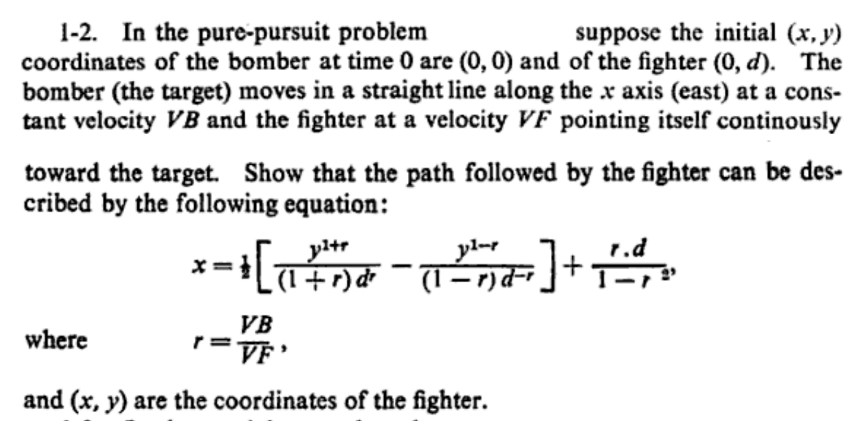
Please solve this question. VF and VB are constant velocities of Fighter and Bomber respectively.
Please solve this question. VF and VB are constant velocities of Fighter and Bomber respectively.


 Approved Tutor Answer1 Year ago
To tackle the problem involving the constant velocities of a Fighter (VF) and a Bomber (VB), we need to clarify what specific question or scenario you're dealing with. However, I can guide you through the general principles of motion and how to approach problems involving constant velocities.
When we say that VF and VB are constant velocities, it means that both the Fighter and the Bomber are moving at steady speeds without acceleration. This is a crucial point because it simplifies our calculations. In physics, constant velocity implies that the distance traveled over time can be calculated using the formula:
Let’s say you want to find out how far each aircraft travels after a certain amount of time, or perhaps you want to determine when they will meet if they are moving towards each other. Here’s how you can approach it:
Imagine the Fighter is flying at a velocity of VF = 600 km/h and the Bomber at VB = 400 km/h. If they start from the same point and head in the same direction, you can calculate the distance each one travels after a specific time, say 2 hours.
If the Fighter and Bomber are moving towards each other, the relative velocity comes into play. The relative velocity is the sum of their speeds:
Using the previous example, the relative velocity would be:
If they start 2000 km apart, the time it takes for them to meet can be calculated as:
In any scenario involving constant velocities, the key is to clearly define the parameters: the velocities, the time, and the distances involved. By applying the basic formulas of motion, you can solve a wide range of problems effectively. If you have a specific situation or additional details, feel free to share, and we can dive deeper into that particular case!

Three identical balls are placed on a frictionless
horizontal surface touching each other. They stick to
each other because of adhesive. Another ball of same
radius and mass m is placed over the void created by
the three balls. Find the forces applied by the balls
kept on the floor to each other if the system remains
in equilibrium.
Last Activity: 10 Months ago
A car loaded with water having total mass 1000 kg moves on a straight horizontal Road starting from rest under the action of a force of 100 Newton. The water spills throw a small hole in the bottom at a rate of 0.1 KG per second the velocity of cart after 300 seconds is nearly.
11
21
31
41
Last Activity: 10 Months ago
Last Activity: 3 Years ago
Last Activity: 3 Years ago