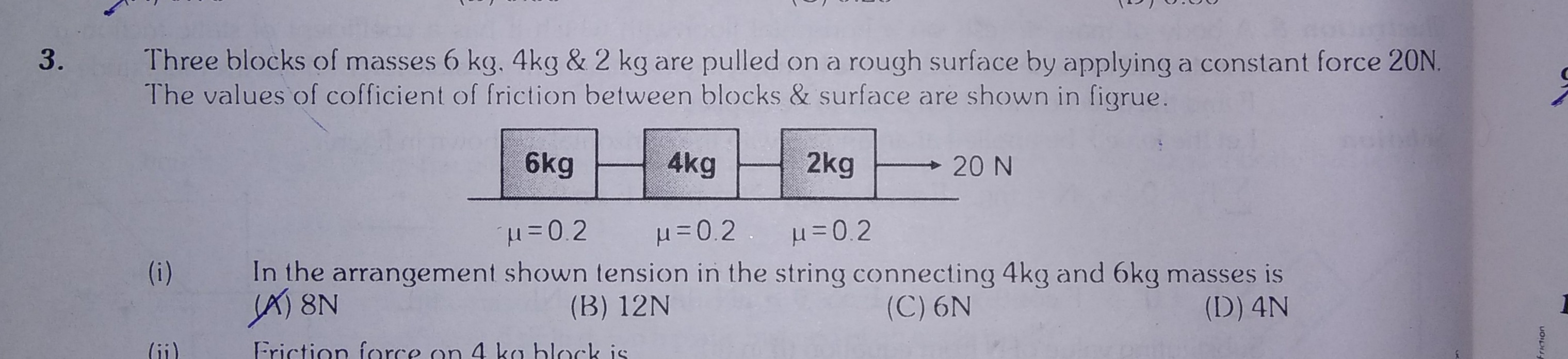
To assist you effectively, I need to know the specific problem you're referring to. However, I can guide you through a general approach to solving mathematical problems and explain the equations involved. Let’s consider a common type of problem: solving a quadratic equation. I’ll walk you through the process step by step.
Understanding Quadratic Equations
A quadratic equation is typically in the form:
ax² + bx + c = 0
where:
- a is the coefficient of x²
- b is the coefficient of x
- c is the constant term
Example Problem
Let’s solve the quadratic equation:
2x² - 4x - 6 = 0
Step 1: Identify Coefficients
In our equation, we can identify:
Step 2: Use the Quadratic Formula
The quadratic formula is a powerful tool for finding the roots of any quadratic equation:
x = (-b ± √(b² - 4ac)) / (2a)
Step 3: Calculate the Discriminant
The discriminant (D) is the part of the formula under the square root:
D = b² - 4ac
For our equation:
D = (-4)² - 4(2)(-6) = 16 + 48 = 64
Step 4: Substitute Values into the Formula
Now, we can substitute the values of a, b, and D into the quadratic formula:
x = (4 ± √64) / (2 * 2)
This simplifies to:
x = (4 ± 8) / 4
Step 5: Solve for Roots
Now, we can find the two possible values for x:
- x₁ = (4 + 8) / 4 = 12 / 4 = 3
- x₂ = (4 - 8) / 4 = -4 / 4 = -1
Final Results
The solutions to the equation 2x² - 4x - 6 = 0 are:
Visual Representation
While I can't insert images directly, I recommend sketching the parabola represented by the equation y = 2x² - 4x - 6. The x-intercepts (where the graph crosses the x-axis) will be at the points we calculated: x = 3 and x = -1. This visual can help you understand how the roots relate to the graph of the function.
By following these steps, you can tackle any quadratic equation with confidence. If you have a different problem in mind, please share it, and I’d be happy to help you solve it!