

Grade 11Mechanics
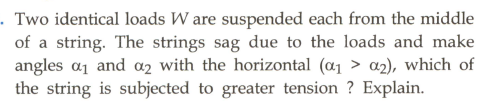
Please solve this physics problem. Two identical loads are suspended each from the middle of a string.
Please solve this physics problem. Two identical loads are suspended each from the middle of a string.


 Approved Tutor Answer1 Year ago
To solve the problem of two identical loads suspended from the middle of a string, we need to analyze the forces acting on the system. Let’s break it down step by step to understand how the loads interact with the string and each other.
Imagine you have a string that is fixed at both ends, and in the middle, you suspend two identical weights, say \( m \). The string will form a V-shape due to the weight of the loads pulling downwards. Each load exerts a gravitational force equal to \( mg \), where \( g \) is the acceleration due to gravity (approximately \( 9.81 \, \text{m/s}^2 \)).
Each load experiences two main forces:
Since the loads are identical and in equilibrium (not moving), the tension in the string must balance the weight of the loads. Let’s denote the tension in the string as \( T \). For each load, the vertical component of the tension must equal the weight:
When the string is at an angle \( \theta \) from the vertical, the vertical component of the tension can be expressed as:
T_vertical = T \cdot \cos(\theta)
Thus, for each load, we have:
T \cdot \cos(\theta) = mg
To find the tension in the string, we can rearrange the equation:
T = \frac{mg}{\cos(\theta)}
This equation shows that the tension in the string increases as the angle \( \theta \) increases, meaning the string must exert more force to support the weight of the loads.
Let’s say each load has a mass of \( 2 \, \text{kg} \). The weight of each load would be:
Weight = mg = 2 \, \text{kg} \cdot 9.81 \, \text{m/s}^2 = 19.62 \, \text{N}
If the angle \( \theta \) is \( 30^\circ \), we can calculate the tension:
T = \frac{19.62 \, \text{N}}{\cos(30^\circ)} = \frac{19.62 \, \text{N}}{0.866} \approx 22.65 \, \text{N}
In summary, when two identical loads are suspended from the middle of a string, the tension in the string must counterbalance the gravitational force acting on each load. By analyzing the forces and using trigonometric relationships, we can determine the tension based on the angle of the string. This approach not only helps in solving this specific problem but also lays the groundwork for understanding similar problems in physics involving forces and equilibrium.

Three identical balls are placed on a frictionless
horizontal surface touching each other. They stick to
each other because of adhesive. Another ball of same
radius and mass m is placed over the void created by
the three balls. Find the forces applied by the balls
kept on the floor to each other if the system remains
in equilibrium.
Last Activity: 10 Months ago
A car loaded with water having total mass 1000 kg moves on a straight horizontal Road starting from rest under the action of a force of 100 Newton. The water spills throw a small hole in the bottom at a rate of 0.1 KG per second the velocity of cart after 300 seconds is nearly.
11
21
31
41
Last Activity: 10 Months ago
Last Activity: 3 Years ago
Last Activity: 3 Years ago