

Grade 11Mechanics
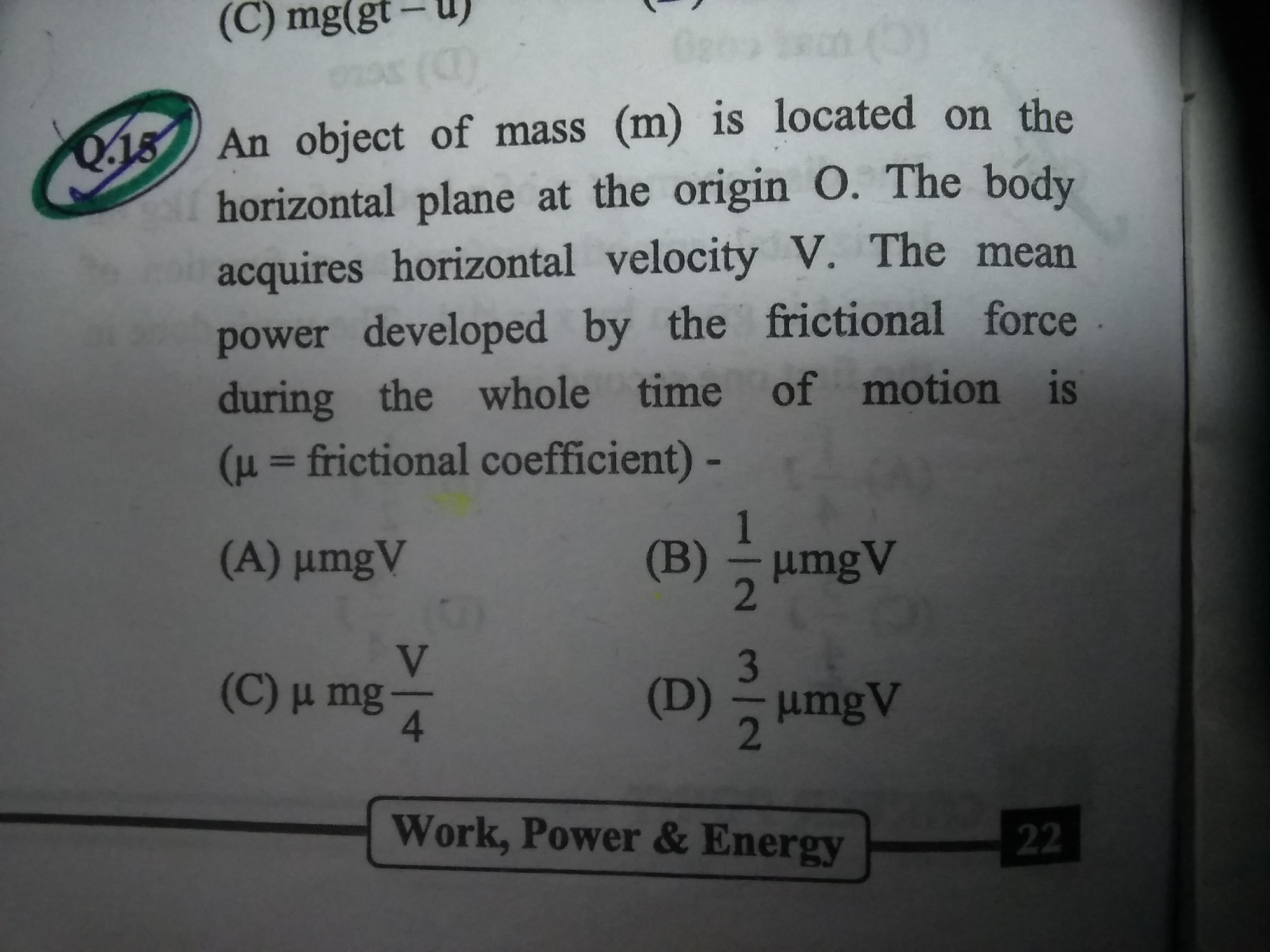
Please solve the question I have attached the image I think it is solvable using the concept of work power energy
Please solve the question I have attached the image I think it is solvable using the concept of work power energy


 Approved Tutor Answer1 Year ago
It seems like you're working on a problem related to the concepts of work, power, and energy. While I can't see the image you've mentioned, I can guide you through the general approach to solving such problems. Let's break down the concepts and see how they interrelate, which should help you tackle your specific question.
In physics, work, power, and energy are interconnected concepts that describe how forces affect motion and how energy is transferred or transformed. Here’s a brief overview of each:
To solve a problem involving these concepts, follow these steps:
Let’s say you have a problem where a force of 10 N is applied to move an object 5 meters in the direction of the force. You want to find the work done and the power if it takes 2 seconds to move the object.
1. **Calculate Work**: Using the formula W = F × d (since the angle θ is 0 degrees, cos(0) = 1), we have:
W = 10 N × 5 m = 50 J
2. **Calculate Power**: Now, using the power formula P = W/t, we find:
P = 50 J / 2 s = 25 W
In this example, 50 joules of work is done, and the power exerted is 25 watts.
By following these steps and understanding the relationships between work, power, and energy, you can effectively solve a variety of physics problems. If you have specific values or a scenario from your image, feel free to share those details, and we can work through it together!

Three identical balls are placed on a frictionless
horizontal surface touching each other. They stick to
each other because of adhesive. Another ball of same
radius and mass m is placed over the void created by
the three balls. Find the forces applied by the balls
kept on the floor to each other if the system remains
in equilibrium.
Last Activity: 10 Months ago
A car loaded with water having total mass 1000 kg moves on a straight horizontal Road starting from rest under the action of a force of 100 Newton. The water spills throw a small hole in the bottom at a rate of 0.1 KG per second the velocity of cart after 300 seconds is nearly.
11
21
31
41
Last Activity: 10 Months ago
Last Activity: 3 Years ago
Last Activity: 3 Years ago