

Grade 12Mechanics
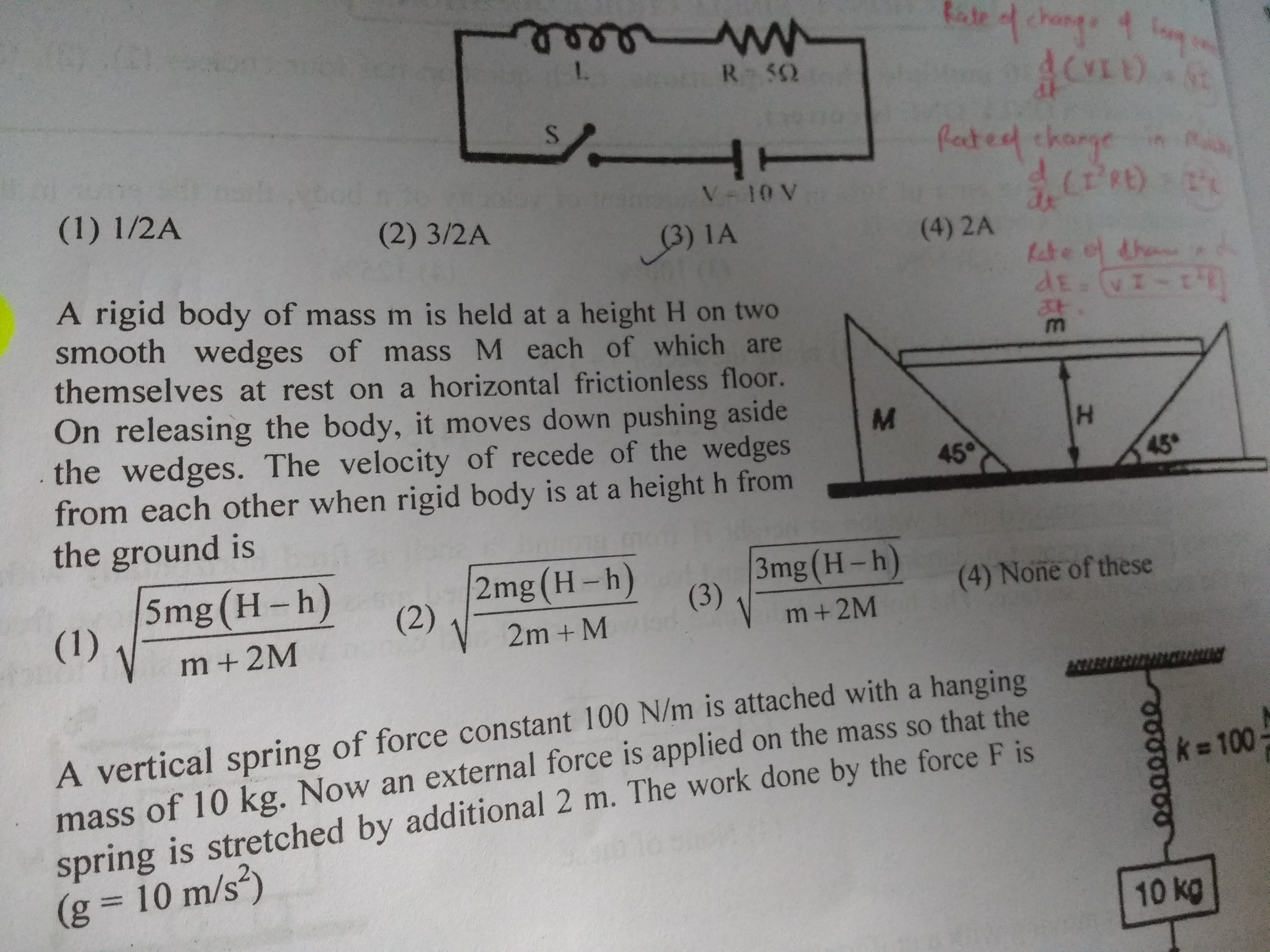
Please solve the attached question..the one with the diagram showing 45 degree angle
Please solve the attached question..the one with the diagram showing 45 degree angle


 Approved Tutor Answer1 Year ago
It seems like you're referring to a geometry problem involving a diagram with a 45-degree angle. While I can't see the diagram, I can guide you through solving a typical problem involving 45-degree angles. These angles often appear in right triangles, particularly isosceles right triangles, where the two legs are equal in length. Let's break down how to approach such a problem step by step.
In a right triangle, if one angle measures 45 degrees, the other non-right angle must also be 45 degrees, making it an isosceles right triangle. This means that the two legs of the triangle are equal in length. The relationship between the sides can be expressed using the Pythagorean theorem.
The Pythagorean theorem states that in a right triangle, the square of the length of the hypotenuse (c) is equal to the sum of the squares of the lengths of the other two sides (a and b). For an isosceles right triangle, where a = b, the formula simplifies to:
This relationship is crucial when solving problems involving 45-degree angles, as it allows you to find the length of the hypotenuse if you know the lengths of the legs.
Let’s say you have an isosceles right triangle where each leg measures 5 units. To find the length of the hypotenuse, you would use the formula derived from the Pythagorean theorem:
This calculation shows how the properties of 45-degree angles can help you determine unknown side lengths in geometric figures.
If your diagram includes additional elements, such as other angles or shapes, consider how they relate to the 45-degree angle. For instance, if there are parallel lines or transversals, you might need to apply properties of angles, such as alternate interior angles being equal or corresponding angles being equal.
When working with angles, always keep in mind the sum of angles in a triangle is 180 degrees. This can help you find missing angles if your diagram includes more than one angle. If you have any specific values or additional details from the diagram, feel free to share them, and we can work through those together!
In summary, understanding the properties of 45-degree angles and how they relate to right triangles is essential for solving related problems. By applying the Pythagorean theorem and recognizing the characteristics of isosceles right triangles, you can effectively tackle a variety of geometry questions.

Three identical balls are placed on a frictionless
horizontal surface touching each other. They stick to
each other because of adhesive. Another ball of same
radius and mass m is placed over the void created by
the three balls. Find the forces applied by the balls
kept on the floor to each other if the system remains
in equilibrium.
Last Activity: 10 Months ago
A car loaded with water having total mass 1000 kg moves on a straight horizontal Road starting from rest under the action of a force of 100 Newton. The water spills throw a small hole in the bottom at a rate of 0.1 KG per second the velocity of cart after 300 seconds is nearly.
11
21
31
41
Last Activity: 10 Months ago
Last Activity: 3 Years ago
Last Activity: 3 Years ago