

Grade 11Mechanics
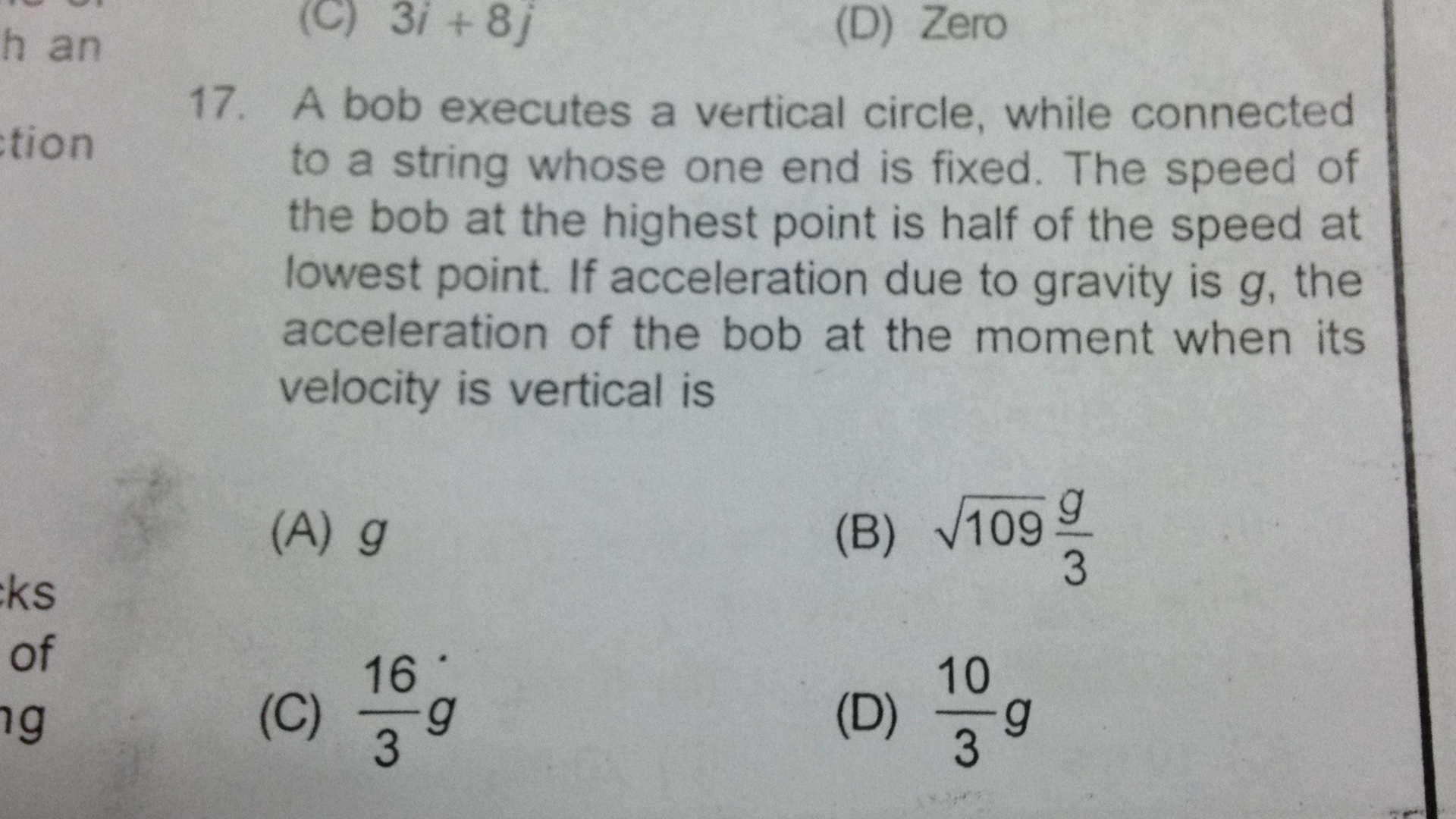
Please solve it for me. The answer is given as root 109*g/3.
Please solve it for me. The answer is given as root 109*g/3.


 Approved Tutor Answer1 Year ago
To solve the problem where the answer is given as \( \frac{\sqrt{109} \cdot g}{3} \), we first need to understand what the problem might be asking us to find. Typically, this format suggests that we are dealing with a physics or mathematics problem involving variables and constants. Let's break it down step by step.
In the expression \( \frac{\sqrt{109} \cdot g}{3} \), we can identify a few key components:
To arrive at the expression \( \frac{\sqrt{109} \cdot g}{3} \), we might be starting from a more complex equation. For instance, if we were calculating a force, we could be using Newton's second law, \( F = ma \), where \( F \) is force, \( m \) is mass, and \( a \) is acceleration. If we assume \( a \) is represented by \( g \), we can set up our equation accordingly.
Let’s say we want to find the force acting on an object with a mass of 3 kg under the influence of gravity. We can express this as:
Force (F) = mass (m) × acceleration (a)
Substituting the values:
F = 3 kg × g
If we want to express this in terms of \( \sqrt{109} \), we might set \( g \) to be \( \frac{\sqrt{109}}{3} \) to simplify our calculations. Thus, we get:
F = 3 kg × \frac{\sqrt{109}}{3} = \sqrt{109} \cdot kg
In summary, the expression \( \frac{\sqrt{109} \cdot g}{3} \) can arise from various contexts, particularly in physics or mathematics. By understanding the components and how they relate to each other, we can derive meaningful interpretations and calculations. If you have a specific context or additional information about the problem, feel free to share, and we can delve deeper into it!

Three identical balls are placed on a frictionless
horizontal surface touching each other. They stick to
each other because of adhesive. Another ball of same
radius and mass m is placed over the void created by
the three balls. Find the forces applied by the balls
kept on the floor to each other if the system remains
in equilibrium.
Last Activity: 10 Months ago
A car loaded with water having total mass 1000 kg moves on a straight horizontal Road starting from rest under the action of a force of 100 Newton. The water spills throw a small hole in the bottom at a rate of 0.1 KG per second the velocity of cart after 300 seconds is nearly.
11
21
31
41
Last Activity: 10 Months ago
Last Activity: 3 Years ago
Last Activity: 3 Years ago