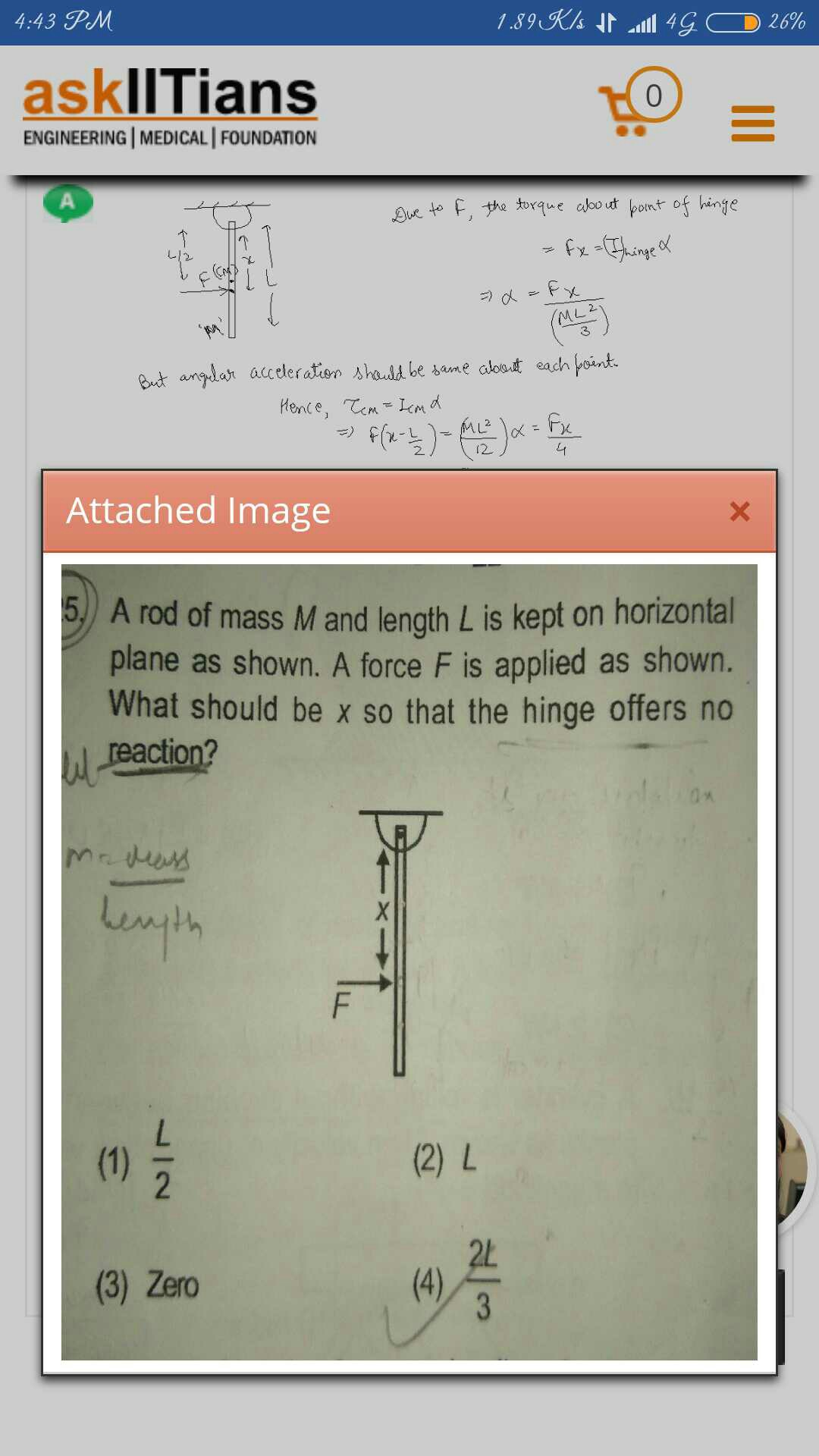
It's perfectly normal to have questions, especially when dealing with concepts that can be a bit tricky. Let's break down your confusion regarding the hinge and the forces acting on it. When we say that a hinge offers no reaction, it means that the hinge is not providing any opposing force to the applied force, which in this case is represented by F. This situation can arise in various mechanical systems, and understanding how to balance forces is key.
Understanding the Concept of Hinge Reaction
A hinge typically allows rotation while providing support. However, if we specify that the hinge offers no reaction, we are essentially saying that it is not exerting any force in response to the applied force F. This can happen under certain conditions, which we need to explore.
Conditions for No Reaction at the Hinge
To achieve a scenario where the hinge does not react to the applied force, we need to consider the following:
- Force Application: The force F must be applied in such a way that it does not create a moment (torque) about the hinge. This means that F should be aligned with the line of action that passes through the hinge.
- Equilibrium of Forces: The system must be in equilibrium, meaning that all forces and moments acting on the object must balance out. If F is the only force acting, it should be balanced by the geometry of the system.
- Support Conditions: If there are other supports or constraints in the system, they may be providing the necessary reactions to keep the hinge from reacting.
Applying the Concept
Let’s consider a simple example: Imagine a door that is hinged on one side. If you push the door directly towards the hinge (along the line of the hinge), the hinge does not need to exert any force to keep the door in place because the force is not creating any torque about the hinge point. In this case, the hinge can be said to offer no resistance.
Visualizing with an Example
Think of a seesaw balanced perfectly at its center. If you apply a downward force at one end, the seesaw will pivot around the hinge (the center). However, if you apply a force directly downward at the center, the hinge does not need to react because there’s no tendency for rotation. The system remains in equilibrium.
Balancing Forces Effectively
To ensure that the hinge offers no resistance, you can follow these steps:
- Identify the point of application of the force F.
- Check if the line of action of F passes through the hinge. If it does, the hinge will not react.
- Ensure that there are no other external torques acting on the system that would create a moment about the hinge.
By following these principles, you can effectively manage the forces in your system and understand when a hinge will not provide a reaction. If you have any specific diagrams or scenarios in mind, feel free to share them for a more tailored explanation!