

Grade 12Mechanics
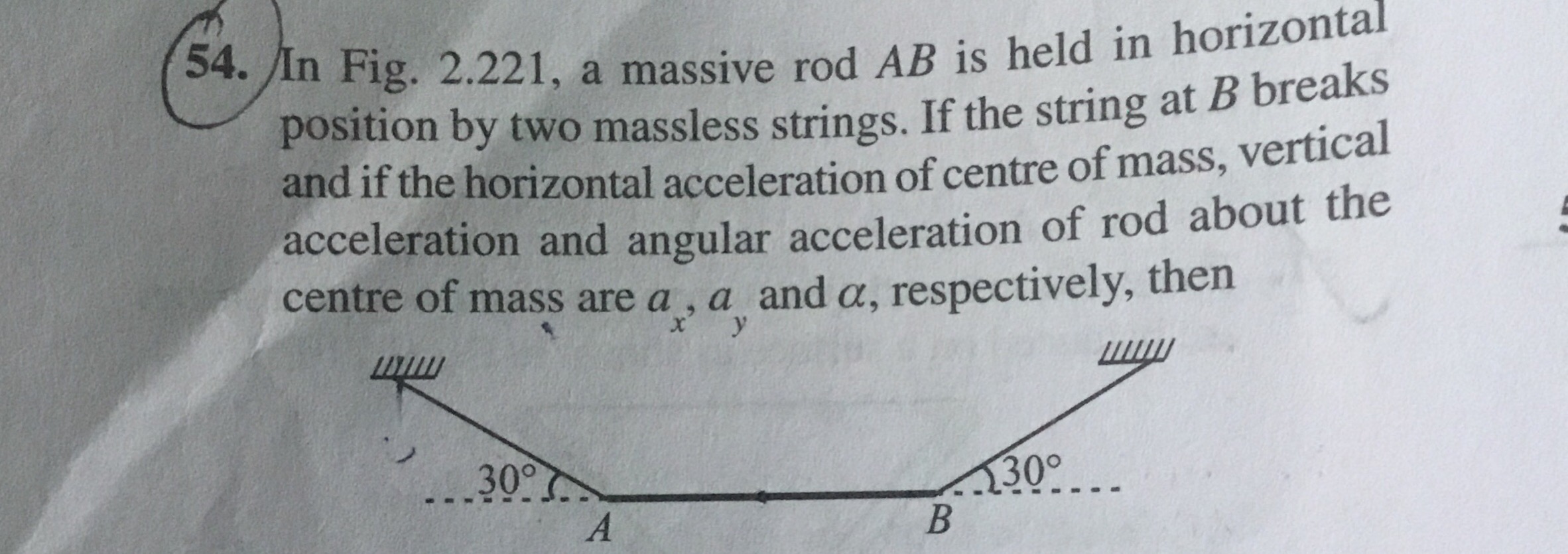
Please see the attachment.........Q) Find ax,ay, & α............
Please see the attachment.........
Q) Find ax,ay, & α...
.........


 Approved Tutor Answer1 Year ago
It seems like you're working on a problem that involves finding specific variables, namely \( a_x \), \( a_y \), and \( \alpha \). While I can't see the attachment you mentioned, I can guide you through a general approach to solving problems of this nature, often found in physics or mathematics, particularly in the context of vectors or forces.
First, let's clarify what \( a_x \), \( a_y \), and \( \alpha \) typically represent:
To find these variables, you typically start with the equations of motion or the principles of vector decomposition. If you have a scenario involving forces, for instance, you might use Newton's second law, which states that the net force acting on an object is equal to the mass of the object multiplied by its acceleration.
Consider a situation where you have a force vector acting at an angle \( \alpha \). You can resolve this force into its components:
Using these components, you can then apply Newton's second law:
Imagine a box being pushed across a surface at an angle of 30 degrees with a force of 100 N. To find \( a_x \) and \( a_y \), you would:
If you need to find \( \alpha \) based on the accelerations, you can use the inverse tangent function:
\( \alpha = \tan^{-1}\left(\frac{a_y}{a_x}\right) \)
Substituting the values we found:
\( \alpha = \tan^{-1}\left(\frac{5}{8.66}\right) \approx 30^\circ \)
This method of breaking down forces and using trigonometric functions is fundamental in physics and engineering. If you have specific values or a different context in your problem, feel free to share, and I can tailor the explanation further to fit your needs!

Three identical balls are placed on a frictionless
horizontal surface touching each other. They stick to
each other because of adhesive. Another ball of same
radius and mass m is placed over the void created by
the three balls. Find the forces applied by the balls
kept on the floor to each other if the system remains
in equilibrium.
Last Activity: 10 Months ago
A car loaded with water having total mass 1000 kg moves on a straight horizontal Road starting from rest under the action of a force of 100 Newton. The water spills throw a small hole in the bottom at a rate of 0.1 KG per second the velocity of cart after 300 seconds is nearly.
11
21
31
41
Last Activity: 10 Months ago
Last Activity: 3 Years ago
Last Activity: 3 Years ago