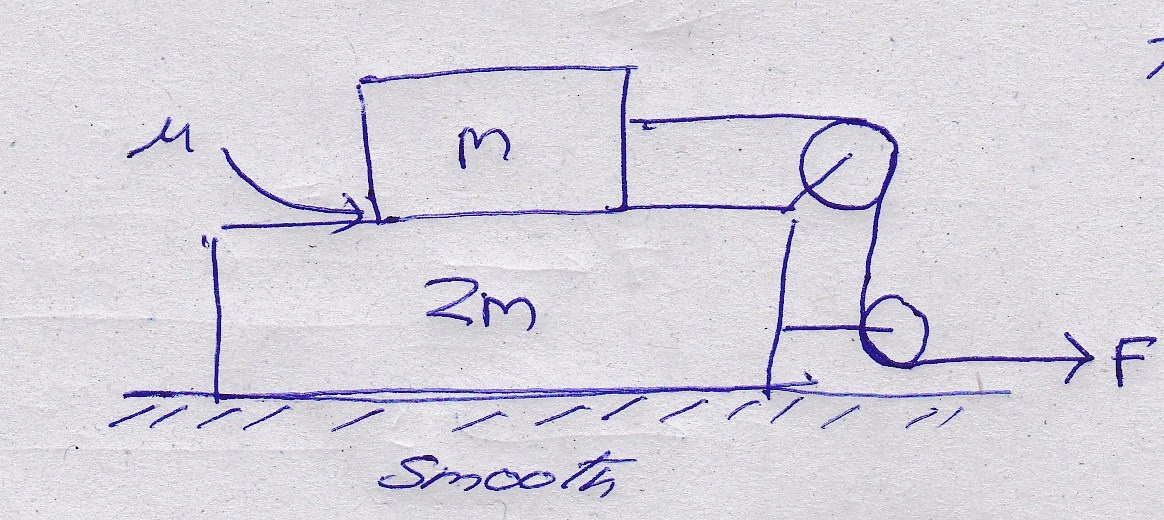
To determine the minimum value for the coefficient of friction between two blocks to prevent slipping, we need to analyze the forces acting on the blocks. Let's break this down step by step.
Understanding the Forces at Play
When two blocks are in contact, several forces come into play, especially if one block is on top of the other. The key forces include:
- Weight of the blocks: This is the gravitational force acting downwards.
- Normal force: This is the force exerted by a surface that supports the weight of an object resting on it.
- Frictional force: This opposes the relative motion between the two surfaces in contact.
Setting Up the Problem
Assuming we have two blocks, Block A on top of Block B, and Block B is on a surface, we need to consider the following:
- The weight of Block A (let's call it WA) creates a normal force (NA) on Block B.
- The frictional force (Ff) between the two blocks must be sufficient to prevent Block A from slipping off Block B.
Calculating the Required Friction
The frictional force can be expressed as:
Ff = μ * NA
Where:
- μ is the coefficient of friction.
- NA is the normal force, which is equal to the weight of Block A (WA).
For Block A to not slip, the frictional force must be greater than or equal to the force trying to cause it to slip. If Block A is subjected to a horizontal force (let's denote it as Fhorizontal), we can set up the inequality:
μ * WA ≥ Fhorizontal
Finding the Minimum Coefficient of Friction
Rearranging the inequality gives us:
μ ≥ Fhorizontal / WA
Now, if we know the values of the horizontal force and the weight of Block A, we can calculate the minimum coefficient of friction required to prevent slipping. For example, if Block A weighs 10 N and the horizontal force applied is 5 N, the calculation would be:
μ ≥ 5 N / 10 N = 0.5
Final Thoughts
In summary, the minimum coefficient of friction necessary to prevent slipping between the two blocks depends on the weight of the top block and the horizontal force acting on it. By analyzing the forces and applying the formula, you can find the required coefficient of friction for any given scenario. If you have specific values for the weights and forces involved, we can plug those in to find the exact coefficient needed.