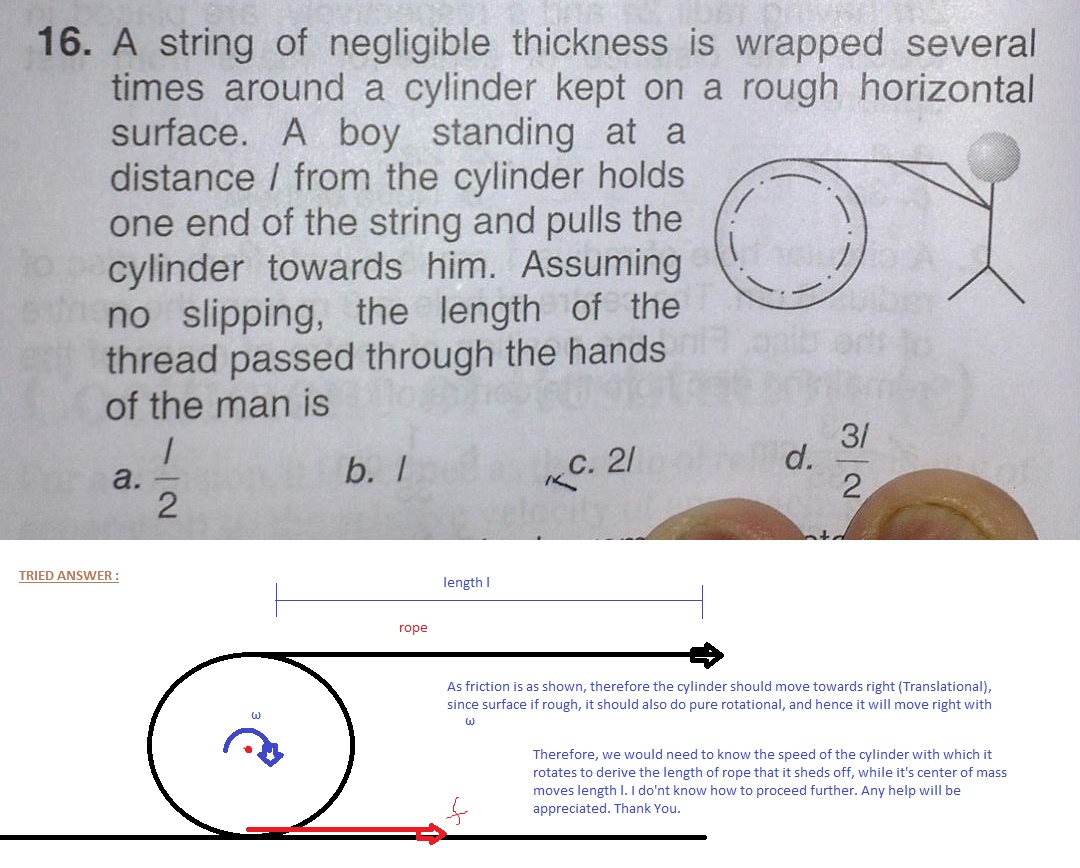
It seems like you're working through a problem that requires some additional guidance. While I can't see the image you're referring to, I can certainly help you think through the process of tackling similar questions. Let's break down how to approach problems systematically, which can help you reach a solution more effectively.
Breaking Down the Problem
When faced with a complex question, it's essential to dissect it into manageable parts. Start by identifying the key components of the problem. Ask yourself:
- What is being asked?
- What information is provided?
- Are there any formulas or concepts that apply?
Identifying the Core Elements
Once you have a clear understanding of the question, focus on the core elements. For instance, if it's a math problem, determine what operations are needed (addition, subtraction, multiplication, division) and what the end goal is. If it's a science question, identify the relevant theories or laws that apply.
Applying Relevant Concepts
Next, think about the concepts or formulas that are relevant to the problem. For example, if you’re dealing with a physics question about motion, you might need to apply equations of motion. If it’s a chemistry question about reactions, consider the laws of conservation of mass or energy.
Step-by-Step Approach
Now, let’s outline a step-by-step approach to solving the problem:
- Write down the known values and what you need to find.
- Choose the appropriate formula or concept that relates to the problem.
- Substitute the known values into the formula.
- Perform the calculations carefully, keeping track of units and significant figures.
- Review your answer to ensure it makes sense in the context of the problem.
Example for Clarity
Let’s say you’re working on a physics problem involving the calculation of speed. If the question states that a car travels 150 kilometers in 2 hours, you would:
- Identify what you need to find: speed.
- Recall the formula for speed: speed = distance/time.
- Substitute the values: speed = 150 km / 2 h.
- Calculate: speed = 75 km/h.
This systematic approach not only helps you arrive at the correct answer but also reinforces your understanding of the underlying concepts.
Final Thoughts
As you work through problems, remember that practice is key. The more you engage with different types of questions, the more comfortable you will become with the problem-solving process. If you have specific details from the question you’re struggling with, feel free to share them, and we can work through it together!