

Grade 11Mechanics
please provide the solution to this question from rotational mechanics
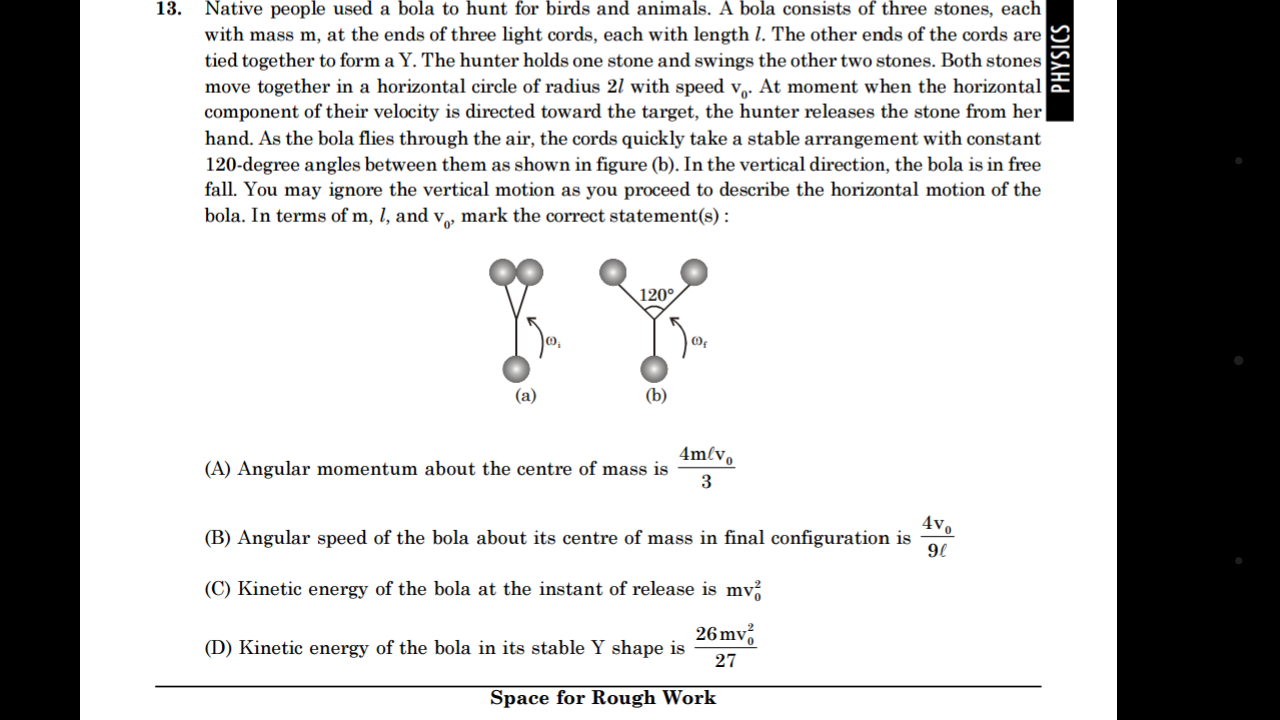


 Approved Tutor Answer11 Months ago
Rotational mechanics is a fascinating area of physics that deals with the motion of objects that rotate around an axis. To provide a comprehensive solution, let’s consider a common problem in this field: calculating the moment of inertia of a solid cylinder and how it affects its rotational motion.
The moment of inertia (I) is a crucial concept in rotational mechanics, analogous to mass in linear motion. It quantifies how difficult it is to change the rotational state of an object. The formula for the moment of inertia depends on the shape of the object and the axis about which it rotates.
For a solid cylinder of mass \( m \) and radius \( r \), rotating about its central axis, the moment of inertia is given by:
I = \frac{1}{2} m r^2
Let’s say we have a solid cylinder with a mass of 10 kg and a radius of 0.5 m. To find its moment of inertia, we can plug these values into the formula:
Now, substituting these values into the formula:
I = \frac{1}{2} \times 10 \, \text{kg} \times (0.5 \, \text{m})^2
This simplifies to:
I = \frac{1}{2} \times 10 \times 0.25 = 1.25 \, \text{kg m}^2
Once we have the moment of inertia, we can analyze the rotational motion using Newton's second law for rotation, which states:
τ = Iα
Where:
Suppose we apply a torque of 5 N·m to our cylinder. To find the angular acceleration (α), we rearrange the equation:
α = \frac{τ}{I}
Substituting the values we have:
α = \frac{5 \, \text{N·m}}{1.25 \, \text{kg m}^2} = 4 \, \text{rad/s}^2
In this example, we calculated the moment of inertia for a solid cylinder and used it to determine the angular acceleration when a torque is applied. This process illustrates how rotational mechanics allows us to predict the behavior of rotating objects based on their physical properties and the forces acting upon them.
Understanding these principles not only helps in solving problems in physics but also has practical applications in engineering, robotics, and various technologies where rotational motion is involved.

Three identical balls are placed on a frictionless
horizontal surface touching each other. They stick to
each other because of adhesive. Another ball of same
radius and mass m is placed over the void created by
the three balls. Find the forces applied by the balls
kept on the floor to each other if the system remains
in equilibrium.
Last Activity: 9 Months ago
A car loaded with water having total mass 1000 kg moves on a straight horizontal Road starting from rest under the action of a force of 100 Newton. The water spills throw a small hole in the bottom at a rate of 0.1 KG per second the velocity of cart after 300 seconds is nearly.
11
21
31
41
Last Activity: 9 Months ago
Last Activity: 3 Years ago
Last Activity: 3 Years ago