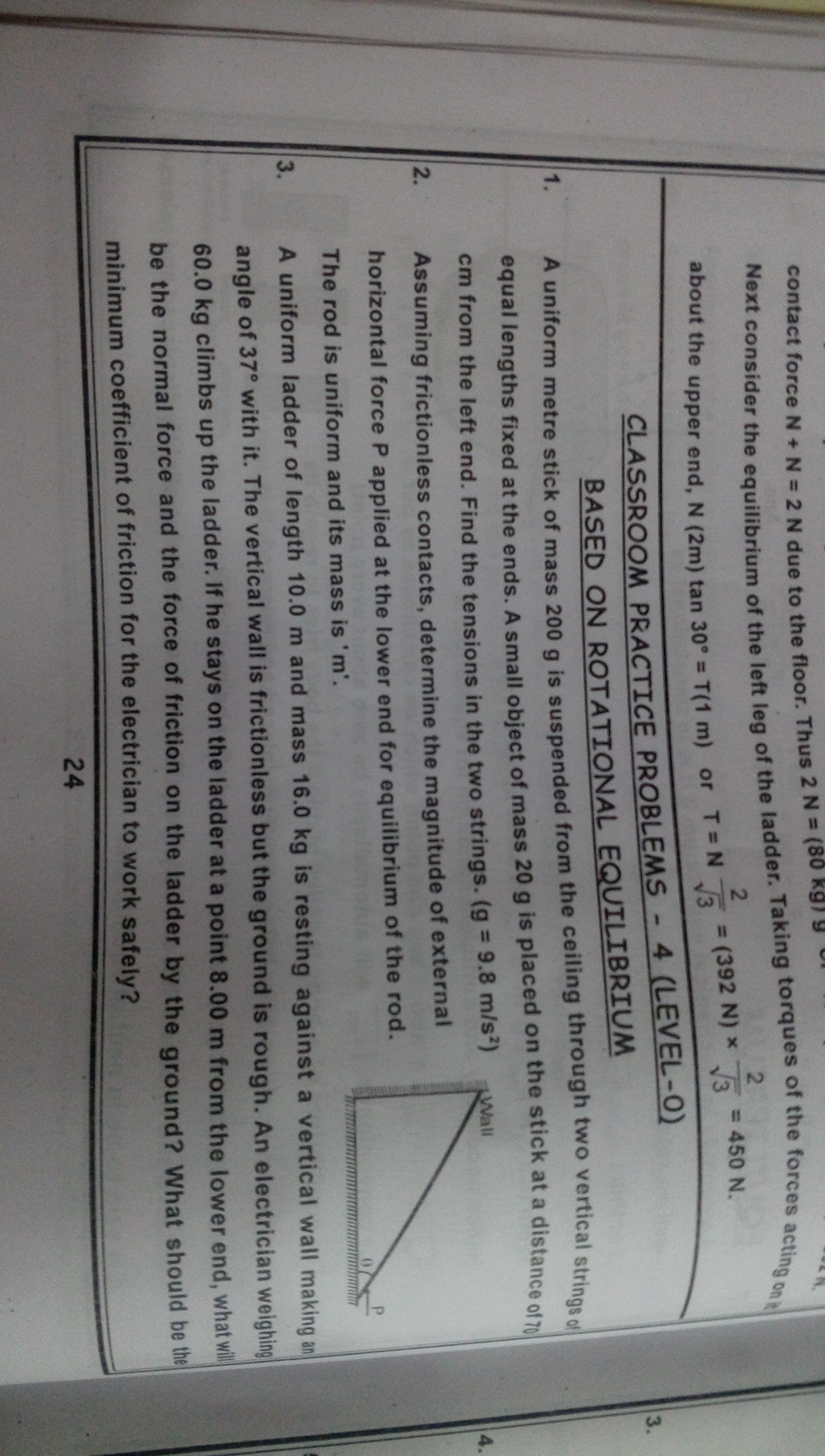
To determine the magnitude of the external horizontal force \( P \) applied at the lower end of a uniform rod in equilibrium, we need to analyze the forces and torques acting on the rod. Let's break this down step by step.
Understanding the System
We have a uniform rod of mass \( m \) and length \( L \) that is positioned vertically. The rod is in equilibrium, meaning that the sum of forces and the sum of torques acting on it must be zero. The only external force we are considering is the horizontal force \( P \) applied at the lower end of the rod.
Forces Acting on the Rod
- The weight of the rod, which acts downward at its center of mass (midpoint of the rod).
- The applied force \( P \), which acts horizontally at the bottom end of the rod.
- Since we are assuming frictionless contacts, there are no frictional forces to consider.
Setting Up the Equilibrium Conditions
For the rod to be in equilibrium, the following conditions must be satisfied:
- The sum of vertical forces must equal zero.
- The sum of horizontal forces must equal zero.
- The sum of torques about any point must equal zero.
Analyzing the Forces
In the vertical direction, the only force acting is the weight of the rod, which can be expressed as:
Weight (W) = mg
where \( g \) is the acceleration due to gravity. Since there are no vertical forces acting upwards, the vertical forces are balanced by the weight of the rod.
Torque Calculation
To analyze the torque, we can take moments about the point where the rod contacts the ground (the lower end). The torque due to the weight of the rod is given by:
Torque due to weight = W \times \frac{L}{2} = mg \times \frac{L}{2}
This torque acts in a clockwise direction. The torque due to the applied force \( P \) is:
Torque due to P = P \times L
This torque acts in a counterclockwise direction. For equilibrium, these two torques must be equal:
mg \times \frac{L}{2} = P \times L
Solving for the Force P
Now, we can simplify the equation:
mg \times \frac{L}{2} = P \times L
Dividing both sides by \( L \) (assuming \( L \neq 0 \)) gives:
mg \times \frac{1}{2} = P
Thus, the magnitude of the external horizontal force \( P \) required for the equilibrium of the rod is:
P = \frac{mg}{2}
Final Thoughts
This result shows that the horizontal force needed to keep the rod in equilibrium is directly proportional to its weight, but halved. This makes sense intuitively, as the force must counteract the torque created by the weight of the rod acting at its center of mass. If you have any further questions or need clarification on any part of this process, feel free to ask!