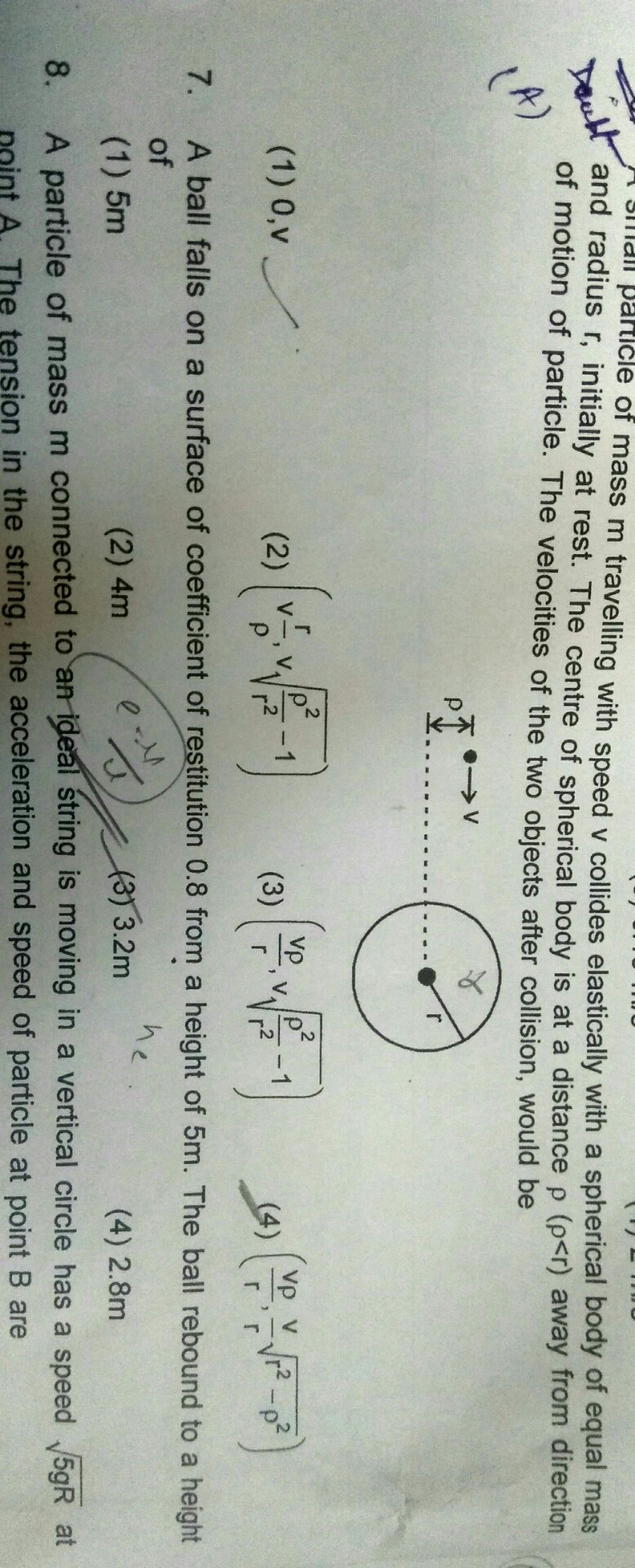
When discussing collisions, it's essential to understand the fundamental principles of physics that govern how objects interact when they collide. Let's break down the concepts involved in collision problems, focusing on key aspects such as types of collisions, conservation laws, and how to approach solving these problems step by step.
Types of Collisions
Collisions can be categorized into two main types:
- Elastic Collisions: In these collisions, both momentum and kinetic energy are conserved. This means that the total kinetic energy before the collision is equal to the total kinetic energy after the collision.
- Inelastic Collisions: Here, momentum is conserved, but kinetic energy is not. Some of the kinetic energy is transformed into other forms of energy, such as heat or sound. A perfectly inelastic collision is a special case where the colliding objects stick together after the collision.
Conservation of Momentum
One of the key principles in collision problems is the conservation of momentum. The total momentum of a closed system remains constant if no external forces act on it. The formula for momentum (p) is:
p = mv
where m is mass and v is velocity. For two objects colliding, the total momentum before the collision equals the total momentum after the collision:
m1v1 + m2v2 = m1v1' + m2v2'
Here, m1 and m2 are the masses of the two objects, v1 and v2 are their initial velocities, and v1' and v2' are their final velocities after the collision.
Steps to Solve Collision Problems
To solve a collision problem, follow these logical steps:
- Identify the Type of Collision: Determine whether it is elastic or inelastic.
- Write Down the Known Values: List the masses and initial velocities of the objects involved.
- Apply Conservation of Momentum: Set up the momentum equation based on the type of collision.
- Use Additional Equations if Necessary: For elastic collisions, you may also need to apply the conservation of kinetic energy.
- Solve for the Unknowns: Rearrange the equations to find the unknown final velocities or other quantities.
Example Problem
Let’s consider a simple example: Two cars collide. Car A has a mass of 1,000 kg and is moving at 20 m/s, while Car B has a mass of 1,500 kg and is stationary. If they collide in an inelastic manner, what are their final velocities?
1. Identify the type of collision: Inelastic.
2. Known values: m1 = 1000 kg, v1 = 20 m/s, m2 = 1500 kg, v2 = 0 m/s.
3. Apply conservation of momentum:
m1v1 + m2v2 = (m1 + m2)v'
Substituting the known values:
1000 kg * 20 m/s + 1500 kg * 0 m/s = (1000 kg + 1500 kg)v'
This simplifies to:
20000 kg*m/s = 2500 kg * v'
4. Solve for v':
v' = 20000 kg*m/s / 2500 kg = 8 m/s
Thus, after the collision, both cars move together at a velocity of 8 m/s.
Final Thoughts
Understanding collisions involves grasping the concepts of momentum and energy conservation. By systematically applying these principles, you can solve a variety of collision problems effectively. If you have a specific question or scenario in mind, feel free to share, and we can work through it together!