
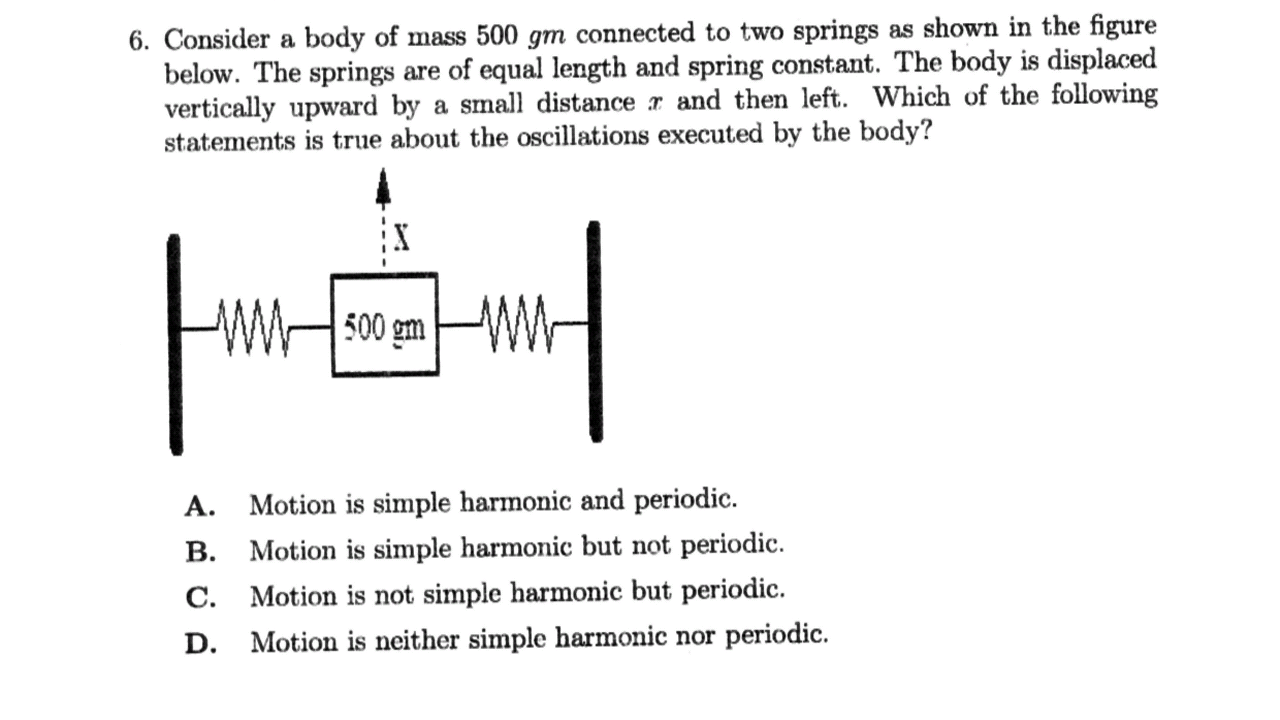
Please answer the question attached.It is about simple harmonic motion.please answer the question

Muhammad sajeer , 8 Years ago
Grade 12th pass
 Mechanics> Please answer the question attached.It is...
 1 Answers
Simple harmonic motion (SHM) is a fascinating concept in physics that describes the oscillatory motion of an object when it is displaced from its equilibrium position and then experiences a restoring force proportional to that displacement. To understand this better, let’s break down the key components and principles involved in SHM.
At its core, simple harmonic motion can be defined as a repetitive movement back and forth through an equilibrium position. This motion is characterized by a few essential features:
Common examples of simple harmonic motion include:
The motion of an object in SHM can be described mathematically using sine or cosine functions. The displacement (x) as a function of time (t) can be expressed as:
x(t) = A cos(ωt + φ)
Where:
To visualize SHM, think of a child on a swing. When the swing is pulled back and released, it moves forward and backward around the central point. The highest points of the swing represent maximum displacement (amplitude), while the lowest point is the equilibrium position. The swing's motion is periodic, repeating at regular intervals, which is a hallmark of SHM.
Understanding simple harmonic motion is crucial in various fields, including engineering, music, and even medicine. For instance:
In summary, simple harmonic motion is a fundamental concept that describes oscillatory systems characterized by a restoring force proportional to displacement. Its principles are not only essential for understanding physical systems but also have practical applications across various domains. By grasping the basics of SHM, you can appreciate the underlying mechanics of many everyday phenomena.
 Approved
Prepraring for the competition made easy just by live online class.

Full Live Access

Study Material

Live Doubts Solving

Daily Class Assignments

Three identical balls are placed on a frictionless
horizontal surface touching each other. They stick to
each other because of adhesive. Another ball of same
radius and mass m is placed over the void created by
the three balls. Find the forces applied by the balls
kept on the floor to each other if the system remains
in equilibrium.
Last Activity: 7 Months ago
A car loaded with water having total mass 1000 kg moves on a straight horizontal Road starting from rest under the action of a force of 100 Newton. The water spills throw a small hole in the bottom at a rate of 0.1 KG per second the velocity of cart after 300 seconds is nearly.
11
21
31
41
Last Activity: 7 Months ago
Last Activity: 3 Years ago
Last Activity: 3 Years ago
Last Activity: 3 Years ago