

Grade 11Mechanics
Pleas solve problem based on relative motion betwwen two blocks given in image ...
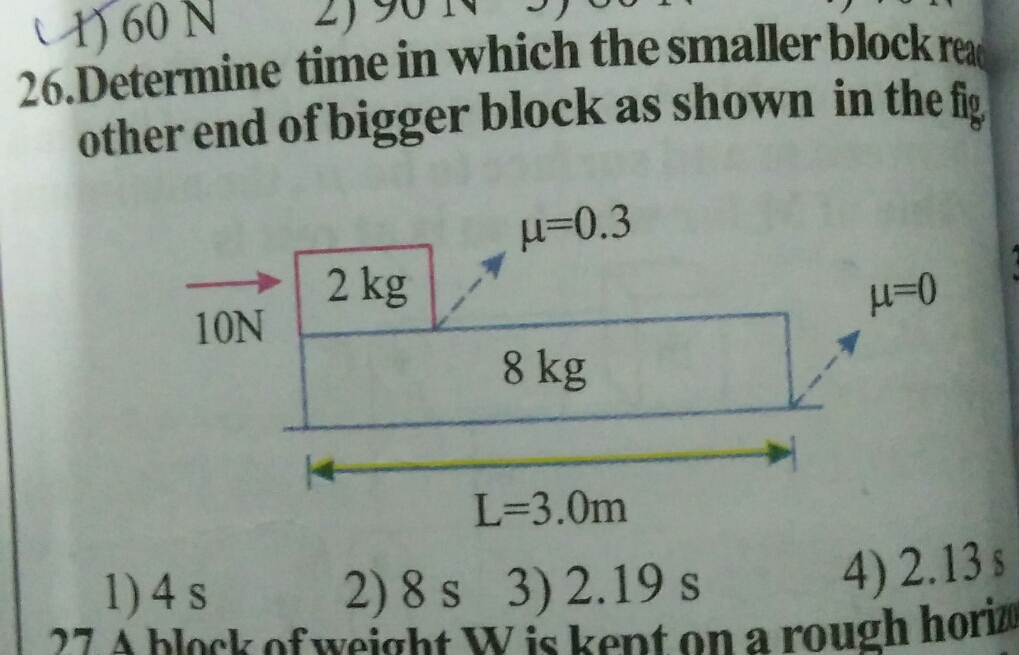


 Approved Tutor Answer0 Years ago
To tackle a problem involving relative motion between two blocks, we first need to understand the basic principles of motion and how they interact with each other. Although I can't see the image you mentioned, I can guide you through a typical scenario involving two blocks moving relative to one another. Let's break it down step by step.
Relative motion refers to the calculation of the motion of an object as observed from another moving object. When dealing with two blocks, we often consider their velocities, directions, and any forces acting on them. Here’s how to approach such a problem:
Identify the two blocks and their initial conditions. For instance, let’s say we have Block A moving to the right with a velocity of vA and Block B moving to the left with a velocity of vB. It’s essential to establish a coordinate system, typically with one direction as positive.
The relative velocity of Block A with respect to Block B can be calculated using the formula:
Here, vAB represents the velocity of Block A as observed from Block B. If both blocks are moving in opposite directions, their velocities will add up in magnitude.
If there are forces acting on the blocks, such as friction or tension, you need to consider these as well. For example, if Block A is on a surface with friction and Block B is hanging, we would analyze the forces acting on each block separately using Newton's second law:
Where F is the net force, m is mass, and a is acceleration. This will help us find the acceleration of each block, which can further influence their relative motion.
To find out where each block will be after a certain time t, we can use the equations of motion. For instance, if Block A starts at position xA0 and moves with constant velocity, its position at time t can be expressed as:
Similarly, for Block B:
By substituting the values, you can determine the positions of both blocks at any given time.
Finally, analyze the results to understand the interaction between the blocks. Are they moving towards each other? Will they collide? Understanding their relative positions over time will give you insights into their motion dynamics.
Let’s say Block A is moving to the right at 5 m/s and Block B is moving to the left at 3 m/s. The relative velocity would be:
This means Block A is moving away from Block B at a rate of 8 m/s. If they started 20 meters apart, you could calculate the time until they meet (if they were moving towards each other) or how far apart they will be after a certain time.
By following these steps, you can systematically approach problems involving relative motion between two blocks, ensuring a comprehensive understanding of their interactions. If you have specific values or conditions from the image, feel free to share them, and we can work through those together!

Three identical balls are placed on a frictionless
horizontal surface touching each other. They stick to
each other because of adhesive. Another ball of same
radius and mass m is placed over the void created by
the three balls. Find the forces applied by the balls
kept on the floor to each other if the system remains
in equilibrium.
Last Activity: 9 Months ago
A car loaded with water having total mass 1000 kg moves on a straight horizontal Road starting from rest under the action of a force of 100 Newton. The water spills throw a small hole in the bottom at a rate of 0.1 KG per second the velocity of cart after 300 seconds is nearly.
11
21
31
41
Last Activity: 9 Months ago
Last Activity: 3 Years ago
Last Activity: 3 Years ago