Rituraj Tiwari
Last Activity: 5 Years ago
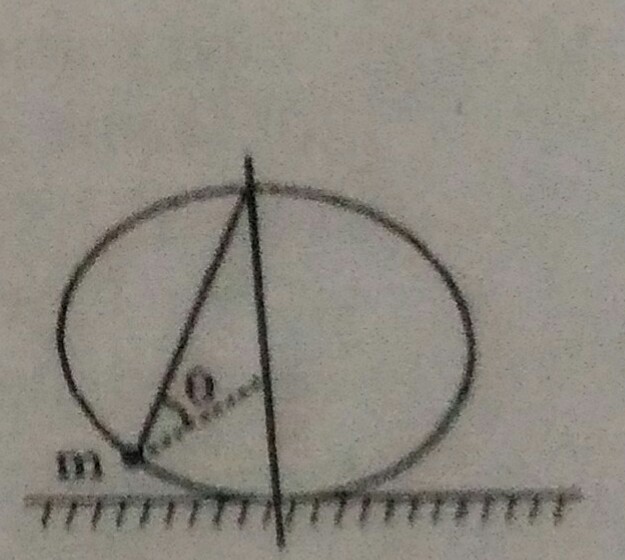
To analyze the situation you've described, we need to consider the forces acting on the bead and understand how tension in the string is determined. In this setup, the bead is sliding on a fixed vertical ring while one end of the string is attached to the top of the ring. Let's break this down step by step to find the tension in the string.
Identifying the Forces
When the bead is in equilibrium, we need to account for the gravitational force acting on it and the tension in the string. The forces acting on the bead include:
- Weight of the bead (W): This acts vertically downward and is equal to the mass of the bead (m) multiplied by gravitational acceleration (g), represented as W = mg.
- Tension in the string (T): This acts along the string, directed toward the point where the string is fixed at the top of the ring.
Analyzing the Situation
Assuming the bead has a mass m and is at a distance r from the center of the ring, we can analyze the forces in play. When the string is taut, the tension (T) can be determined by considering the forces in the vertical direction:
At equilibrium, the vertical forces must balance out. Therefore, we can write the equation based on the vertical components:
T - W = 0
Substituting the weight of the bead:
T - mg = 0
Calculating the Tension
From the equation above, we can rearrange it to find the tension:
T = mg
Example Calculation
Let’s consider a specific example: If the bead has a mass of 2 kg, and we take g to be approximately 9.81 m/s² (the acceleration due to gravity), we can calculate the tension:
T = 2 kg * 9.81 m/s² = 19.62 N.
Final Thoughts
The tension in the string when it is taut is directly proportional to the weight of the bead. If the mass of the bead changes, the tension will change accordingly. This scenario highlights how forces interact in a system, demonstrating basic principles of equilibrium and tension in strings.