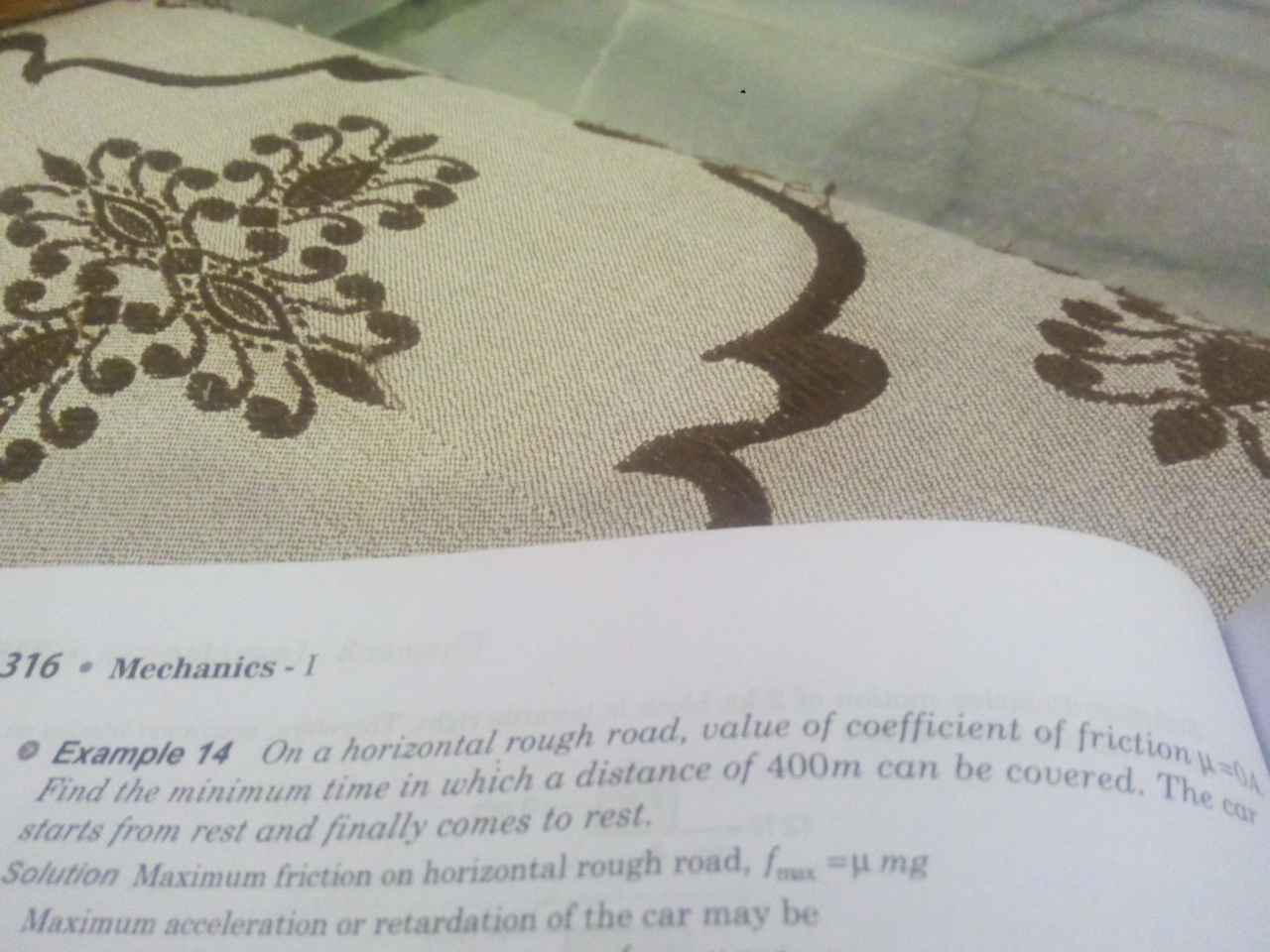
To solve the problem of finding the minimum time required for a car to cover a distance of 400 meters on a rough road with a coefficient of friction of 0.4, we need to consider the physics of motion and the forces acting on the car. Let's break this down step by step.
Understanding the Forces at Play
The car starts from rest and eventually comes to rest after covering the distance. The only horizontal force acting on the car while it is moving is the frictional force, which can be calculated using the formula:
- Frictional Force (F) = μ * N
Here, μ (mu) is the coefficient of friction (0.4 in this case), and N is the normal force. On a horizontal road, the normal force is equal to the weight of the car (mg), where m is the mass of the car and g is the acceleration due to gravity (approximately 9.81 m/s²).
Calculating the Acceleration
The frictional force will cause the car to decelerate. The deceleration (a) can be expressed as:
Substituting the values:
- a = 0.4 * 9.81 m/s² = 3.924 m/s²
Since the car is decelerating, we take this value as negative:
Using Kinematic Equations
To find the minimum time to cover the distance of 400 meters, we can use the kinematic equation that relates distance (s), initial velocity (u), acceleration (a), and time (t):
Since the car starts from rest, the initial velocity (u) is 0. Thus, the equation simplifies to:
Substituting the known values:
- 400 m = 0.5 * (-3.924 m/s²) * t²
Rearranging gives:
- t² = 400 m / (0.5 * 3.924 m/s²)
Calculating this yields:
- t² = 400 m / 1.962 m/s² ≈ 203.4 s²
Taking the square root to find t:
Final Result
The minimum time required for the car to cover a distance of 400 meters, starting from rest and coming to rest, is approximately 14.26 seconds.
This calculation illustrates the relationship between friction, acceleration, and time in motion. By understanding these concepts, you can apply similar reasoning to various problems involving motion on different surfaces.