Question icon
Grade 12Mechanics

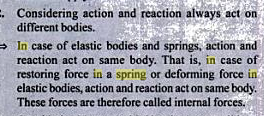
Newton’s third law tells that there must be paired force acting on different bodies during an interaction between them. This comes directly from Law of Conservation of momentum (& Noether’s theorem). But what about springs? When a block of mass $M$ is attached to a spring, it applies force $Mg$ on the spring; according to Newton’s third Law, the spring provides equal & opposite force on the block but also due to Hooke’s law, this is equal to $-kx$. But this restoring force acts on the spring also apart from the block. So, the reaction to the block’s force to the spring is the same as the restoring force & thus action(force from the block) & reaction(force on the block by the spring) act on the same body! This seems counterintuitive to me. How can it be reasonable? Is it reaaly happening like this?? Plz explain.
___
I’ve taken the pic from Pearson Guide to Objective physics.
Question image for Newton’s third law tells that there must be paire
Profile image of Om
10 Years agoGrade 12
Answers icon

1 Answer

Profile image of Askiitians Tutor Team
ApprovedApproved Tutor Answer1 Year ago

It's great that you're diving into the intricacies of Newton's laws and their application to systems like springs! Let's break this down step by step to clarify how these forces interact and why it all makes sense in the context of physics.

Understanding the Forces Involved

When we talk about a block of mass \( M \) attached to a spring, we need to consider the forces acting on both the block and the spring. According to Newton's third law, for every action, there is an equal and opposite reaction. This means that if the block exerts a force on the spring, the spring exerts an equal and opposite force on the block.

Forces at Play

  • Weight of the Block: The block exerts a downward force due to its weight, which is \( Mg \), where \( g \) is the acceleration due to gravity.
  • Spring Force: According to Hooke's Law, the spring exerts a restoring force that is proportional to its displacement from the equilibrium position, expressed as \( F = -kx \), where \( k \) is the spring constant and \( x \) is the displacement from equilibrium.

Analyzing the Interaction

Now, let's analyze the interaction between the block and the spring. When the block is at rest, the forces are balanced. The weight of the block \( Mg \) is equal to the spring force \( kx \) (where \( x \) is the amount the spring is stretched or compressed). This balance is crucial for understanding the system's equilibrium.

Applying Newton's Third Law

When the block pulls down on the spring with a force of \( Mg \), the spring indeed exerts an upward force of \( -kx \) on the block. According to Newton's third law, these forces are equal and opposite. However, it’s important to note that the spring itself is not just a passive object; it is also experiencing forces.

Clarifying the Confusion

Your concern arises from the idea that the action and reaction forces act on the same body. In reality, they act on different bodies: the block and the spring. The block exerts a force on the spring, and the spring exerts an equal and opposite force on the block. The spring also experiences the force due to the block, but it is not the same as the restoring force it exerts back on the block.

Example to Illustrate

Imagine a person standing on a trampoline. The person exerts a downward force due to their weight. The trampoline (spring) pushes back with an equal and opposite force. The trampoline is also being compressed, which is where Hooke's law comes into play. The force exerted by the trampoline is not the same as the force exerted by the person; rather, they are two distinct interactions that satisfy Newton's third law.

Conclusion

In summary, while it may seem counterintuitive at first, the forces involved in the interaction between the block and the spring are consistent with Newton's laws. The action and reaction forces act on different bodies, and the spring's restoring force is a separate interaction that allows the system to return to equilibrium. This interplay of forces is fundamental to understanding dynamics in systems involving springs and other elastic materials.