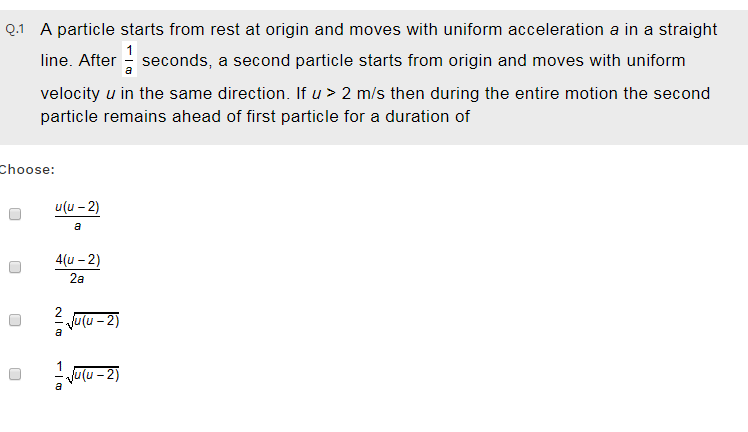
For the second partice to go ahead of first particle, it should meet the first particle ovetake it.
Again the first paticle should overtake the second particle. This will happen only when the distances travelled by both the particles is same at two instants of time.

S
first=S
secondInitial velocity of the first body u1=0
Initial velocity of the second body u2=u [u>2]
Acceleration of the first body is a
If the second particle moves for t seconds, then the first particle must have travelled for (t+1/a)seconds.Here we have to calculate the time interval between the two point if times where the two particles meet.
Hence,
[a(t+1/a)2]/2 = ut+0
After solving we get a quadratic equation in terms of ‘t’.
a2t2+(2a-2au)t+1=0
The difference between the roots of the quadrtic equation is our answer.
i.e., if t1 and t2 are roots of the above equation then,
where

=discriminant of the quadrtic equation and
a=coefficient of x2 in the quadratic equation.
=[2(

u
2-2u)]/a
Please approve my answer if it helped you.