
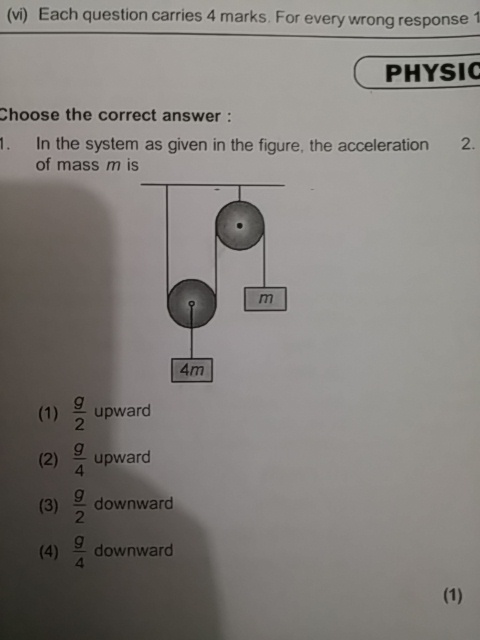
,kindly help me in this pulley question.the answer given to be is the 1st one
,kindly help me in this pulley question.
the answer given to be is the 1st one

megha , 8 Years ago
Grade 12
 Mechanics> ,kindly help me in this pulley question. ...
 1 Answers
Let's dive into the concept of pulleys and how they work. Pulleys are simple machines that help lift or move loads with less effort. They consist of a wheel on an axle or shaft that is designed to support movement and change the direction of force. Understanding how pulleys function can be quite beneficial, especially in physics and engineering contexts.
Pulleys can be categorized into different types based on their configuration and usage:
The fundamental principle behind pulleys is the mechanical advantage they provide. Mechanical advantage is the ratio of the output force exerted by the machine to the input force applied to it. In simpler terms, it allows you to lift heavier objects with less force.
To calculate the mechanical advantage of a pulley system, you can use the following formula:
Mechanical Advantage (MA) = Load Force / Effort Force
For example, if you have a movable pulley lifting a 100 kg load, and it requires only 50 kg of force to lift it, the mechanical advantage would be:
MA = 100 kg / 50 kg = 2
This means you can lift the load with half the effort you would normally need without the pulley.
Pulleys are widely used in various applications, including:
Imagine you are trying to lift a heavy box straight up. Without a pulley, you would need to exert a force equal to the weight of the box. However, if you use a fixed pulley, you can pull down on the rope, which allows you to lift the box up with less effort. If you add a movable pulley into the mix, you can lift the box even more easily, as the system distributes the weight and reduces the force needed.
In summary, pulleys are essential tools that simplify the process of lifting and moving heavy objects. By understanding their types, mechanical advantage, and applications, you can appreciate how they play a crucial role in everyday tasks and engineering solutions.
 Approved
Prepraring for the competition made easy just by live online class.

Full Live Access

Study Material

Live Doubts Solving

Daily Class Assignments