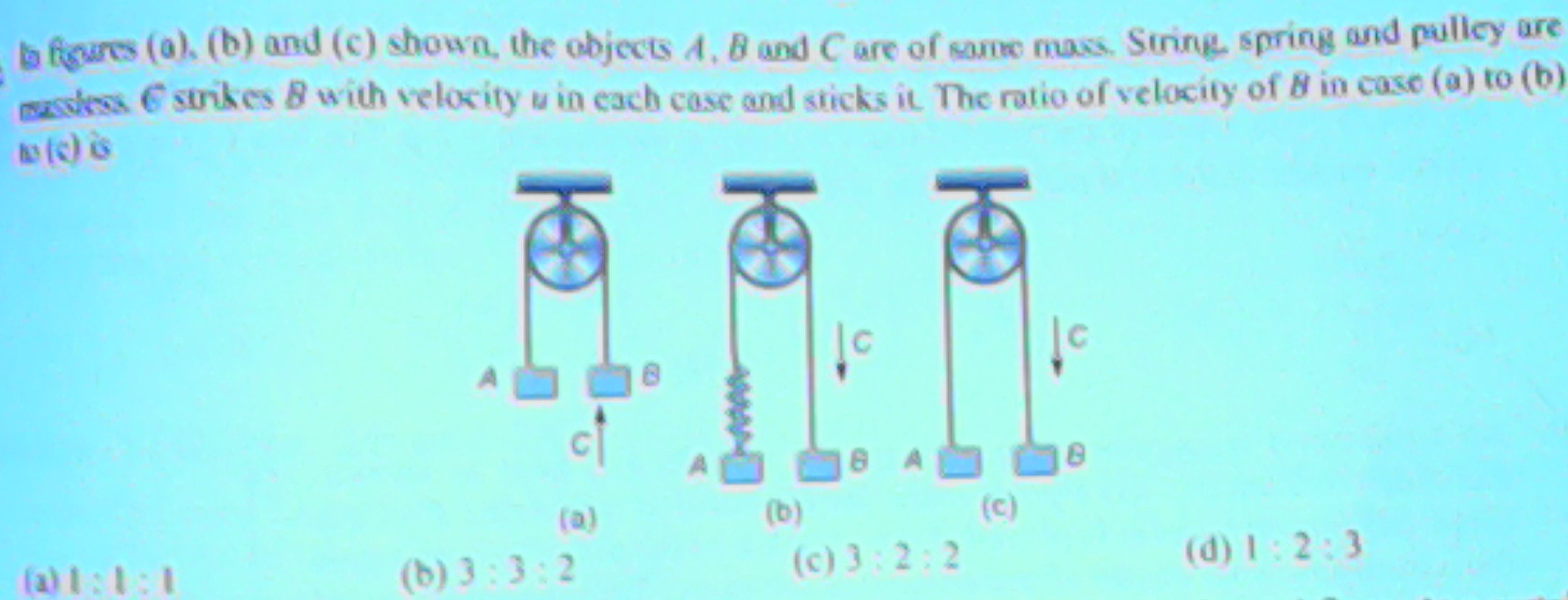
To help you understand how to arrive at the answer option b, which is 3:3:2, let's break down the problem step by step. It’s important to analyze the context of the question and the relationships between the numbers involved. Although I don’t have the specific details of the question, I can guide you through a typical approach that leads to this ratio.
Understanding Ratios
Ratios are a way to compare quantities, showing the relative sizes of two or more values. In this case, the ratio 3:3:2 suggests that there are three parts of one quantity, three parts of another, and two parts of a third quantity. This can often arise in problems involving distribution, proportions, or combinations.
Breaking Down the Components
Let’s assume the question involves distributing items or values among different categories. Here’s how you might approach it:
- Identify the Total: Determine the total number of items or values you are working with.
- Define the Parts: Understand what each part of the ratio represents. In this case, the first two parts (3:3) could represent two categories that are equal, while the last part (2) represents a different category.
- Set Up an Equation: If you know the total and the ratio, you can set up an equation to find the individual quantities. For example, if the total is 16, you can express it as:
3x + 3x + 2x = Total
In this case, 8x = 16, leading to x = 2. Thus, the quantities would be:
- First category: 3x = 6
- Second category: 3x = 6
- Third category: 2x = 4
Verifying the Ratio
Now, if we look at these quantities, we can express them as a ratio:
6:6:4, which simplifies to 3:3:2 when you divide each part by 2. This confirms that the ratio you arrived at is indeed correct.
Applying This Approach
Whenever you encounter a problem involving ratios, follow these steps:
- Clarify what each part of the ratio represents.
- Use the total to set up an equation.
- Solve for the variable and then express the results in the simplest form.
By practicing this method, you’ll become more comfortable with ratios and how to manipulate them to find the answers you need. If you have the specific details of the question, feel free to share, and I can provide a more tailored explanation!