

Grade 12th passMechanics
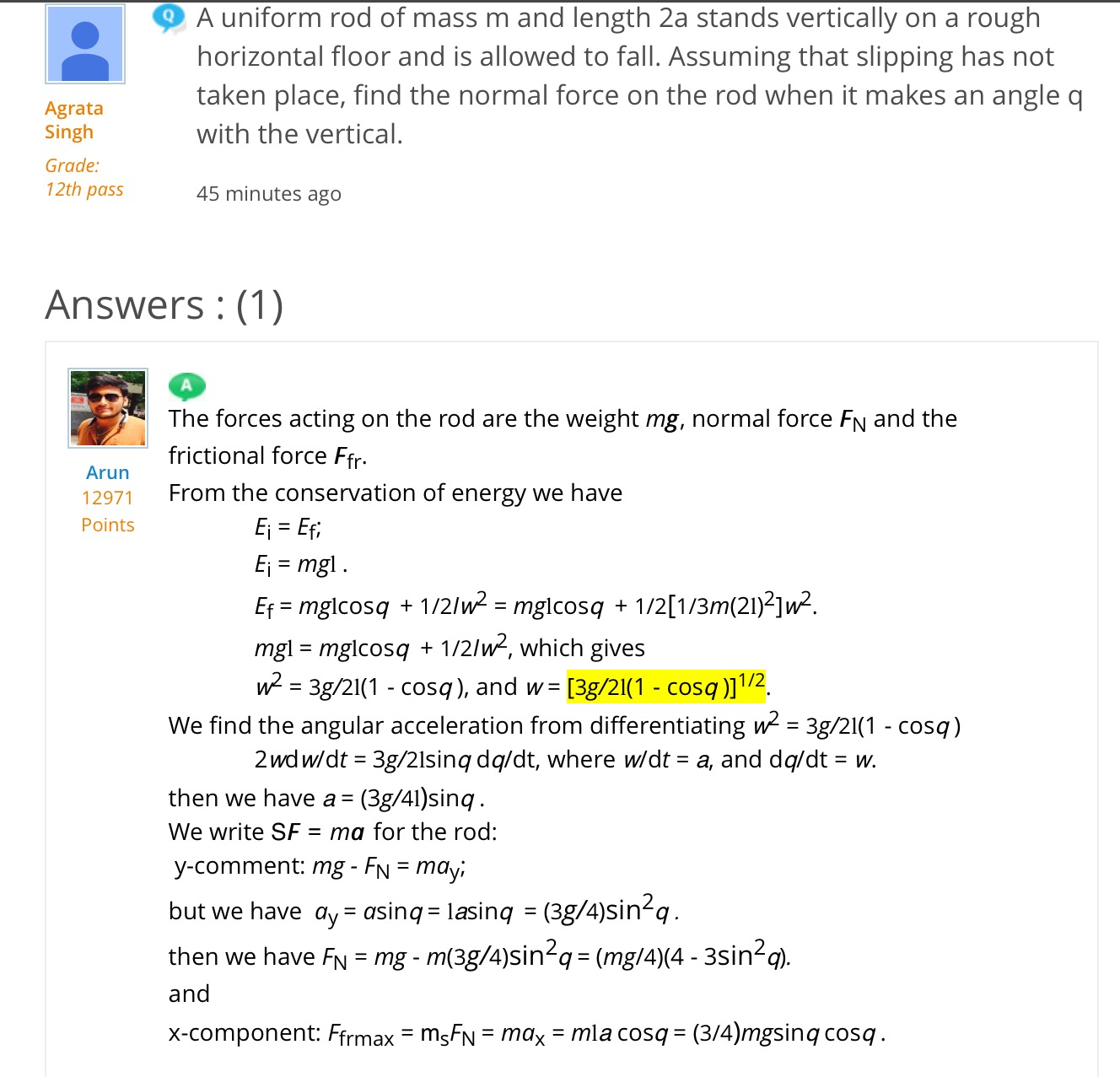
In the given solution how do we find ay and ax from angular accn
In the given solution how do we find ay and ax from angular accn


 Approved Tutor Answer0 Years ago
To find the values of \( y \) and \( x \) from angular acceleration, we first need to understand the relationship between angular acceleration and the angular displacement and velocity of an object. Angular acceleration, denoted as \( \alpha \), is defined as the rate of change of angular velocity over time. It can be expressed mathematically as:
Angular acceleration can be calculated using the formula:
where \( \Delta \omega \) is the change in angular velocity and \( \Delta t \) is the change in time. This means that if you know how much the angular velocity changes over a specific time interval, you can determine the angular acceleration.
To find the angular displacement \( \theta \) (which can be related to \( y \) in some contexts), we can use the following kinematic equation for rotational motion:
In this equation, \( \omega_0 \) is the initial angular velocity, \( t \) is the time, and \( \alpha \) is the angular acceleration. By substituting known values into this equation, you can solve for \( \theta \), which may correspond to \( y \) in your specific problem.
If you are looking for a linear displacement \( x \) related to the angular motion, you can use the relationship between linear and angular quantities. The linear displacement \( s \) is given by:
Here, \( r \) is the radius of the circular path. If you have calculated \( \theta \) from the previous step, you can find \( x \) by multiplying \( \theta \) by the radius \( r \). This relationship shows how angular motion translates into linear motion.
Let’s say an object starts from rest (\( \omega_0 = 0 \)) and has an angular acceleration of \( 2 \, \text{rad/s}^2 \) for \( 3 \, \text{s} \). We can find \( \theta \) as follows:
If the radius \( r \) of the circular path is \( 1 \, \text{m} \), then the linear displacement \( x \) would be:
To summarize, finding \( y \) and \( x \) from angular acceleration involves:
By following these steps, you can effectively relate angular motion to linear motion and derive the necessary values from angular acceleration.

Three identical balls are placed on a frictionless
horizontal surface touching each other. They stick to
each other because of adhesive. Another ball of same
radius and mass m is placed over the void created by
the three balls. Find the forces applied by the balls
kept on the floor to each other if the system remains
in equilibrium.
Last Activity: 9 Months ago
A car loaded with water having total mass 1000 kg moves on a straight horizontal Road starting from rest under the action of a force of 100 Newton. The water spills throw a small hole in the bottom at a rate of 0.1 KG per second the velocity of cart after 300 seconds is nearly.
11
21
31
41
Last Activity: 9 Months ago
Last Activity: 3 Years ago
Last Activity: 3 Years ago