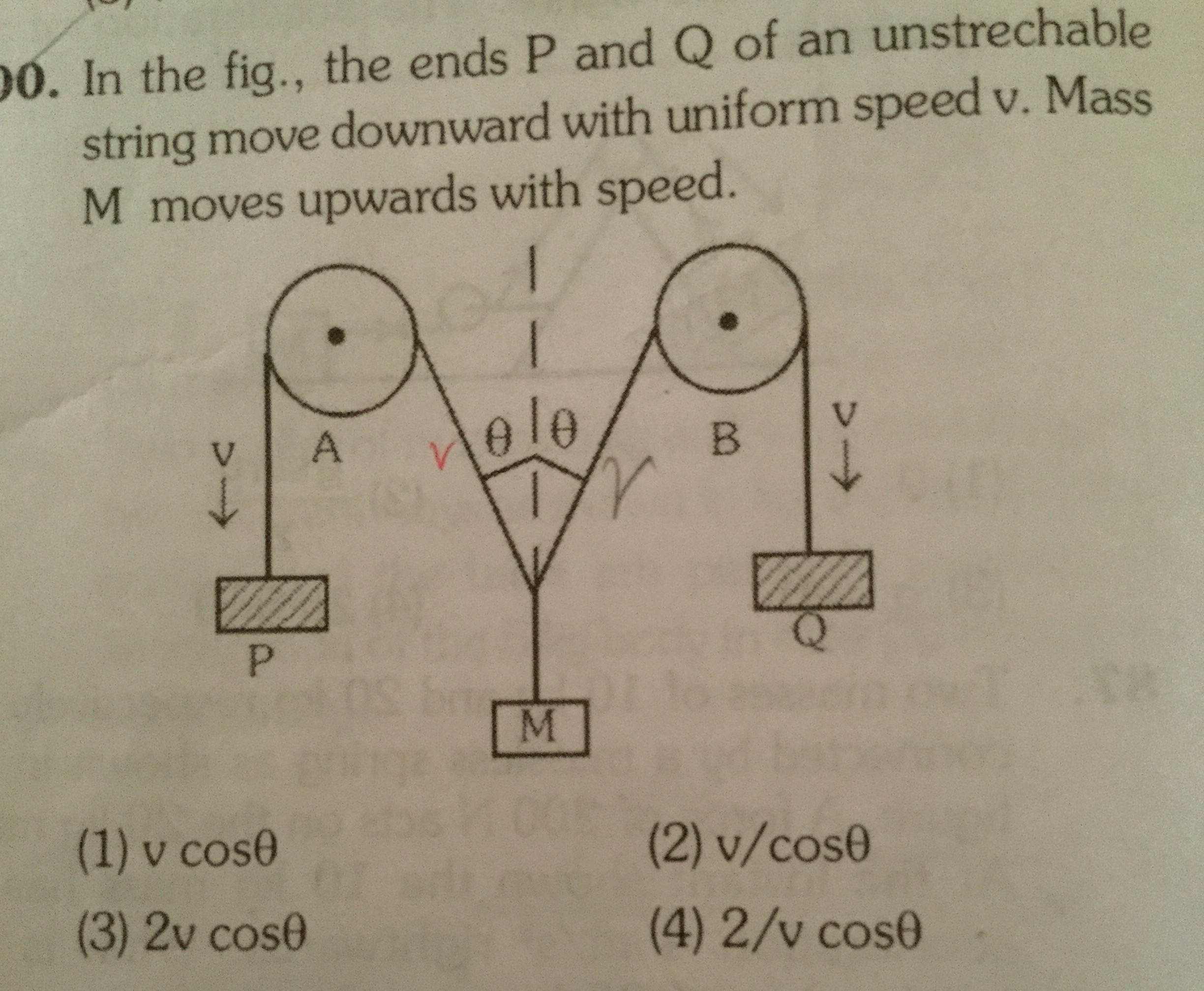
To analyze the motion of mass M in relation to the ends P and Q of the unstretchable string moving downward, we can use some fundamental principles of physics, particularly those related to kinematics and the properties of strings. Let’s break this down step by step.
Understanding the System
Imagine a scenario where you have a string attached to a mass M, and the ends of the string (P and Q) are being pulled downward at a constant speed v. Since the string is unstretchable, the total length of the string remains constant as it moves. This means that any movement at the ends of the string directly affects the position of the mass M.
Analyzing the Motion
When both ends of the string move downward with speed v, the mass M, which is suspended in the middle of the string, will also move upward. The key here is to recognize how the downward motion of the ends translates to the upward motion of the mass.
Using Geometry
Let’s visualize the situation. If the ends P and Q are moving downward, the distance between them decreases. If we denote the vertical distance from the ends of the string to the mass M as h, then as P and Q move down, the length of the string segments on either side of M decreases. The mass M will rise as a result.
Calculating the Speed of Mass M
To find the speed of mass M, we can use the relationship between the speeds of the ends and the mass. Since both ends are moving down at speed v, the upward speed of mass M can be derived from the geometry of the situation:
- Let’s denote the upward speed of mass M as u.
- As both ends move down, the total downward movement of the ends (2v, since both P and Q are moving) results in an upward movement of mass M.
- Thus, we can establish the relationship: u = v.
This means that the mass M moves upward with the same speed as the ends of the string move downward. Therefore, if P and Q are moving downward at speed v, mass M will also move upward at speed v.
Conclusion
In summary, when the ends P and Q of an unstretchable string move downward with a uniform speed v, the mass M attached to the string will move upward with the same speed v. This relationship is a direct consequence of the properties of the string and the geometry of the system. Understanding these principles helps us analyze similar problems in mechanics effectively.