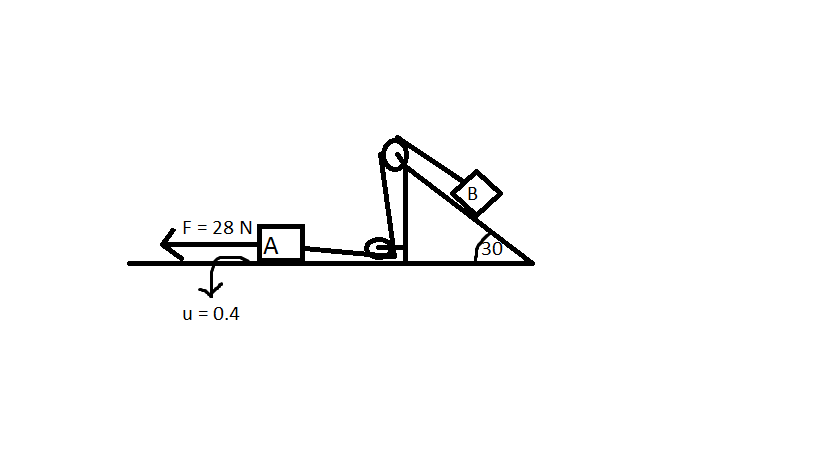
To solve this problem, we need to analyze the forces acting on both block A and block B, taking into account the given coefficients of friction and the applied force. Let's break it down step by step.
Understanding the System
We have two blocks: block A resting on the ground and block B resting on a wedge. The wedge is fixed, meaning it does not move, and the coefficient of friction between block A and the ground is 0.4. The friction between the wedge and block B is zero, indicating that block B can slide freely on the wedge.
Identifying Forces on Block A
For block A, the forces acting on it include:
- The gravitational force (weight) acting downwards, which is equal to \( m_A \cdot g \) where \( m_A \) is the mass of block A and \( g \) is the acceleration due to gravity (approximately 9.81 m/s²).
- The normal force \( N_A \) acting upwards from the ground.
- The frictional force \( f_A \) opposing the motion, which can be calculated as \( f_A = \mu \cdot N_A \), where \( \mu = 0.4 \).
- The tension \( T \) in the string acting horizontally.
Setting Up the Equations
Assuming block A has a mass \( m_A \), the normal force can be expressed as:
N_A = m_A \cdot g
Thus, the frictional force becomes:
f_A = 0.4 \cdot m_A \cdot g
Now, applying Newton's second law in the horizontal direction for block A, we have:
T - f_A = m_A \cdot a
Substituting for \( f_A \):
T - 0.4 \cdot m_A \cdot g = m_A \cdot a
Analyzing Block B
For block B, since it is on a wedge with no friction, the forces acting on it include:
- The gravitational force \( m_B \cdot g \) acting downwards.
- The normal force from the wedge acting perpendicular to the surface of the wedge.
Since the wedge is fixed, block B will not accelerate horizontally, but it will accelerate vertically due to gravity. The tension in the string will also affect the motion of block B. However, since the friction between block B and the wedge is zero, we can focus on the vertical component of the forces.
Finding Tension and Acceleration
To find the tension \( T \) and the acceleration \( a \) of block A, we need to consider the total force acting on the system. The applied force \( F = 28 \, N \) is acting on block A. Thus, we can write:
F = T + f_A
Substituting for \( f_A \):
28 = T + 0.4 \cdot m_A \cdot g
Now we have two equations:
- T - 0.4 \cdot m_A \cdot g = m_A \cdot a
- 28 = T + 0.4 \cdot m_A \cdot g
By solving these equations simultaneously, we can find the values of \( T \) and \( a \). Rearranging the second equation gives:
T = 28 - 0.4 \cdot m_A \cdot g
Substituting this expression for \( T \) into the first equation:
(28 - 0.4 \cdot m_A \cdot g) - 0.4 \cdot m_A \cdot g = m_A \cdot a
This simplifies to:
28 - 0.8 \cdot m_A \cdot g = m_A \cdot a
Solving for Acceleration
Now, we can isolate \( a \):
a = (28 - 0.8 \cdot m_A \cdot g) / m_A
At this point, we need the mass of block A to calculate the exact values of tension and acceleration. If we assume a mass for block A, we can plug it into the equations to find numerical values for \( T \) and \( a \).
Conclusion
In summary, the tension in the string and the acceleration of block A depend on the mass of block A and the gravitational force acting on it. By setting up the equations based on the forces acting on both blocks, we can derive the necessary relationships to find the desired quantities. If you have a specific mass for block A, we can calculate the exact values for tension and acceleration.