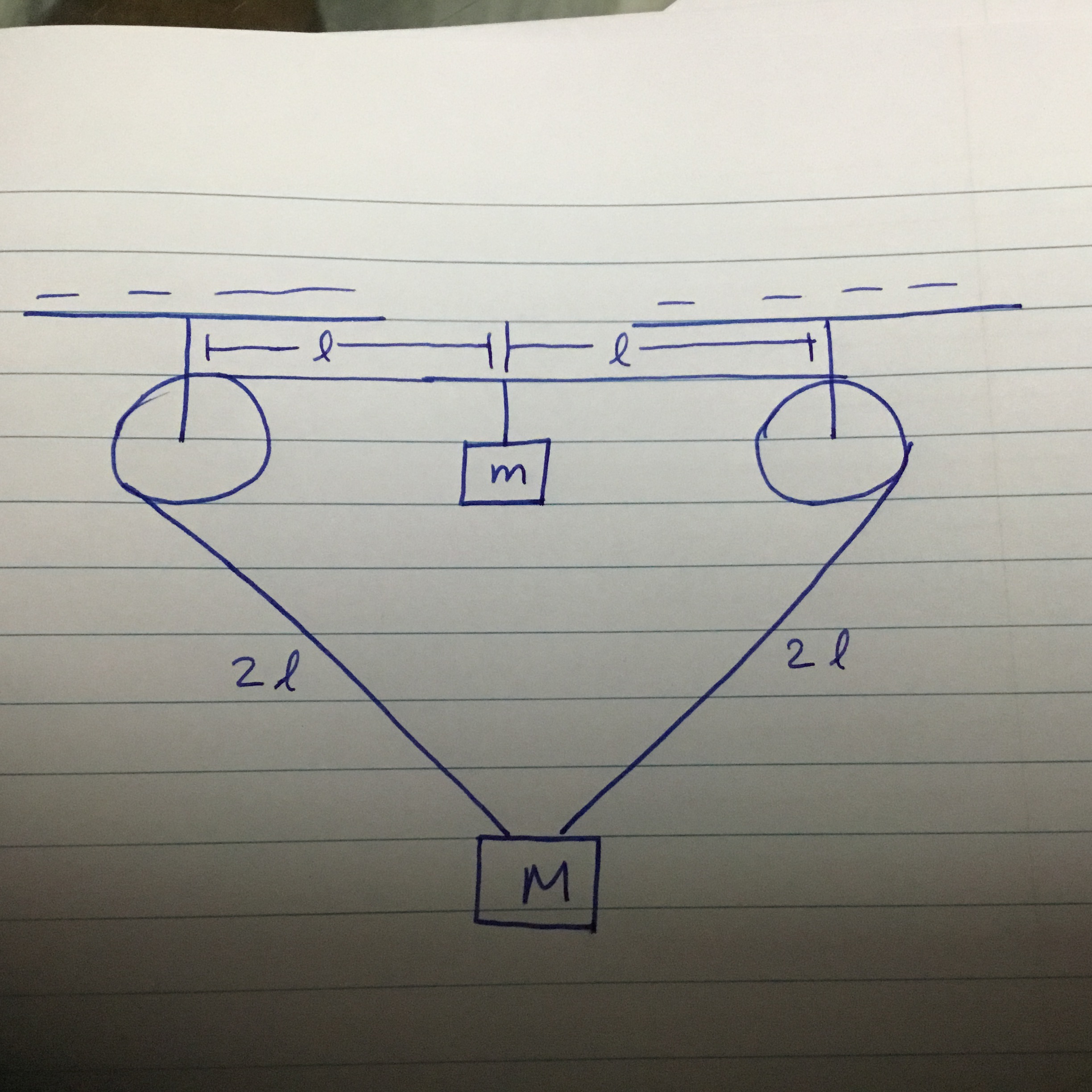
To tackle the problem of determining the minimum value of the mass ratio \( \frac{m}{M} \) when two objects collide after being released from rest, we need to consider the principles of conservation of momentum and energy, as well as the conditions for a collision. Let's break this down step by step.
Understanding the Scenario
We have two objects: one with mass \( M \) and another with mass \( m \). Both are initially at rest and are set free, presumably from some height, allowing them to fall under the influence of gravity. When they collide, we want to find the minimum ratio \( \frac{m}{M} \) that allows for this collision to occur.
Key Concepts
- Conservation of Momentum: The total momentum before the collision must equal the total momentum after the collision.
- Gravitational Potential Energy: The potential energy of the objects converts to kinetic energy as they fall.
- Collision Dynamics: The nature of the collision (elastic or inelastic) will affect the outcome.
Analyzing the Fall
Assuming both objects are released from the same height, they will fall under gravity, gaining kinetic energy as they descend. The potential energy lost by each object converts into kinetic energy:
The potential energy (PE) for each object at height \( h \) is given by:
PE = mgh \quad \text{(for mass \( m \))}
PE = Mgh \quad \text{(for mass \( M \))}
As they fall, this potential energy converts to kinetic energy (KE):
KE = \( \frac{1}{2}mv^2 \) for mass \( m \
KE = \( \frac{1}{2}Mv^2 \) for mass \( M \
Collision Conditions
For the objects to collide, they must reach the same vertical position at the same time. This means that the time taken for both to fall must be equal. The time of fall \( t \) for an object falling from rest is given by:
t = \( \sqrt{\frac{2h}{g}} \)
Since both objects are released simultaneously from the same height, they will reach the ground at the same time, assuming no air resistance. The velocities just before the collision can be calculated using:
v = gt
Momentum Conservation
At the moment of collision, we apply the conservation of momentum:
Initial momentum = Final momentum
0 = mv + MV (assuming they collide perfectly inelastically)
From this, we can derive the relationship between the masses:
mv + MV = 0
Thus, \( mv = -MV \)
From this, we can express \( \frac{m}{M} \) as:
\( \frac{m}{M} = -\frac{V}{v} \)
Finding the Minimum Ratio
To find the minimum value of \( \frac{m}{M} \), we need to consider the conditions under which the collision occurs. If \( m \) is too small compared to \( M \), the smaller mass may not have enough momentum to affect the larger mass significantly. Therefore, we can set a threshold where the momentum of \( m \) must be at least equal to that of \( M \) for a collision to occur.
By analyzing the velocities and applying the conservation laws, we can derive that:
\( \frac{m}{M} \geq 1 \)
This means that the minimum value of \( \frac{m}{M} \) must be at least 1 for a collision to happen effectively. If \( m \) is less than \( M \), the smaller mass will not be able to exert enough force to cause a significant collision.
Conclusion
In summary, the minimum value of \( \frac{m}{M} \) for the objects to collide after being released from rest is 1. This ensures that both masses can interact effectively during the collision, allowing for the conservation of momentum to hold true. Understanding these principles helps in analyzing various physical scenarios involving collisions and motion.