

Grade 11Mechanics
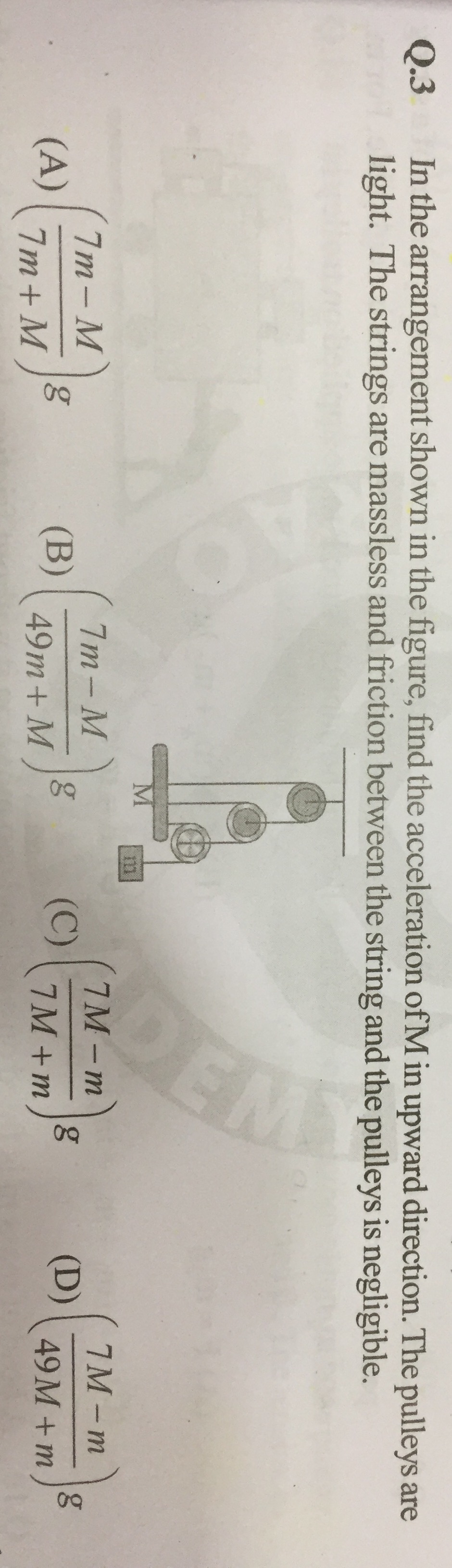
In the arrangement shown in the figure , find acceleration
In the arrangement shown in the figure , find acceleration


 Approved Tutor Answer1 Year ago
To determine the acceleration in the arrangement you mentioned, we first need to clarify the specifics of the system you're referring to. Typically, such problems involve objects connected by strings, pulleys, or forces acting on them. Let's break down the process step by step, assuming a common scenario where two masses are connected by a pulley.
Imagine we have two masses, \( m_1 \) and \( m_2 \), connected by a light, inextensible string over a frictionless pulley. The gravitational force acts on both masses. If \( m_1 \) is hanging vertically and \( m_2 \) is on a horizontal surface, the forces acting on each mass will dictate the system's acceleration.
For mass \( m_1 \), the forces acting on it are:
For mass \( m_2 \), the forces are:
We can apply Newton's second law, \( F = ma \), to both masses. For mass \( m_1 \), the equation becomes:
1. For \( m_1 \):
\( m_1 \cdot g - T = m_1 \cdot a \)
For mass \( m_2 \), the equation is:
2. For \( m_2 \):
\( T = m_2 \cdot a \)
Now we have two equations with two unknowns: \( T \) (tension) and \( a \) (acceleration). We can solve these equations simultaneously.
From equation 2, we can express \( T \) in terms of \( a \):
3. Rearranging:
\( T = m_2 \cdot a \)
Now, substitute equation 3 into equation 1:
4. Substituting:
\( m_1 \cdot g - m_2 \cdot a = m_1 \cdot a \)
Rearranging this gives us:
5. Combining terms:
\( m_1 \cdot g = m_1 \cdot a + m_2 \cdot a \)
6. Factoring out \( a \):
\( m_1 \cdot g = (m_1 + m_2) \cdot a \)
Now, we can solve for \( a \):
7. Final equation:
\( a = \frac{m_1 \cdot g}{m_1 + m_2} \)
This formula gives you the acceleration of the system based on the masses and the acceleration due to gravity. If you have specific values for \( m_1 \) and \( m_2 \), you can plug them into this equation to find the acceleration.
For instance, if \( m_1 = 5 \, \text{kg} \) and \( m_2 = 3 \, \text{kg} \), and using \( g = 9.81 \, \text{m/s}^2 \):
8. Plugging in values:
\( a = \frac{5 \cdot 9.81}{5 + 3} = \frac{49.05}{8} = 6.13 \, \text{m/s}^2 \)
This result indicates the acceleration of the system. If you have a different arrangement or additional forces, please provide those details, and we can adjust the analysis accordingly!

Three identical balls are placed on a frictionless
horizontal surface touching each other. They stick to
each other because of adhesive. Another ball of same
radius and mass m is placed over the void created by
the three balls. Find the forces applied by the balls
kept on the floor to each other if the system remains
in equilibrium.
Last Activity: 9 Months ago
A car loaded with water having total mass 1000 kg moves on a straight horizontal Road starting from rest under the action of a force of 100 Newton. The water spills throw a small hole in the bottom at a rate of 0.1 KG per second the velocity of cart after 300 seconds is nearly.
11
21
31
41
Last Activity: 10 Months ago
Last Activity: 3 Years ago
Last Activity: 3 Years ago