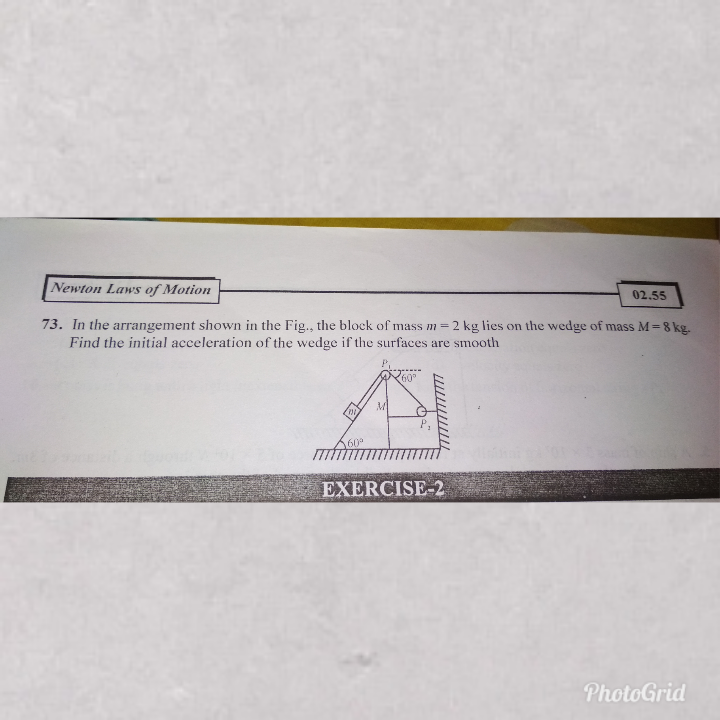
To determine the initial acceleration of the wedge when a block is placed on it, we need to analyze the forces acting on both the block and the wedge. Given that the surfaces are smooth, we can assume there is no friction between the block and the wedge. Let's break down the problem step by step.
Understanding the System
We have two masses: a block of mass \( m = 2 \, \text{kg} \) resting on a wedge of mass \( M = 8 \, \text{kg} \). The wedge is inclined, and we need to find the acceleration of the wedge when the block is released. The key here is to recognize that the block will slide down the wedge due to gravity, and this will cause the wedge to accelerate in the opposite direction.
Forces Acting on the Block
The forces acting on the block include:
- The gravitational force acting downward, \( F_g = mg = 2 \times 9.81 = 19.62 \, \text{N} \).
- The normal force \( N \) exerted by the wedge on the block, which acts perpendicular to the surface of the wedge.
Since the wedge is inclined, we can resolve the gravitational force into two components: one parallel to the incline and one perpendicular to it. If we denote the angle of inclination of the wedge as \( \theta \), the components are:
- Perpendicular to the incline: \( F_{\perp} = mg \cos(\theta) \)
- Parallel to the incline: \( F_{\parallel} = mg \sin(\theta) \)
Forces Acting on the Wedge
The wedge experiences a reaction force due to the normal force from the block. This normal force can be expressed as:
Normal Force: \( N = mg \cos(\theta) \)
This normal force will cause the wedge to accelerate horizontally. According to Newton's second law, the acceleration \( a \) of the wedge can be determined by:
Net Force on Wedge: \( F_{net} = N \)
Acceleration of Wedge: \( M a = N \)
Calculating the Acceleration
Now, substituting the expression for the normal force into the equation for the wedge's acceleration:
Acceleration of Wedge: \( a = \frac{N}{M} = \frac{mg \cos(\theta)}{M} \)
Substituting the known values:
Mass of Block: \( m = 2 \, \text{kg} \)
Mass of Wedge: \( M = 8 \, \text{kg} \)
Acceleration due to Gravity: \( g = 9.81 \, \text{m/s}^2 \)
Final Expression
Thus, the acceleration of the wedge can be expressed as:
Acceleration: \( a = \frac{(2)(9.81) \cos(\theta)}{8} \)
To find the numerical value of \( a \), we need the angle \( \theta \). If \( \theta \) is provided, we can calculate the exact acceleration. For example, if \( \theta = 30^\circ \):
Cosine of 30 degrees: \( \cos(30^\circ) = \frac{\sqrt{3}}{2} \approx 0.866 \)
Substituting this value:
Acceleration: \( a = \frac{(2)(9.81)(0.866)}{8} \approx 2.12 \, \text{m/s}^2 \)
In summary, the initial acceleration of the wedge depends on the angle of inclination and can be calculated using the above formula. If you have the angle, you can plug it in to find the exact acceleration.