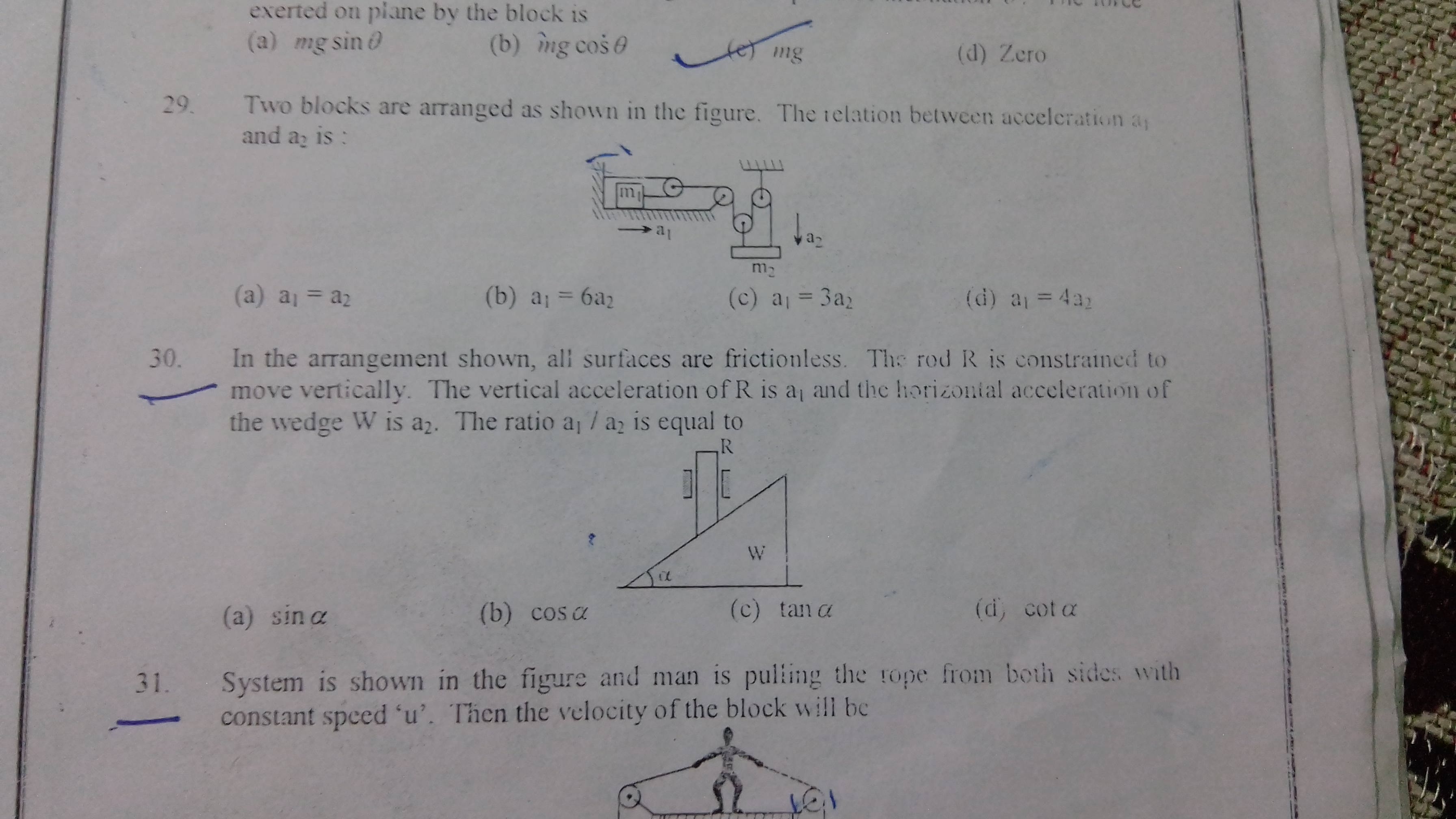
To solve the problem regarding the vertical acceleration of rod R and the horizontal acceleration of wedge W, we need to analyze the system's dynamics carefully. Since all surfaces are frictionless, we can apply Newton's laws of motion and the principles of kinematics to derive the relationship between the accelerations.
Understanding the System
In this scenario, we have a wedge that can move horizontally and a rod that can move vertically. The key is to recognize how the movements of these two components are related due to the constraints of the system.
Setting Up the Relationship
Let’s denote:
- a1: the vertical acceleration of the rod R
- a2: the horizontal acceleration of the wedge W
Since the rod is constrained to move vertically, any vertical movement of the rod will affect the horizontal position of the wedge. Specifically, as the rod moves down, the wedge must also move horizontally to maintain the system's balance.
Using Geometry to Relate Accelerations
Consider the geometry of the situation. If the rod makes an angle θ with the horizontal, the vertical movement of the rod can be related to the horizontal movement of the wedge through trigonometric relationships. For small angles, we can use the following relationships:
- The vertical displacement of the rod is related to the horizontal displacement of the wedge by the tangent of the angle: tan(θ) = vertical displacement / horizontal displacement.
- In terms of acceleration, we can express this as: a1 = a2 * tan(θ).
Finding the Ratio of Accelerations
From the relationship derived above, we can rearrange the equation to find the ratio of the accelerations:
a1/a2 = tan(θ)
This means that the ratio of the vertical acceleration of the rod to the horizontal acceleration of the wedge depends directly on the angle θ at which the rod is positioned relative to the horizontal.
Conclusion
In summary, the ratio of the vertical acceleration of rod R to the horizontal acceleration of wedge W is given by the tangent of the angle θ. This relationship highlights how the movements of interconnected components in a frictionless environment can be analyzed using basic principles of physics and geometry.