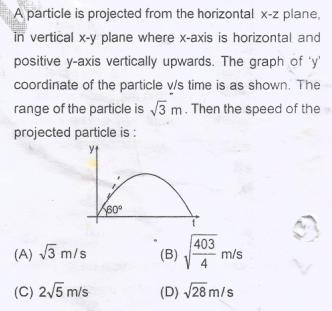
It sounds like you're grappling with a problem involving motion, possibly in a physics context. Let's break down the situation step by step to clarify the confusion surrounding the value of 'x' and the corresponding options provided.
Understanding the Problem
From what you've described, it seems that you have a scenario where 'x' represents a distance, and you're trying to determine the initial velocity 'u' based on that distance. If Vikas TU suggested that 'x' equals 80 m, we need to analyze how that relates to the other values and the answer key.
Analyzing the Given Values
First, let's consider the relationship between distance, initial velocity, and final velocity in motion. The equations of motion can help us here. One common equation is:
Where:
- s = distance (x)
- u = initial velocity
- a = acceleration
- t = time
If we assume there is no acceleration (a = 0), the equation simplifies to:
Calculating Initial Velocity
Given that 'x' is 80 m, if we assume a time 't' of 8 seconds (for example), we can rearrange the equation to find 'u':
- u = s/t = 80 m / 8 s = 10 m/s
However, you mentioned that there is no option for 10 m/s. This discrepancy suggests that either the time value is different or there is an acceleration involved that we haven't accounted for.
Exploring the Answer Key
The answer key indicates D) √28 m/s. Let's calculate what this value is:
This value is significantly lower than the 10 m/s we calculated. If we consider the possibility of acceleration, we can use another equation of motion:
Where 'v' is the final velocity. If we assume a final velocity of √28 m/s and solve for 'u' with 's' as 80 m, we can rearrange the equation:
Substituting the values:
- u² = (√28)² - 2a(80)
- u² = 28 - 160a
From this, we can see that the initial velocity 'u' depends heavily on the acceleration 'a'. If 'a' is negative (deceleration), it could lead to a lower initial velocity. Without knowing the acceleration, we can't definitively conclude the initial velocity.
Final Thoughts
To resolve your confusion, I recommend checking the problem statement for any details regarding acceleration or time. If those values are provided, you can plug them into the equations to find a consistent answer. If not, it may be worth discussing with your instructor for clarification on the expected conditions of the problem.