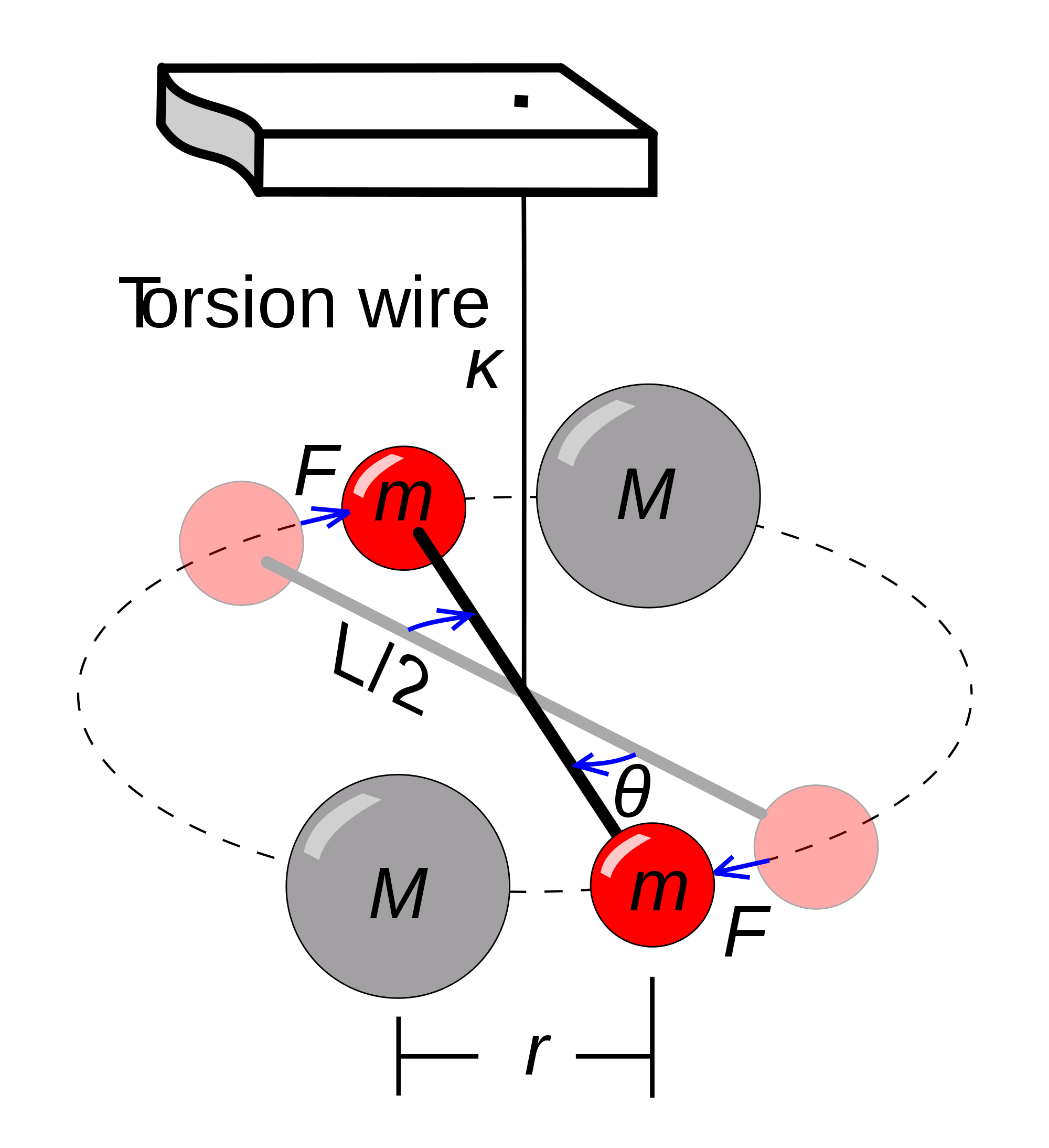
The Cavendish experiment is a fascinating setup that allows us to measure the gravitational constant, G, by observing the tiny forces between masses. You’re right to point out that each large sphere attracts not only the small sphere closest to it but also the small sphere on the opposite end of the rod. This additional attraction does have implications for the measurement of G, and understanding these effects is crucial for interpreting the results accurately.
Understanding the Forces at Play
In the Cavendish experiment, we have two large lead spheres and two smaller lead spheres attached to a horizontal bar, which is suspended from a thin wire. The gravitational attraction between the large and small spheres causes the bar to twist, and this twist is measured to determine the gravitational constant.
Attraction from Both Ends
When we consider the gravitational attraction from both large spheres, it’s important to recognize that the force exerted by each large sphere on the small sphere is not isolated. The small sphere closest to a large sphere experiences a stronger gravitational pull compared to the one on the opposite end. However, the small sphere on the opposite end also experiences a gravitational attraction from the large sphere that is closest to it.
- Net Force Calculation: The net gravitational force acting on each small sphere is the vector sum of the forces from both large spheres. This means that the attraction from the opposite large sphere can slightly alter the effective force measured.
- Torque Consideration: The torque generated by the forces is what causes the bar to rotate. If both large spheres exert forces on the small spheres, the resulting torque must be calculated considering both attractions. This can complicate the calculations if not accounted for properly.
Impact on Measurement of G
The gravitational constant G is derived from the relationship between the measured torque and the gravitational force. If the attraction from the opposite large sphere is not considered, it could lead to an underestimation or overestimation of the gravitational force acting on the small spheres. This, in turn, affects the calculated value of G.
To mitigate this effect, experimenters often take into account the contributions from both large spheres when analyzing the data. By carefully measuring the angles of deflection and applying corrections for the additional forces, they can arrive at a more accurate value for G.
Practical Example
Imagine you have two magnets on either side of a small metal ball. If you only consider the force from the magnet closest to the ball, you might think the ball is only being pulled in one direction. However, the magnet on the opposite side is also exerting a force, albeit weaker due to distance. If you want to measure how strongly the ball is being pulled, you need to account for both magnets. Similarly, in the Cavendish experiment, neglecting the attraction from the opposite large sphere could skew the results.
Final Thoughts
In summary, while the Cavendish experiment primarily focuses on the attraction between the closest large and small spheres, the gravitational pull from the opposite large sphere cannot be ignored. Properly accounting for these forces ensures that the measurement of G is as accurate as possible, allowing us to better understand the fundamental nature of gravity.