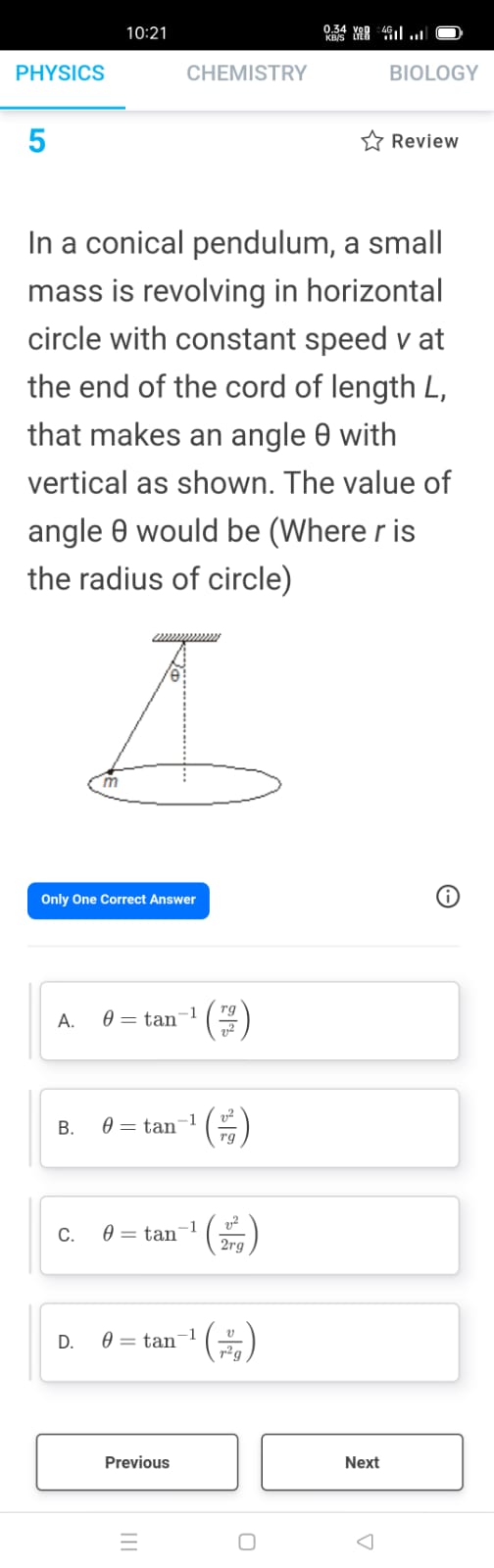
In a conical pendulum, the motion of the mass involves both circular motion and the effects of gravity. To find the angle θ that the cord makes with the vertical, we can analyze the forces acting on the mass and apply some trigonometric relationships. Let's break it down step by step.
Understanding the Forces
When the mass is in motion, two main forces act on it:
- Gravitational Force (Weight): This acts downward and is equal to mg, where m is the mass and g is the acceleration due to gravity.
- Tension in the Cord: This force acts along the cord and has two components: one that balances the gravitational force and another that provides the centripetal force necessary for circular motion.
Breaking Down the Tension
The tension (T) in the cord can be resolved into two components:
- The vertical component: T cos(θ), which balances the weight of the mass (mg).
- The horizontal component: T sin(θ), which provides the centripetal force required for circular motion.
Setting Up the Equations
From the vertical balance of forces, we have:
T cos(θ) = mg
From the horizontal component providing centripetal force, we have:
T sin(θ) = m(v²/r)
where r is the radius of the circular path, which can be expressed as r = L sin(θ).
Substituting and Simplifying
Now, we can substitute r in the centripetal force equation:
T sin(θ) = m(v²/(L sin(θ)))
Now we have two equations:
- T cos(θ) = mg
- T sin(θ) = m(v²/(L sin(θ)))
We can solve for T from the first equation:
T = mg/cos(θ)
Combining the Equations
Substituting T into the second equation gives:
(mg/cos(θ)) sin(θ) = m(v²/(L sin(θ)))
We can cancel m from both sides (assuming m ≠ 0):
(g sin(θ))/cos(θ) = v²/(L sin(θ))
Rearranging this leads to:
g sin²(θ) = v²/(L cos(θ))
Finding the Angle θ
To isolate θ, we can rearrange the equation:
g L sin²(θ) = v² cos(θ)
This equation can be solved numerically or graphically for θ, depending on the values of g, L, and v. However, a common approach is to use the relationship between the angle and the radius:
tan(θ) = r/(L cos(θ))
In summary, the angle θ can be determined by analyzing the balance of forces and using trigonometric identities. The relationship between the radius, length of the cord, and the speed of the mass is crucial in finding the exact value of θ in a conical pendulum setup.