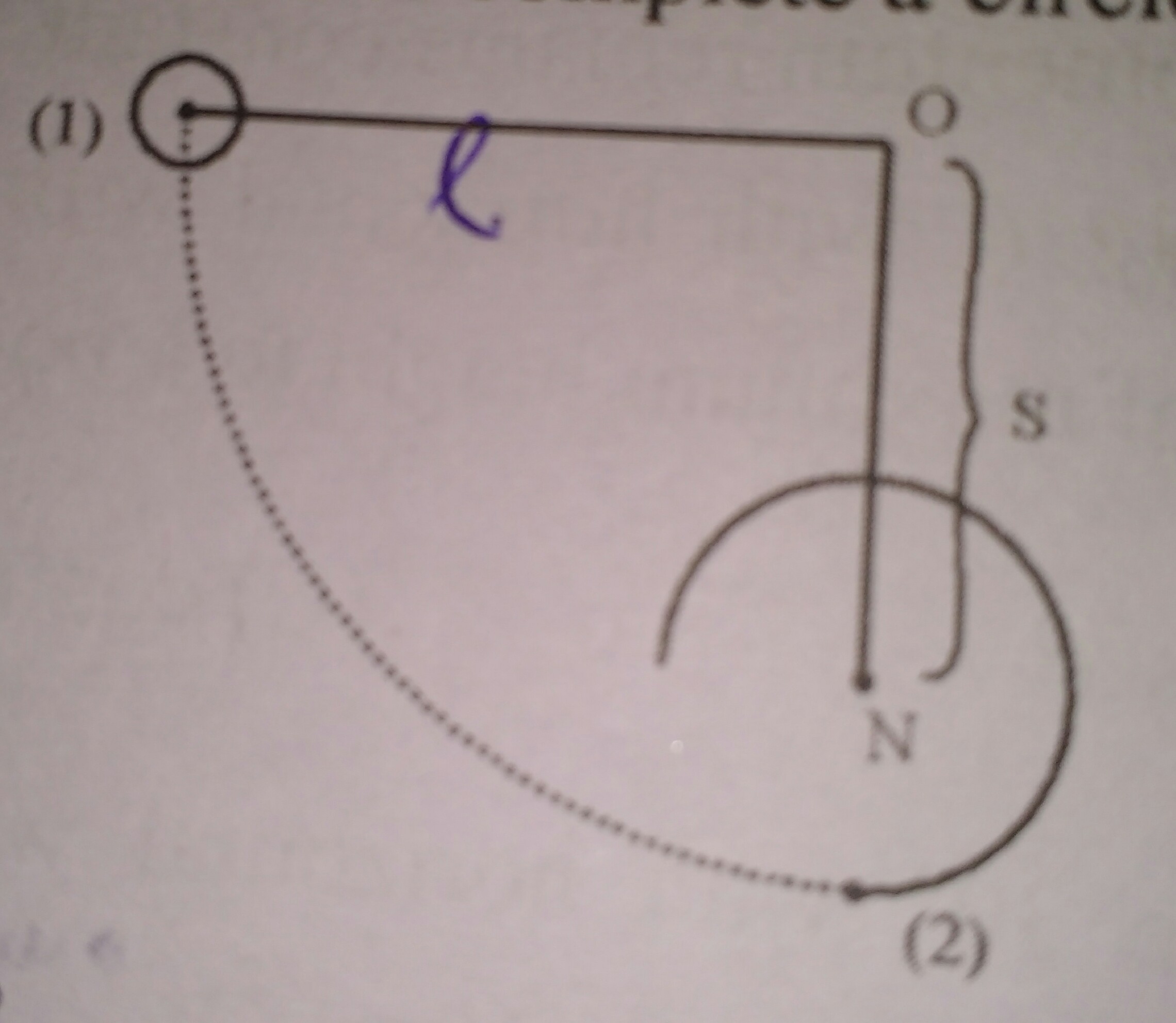
To determine the distance \( S \) below point \( O \) where the nail should be placed for the bob to complete a circular motion around it, we can analyze the forces and energy involved in the motion of the bob. Let's break this down step by step.
Understanding the Motion of the Bob
When the bob of mass \( m \) is released from a horizontal position, it starts to swing downwards due to gravity. As it reaches the lowest point, it has converted its potential energy into kinetic energy. For the bob to complete a circular motion around the nail, it must have enough speed at the top of the circle to maintain tension in the string.
Energy Conservation Principle
Initially, when the bob is at the horizontal position, its potential energy (PE) is given by:
- PE_initial = \( mgh \), where \( h = l \) (the length of the string).
As the bob swings down to the lowest point, all this potential energy converts into kinetic energy (KE):
- KE = \( \frac{1}{2}mv^2 \).
At the lowest point, we can set the initial potential energy equal to the kinetic energy:
- mgl = \( \frac{1}{2}mv^2 \).
From this, we can solve for the speed \( v \) of the bob at the lowest point:
Conditions for Completing the Circle
For the bob to complete a circular motion around the nail, at the top of the circle, the centripetal force must be sufficient to keep the bob in circular motion. The forces acting on the bob at the top of the circle include gravitational force and tension in the string. The minimum speed \( v_{top} \) required at the top of the circle can be derived from the centripetal force equation:
- mg = \( \frac{mv_{top}^2}{r} \), where \( r \) is the radius of the circle (which is \( l \)).
From this, we find:
- v_{top} = \( \sqrt{gl} \).
Relating the Speeds
Now, we need to relate the speed at the lowest point to the speed at the top of the circle. Using conservation of energy again, we can say:
- PE at the lowest point = KE at the top of the circle + PE at the top of the circle.
At the top of the circle, the height is \( 2l \) (since it is \( l \) above the nail and \( l \) below the point \( O \)). Thus:
- mgl = \( \frac{1}{2}mv_{top}^2 + mg(2l) \).
Substituting \( v_{top} = \sqrt{gl} \) into the equation gives:
- mgl = \( \frac{1}{2}m(gl) + mg(2l) \).
Solving this equation will allow us to find the height \( S \) below point \( O \) where the nail should be placed. After simplifying, we find:
Final Result
Therefore, the distance \( S \) below point \( O \) where the nail should be placed for the bob to complete a circular motion around it is \( \frac{l}{2} \). This ensures that the bob has enough speed at the top of the circle to maintain tension in the string and complete the motion successfully.