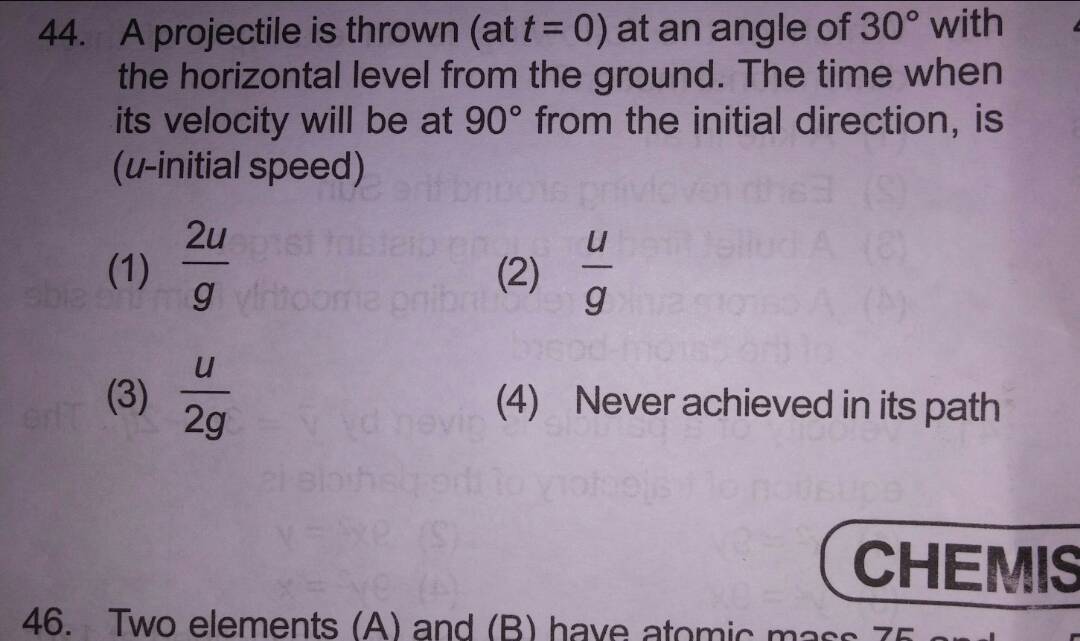
It sounds like you're grappling with a problem related to projectile motion, specifically concerning the angles between initial and final velocities. Let's break this down step by step to clarify how the final velocity can indeed make a 90° angle with the initial velocity, even if the angle between the velocity and the horizontal varies as you described.
Understanding Projectile Motion
In projectile motion, an object is launched into the air and moves under the influence of gravity. The motion can be analyzed in two dimensions: horizontal and vertical. The key points to remember are:
- The horizontal component of velocity remains constant (ignoring air resistance).
- The vertical component of velocity changes due to gravitational acceleration.
Initial and Final Velocities
When you launch a projectile, it has an initial velocity that can be broken down into two components:
- Horizontal Component (Vx): This remains constant throughout the flight.
- Vertical Component (Vy): This changes as the projectile rises and falls.
At the peak of its trajectory, the vertical component of the velocity becomes zero, but the horizontal component remains unchanged. As the projectile descends, the vertical component becomes negative (downward direction).
Analyzing the Angles
Now, let’s focus on the angles. You mentioned that the angle between the velocity and the horizontal varies from 30° to 0° and back to 30°. This is indeed true during the ascent and descent phases of the projectile's flight. However, the final velocity vector at the point of impact can be analyzed differently.
Final Velocity Vector
When the projectile hits the ground, its final velocity vector is directed downward. If we consider the initial velocity vector, which is at an angle (let's say 30° above the horizontal), the final velocity vector can be represented as:
- Initial Velocity (Vi) at 30° above the horizontal.
- Final Velocity (Vf) directed straight down (90° to the horizontal).
Even though the projectile's path involves angles of 30° and 0°, the final velocity vector can indeed be perpendicular to the initial velocity vector. This is because the final velocity vector's direction is influenced by the vertical motion, which is entirely downward at the moment of impact.
Visualizing the Concept
To visualize this, imagine a right triangle where:
- The initial velocity vector forms one side of the triangle.
- The final velocity vector, directed straight down, forms the other side.
When you draw these vectors, you can see that they can indeed be perpendicular to each other, resulting in a 90° angle between them at the moment of impact.
Conclusion
In summary, while the angle between the velocity and the horizontal changes during the flight, the final velocity can be perpendicular to the initial velocity due to the nature of projectile motion. This is why the correct answer is (3), as the final velocity can indeed make a 90° angle with the initial velocity vector at the moment of impact. Understanding these dynamics is crucial in mastering projectile motion concepts!