

Grade 11Mechanics
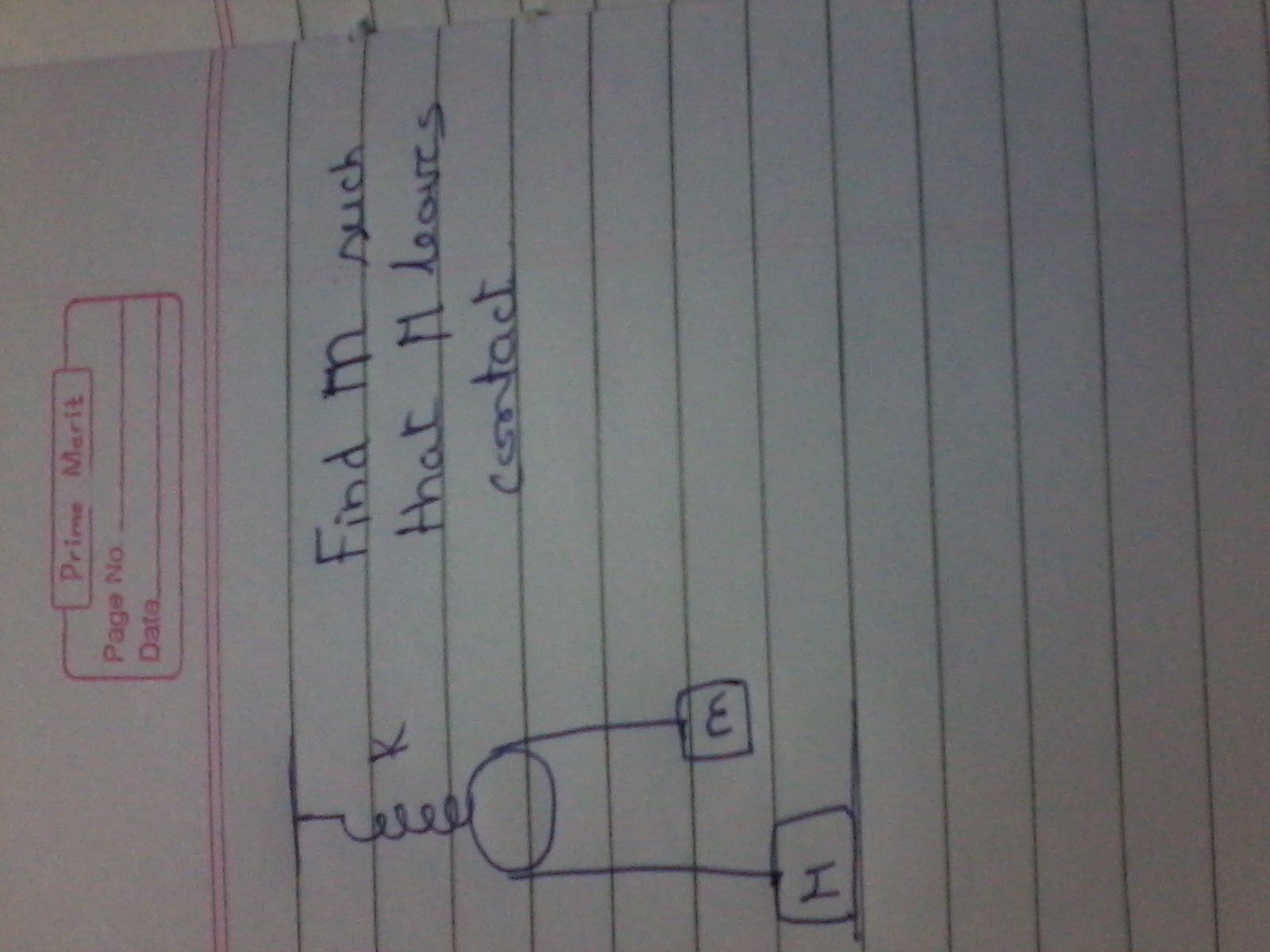
I am unable to go about problems from work particularly those which involve constraints and springs
I am unable to go about problems from work particularly those which involve constraints and springs


 Approved Tutor Answer1 Year ago
It sounds like you're grappling with some challenging concepts related to constraints and springs in your work problems. Let's break this down step by step to clarify these ideas and help you tackle similar problems more effectively.
In the context of physics and engineering, a constraint is a condition that limits the motion of a system. Constraints can be categorized into two main types: holonomic and non-holonomic. Holonomic constraints depend only on the positions of the system, while non-holonomic constraints involve velocities or other factors.
Springs are fascinating components in mechanics, and they follow Hooke's Law, which states that the force exerted by a spring is proportional to its displacement from the equilibrium position. This relationship can be expressed mathematically as:
F = -kx
Here, F is the force exerted by the spring, k is the spring constant (a measure of the spring's stiffness), and x is the displacement from the equilibrium position.
When solving problems involving springs, it’s essential to identify the spring constant and the displacement. For example, if you have a spring with a spring constant of 200 N/m that is compressed by 0.1 meters, the force exerted by the spring can be calculated as follows:
F = -kx = -200 N/m * 0.1 m = -20 N
The negative sign indicates that the force exerted by the spring is in the opposite direction of the displacement.
When you encounter problems that involve both constraints and springs, it’s crucial to analyze the system carefully. Start by identifying all the forces acting on the system, including gravitational forces, spring forces, and any external forces. Then, apply the principles of equilibrium or dynamics as needed.
Imagine a block attached to a spring on a frictionless surface. If the spring is compressed and then released, you can analyze the motion of the block using both the spring force and the constraints of the system. Here’s how you might approach it:
By following these steps, you can systematically solve problems involving constraints and springs. Remember, practice is key, so try working through various examples to build your confidence and understanding.

Three identical balls are placed on a frictionless
horizontal surface touching each other. They stick to
each other because of adhesive. Another ball of same
radius and mass m is placed over the void created by
the three balls. Find the forces applied by the balls
kept on the floor to each other if the system remains
in equilibrium.
Last Activity: 10 Months ago
A car loaded with water having total mass 1000 kg moves on a straight horizontal Road starting from rest under the action of a force of 100 Newton. The water spills throw a small hole in the bottom at a rate of 0.1 KG per second the velocity of cart after 300 seconds is nearly.
11
21
31
41
Last Activity: 10 Months ago
Last Activity: 3 Years ago
Last Activity: 3 Years ago