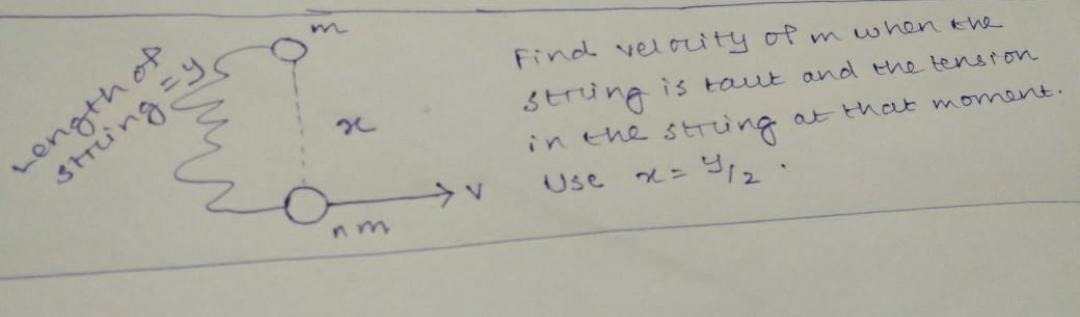
To tackle this question, we need to break down the concepts of velocity components, tension, and work done in a system involving strings and masses. Let's clarify the situation step by step.
Understanding Velocity Components
When we talk about velocity components, we often refer to how the total velocity of an object can be broken down into different directions. For instance, if an object is moving in a two-dimensional plane, its velocity can be split into components along the x-axis and y-axis. In your case, we are particularly interested in the component of velocity along the direction of the string and the component perpendicular to it.
Work Done by Tension
Work is defined as the force applied to an object times the distance over which that force is applied, and it is calculated as:
- Work = Force × Distance × cos(θ)
Here, θ is the angle between the force and the direction of movement. If the tension in the string is acting perpendicular to the direction of motion, then θ = 90 degrees, and cos(90°) = 0. This means that the work done by the tension is indeed zero. Therefore, the component of velocity along the direction of the string can change, but the component perpendicular to it remains unaffected by the tension.
Effect of Mass Loss on Velocity
Now, regarding the mass loss and its effect on velocity, let’s consider a scenario where a mass (m) loses a small amount of velocity (dv). If this mass is connected to a string and experiences a change in velocity, we need to think about conservation of momentum. If the mass loses velocity, it implies that there is a change in its momentum.
According to the principle of conservation of momentum, if one part of the system (the mass) loses momentum, another part (the string or another mass connected to it) must gain momentum to keep the total momentum of the system constant. Therefore, if the mass loses a velocity component along the string, it is reasonable to expect that another mass or component in the system will gain that same amount of velocity along the direction of the string.
Putting It All Together
In summary, when tension does no work (as it is perpendicular to the motion), the velocity component along the string can change while the perpendicular component remains constant. If a mass loses velocity, it is indeed necessary for another part of the system to gain that velocity to satisfy the conservation of momentum. This interplay of forces and motion is fundamental in understanding dynamics in systems involving strings and masses.
By analyzing these components and their interactions, you can gain a clearer understanding of how forces affect motion in such systems. If you have any further questions or need clarification on any specific point, feel free to ask!