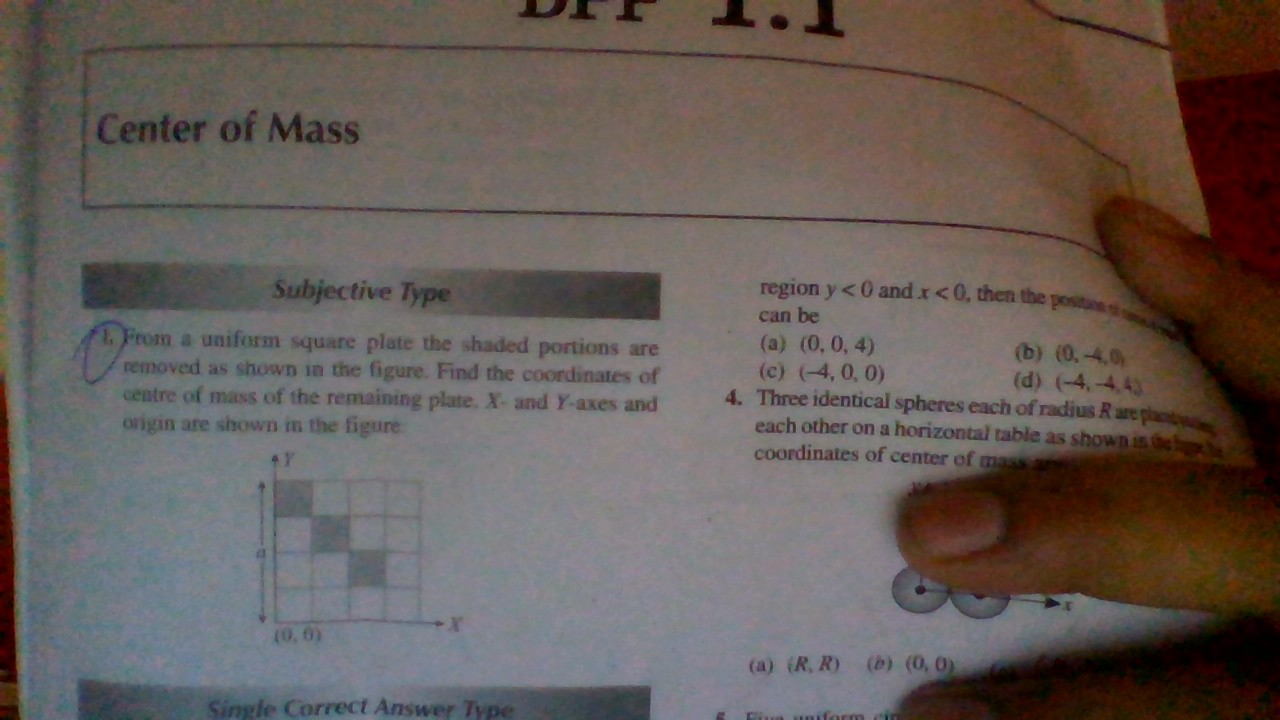
To find the coordinates of the center of mass of the remaining portion of a uniform square plate after certain shaded areas are removed, we can use the concept of composite bodies. The center of mass of the remaining shape can be determined by considering the original square plate and subtracting the areas that have been removed. Let’s break this down step by step.
Understanding the Problem
Assuming we have a square plate with a side length of 'a', the total area of the square is \( A = a^2 \). When portions of this plate are removed, we need to calculate the center of mass of both the original square and the removed sections to find the center of mass of the remaining area.
Step 1: Identify the Original Center of Mass
The center of mass of a uniform square plate is located at its geometric center. For a square with vertices at (0,0), (a,0), (a,a), and (0,a), the coordinates of the center of mass (CM) are:
- CM_x = \( \frac{a}{2} \)
- CM_y = \( \frac{a}{2} \)
Step 2: Calculate the Area and Center of Mass of Removed Portions
Let’s denote the areas that are removed as \( A_1, A_2, \ldots, A_n \) with their respective centers of mass at coordinates \( (x_1, y_1), (x_2, y_2), \ldots, (x_n, y_n) \). The area of each removed section can be calculated based on its shape (e.g., rectangles, circles, etc.). The center of mass for each removed area can be determined using geometric properties.
Step 3: Use the Composite Body Method
To find the center of mass of the remaining area, we can apply the formula for the center of mass of composite bodies:
- Let \( A_{total} \) be the total area of the original square.
- Let \( A_{removed} \) be the total area of the removed sections.
- Let \( A_{remaining} = A_{total} - A_{removed} \).
The coordinates of the center of mass of the remaining area can be calculated using the following equations:
- CM_x = \( \frac{A_{total} \cdot CM_{x, original} - \sum (A_i \cdot x_i)}{A_{remaining}} \)
- CM_y = \( \frac{A_{total} \cdot CM_{y, original} - \sum (A_i \cdot y_i)}{A_{remaining}} \)
Step 4: Substitute Values and Solve
Now, substitute the values you have for the areas and their respective centers of mass into the equations. For example, if you removed two rectangular sections with areas \( A_1 \) and \( A_2 \) and their centers of mass at \( (x_1, y_1) \) and \( (x_2, y_2) \), you would plug those into the equations. This will yield the coordinates of the center of mass of the remaining plate.
Example Calculation
Suppose you have a square plate of side length 4 (so \( a = 4 \)), and you removed two rectangles: one with area 4 at (1, 1) and another with area 2 at (3, 3). The calculations would look like this:
- Original CM: \( (2, 2) \)
- Removed areas: \( A_1 = 4 \) at \( (1, 1) \), \( A_2 = 2 \) at \( (3, 3) \)
- Total area removed: \( A_{removed} = 4 + 2 = 6 \)
- Remaining area: \( A_{remaining} = 16 - 6 = 10 \)
Substituting into the center of mass equations will give you the new coordinates for the center of mass of the remaining area.
Final Thoughts
This method allows you to systematically approach the problem of finding the center of mass for complex shapes by breaking them down into simpler components. By understanding the contributions of both the original and removed areas, you can accurately determine the center of mass of the remaining portion of the plate.