
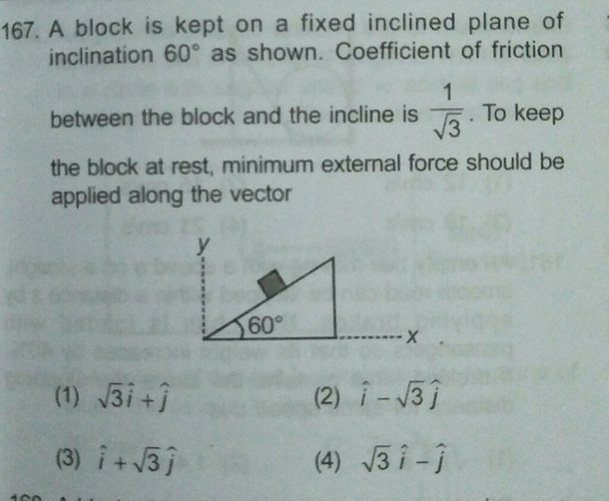
Finding minimum external force to be applied alongside vector
Finding minimum external force to be applied alongside vector

PULKIT DAMANI , 8 Years ago
Grade 12th Pass
 Mechanics> Finding minimum external force to be appl...
 1 Answers
To determine the minimum external force required to be applied alongside a vector, we first need to clarify what we mean by "alongside a vector." This typically involves understanding the relationship between the force vector and the direction of motion or another vector in a given scenario. Let's break this down step by step.
In physics, a vector is a quantity that has both magnitude and direction. Forces are also vectors, meaning they can be represented graphically as arrows. The direction of the force vector is crucial when analyzing how it interacts with other vectors, such as velocity or displacement vectors.
When we talk about applying a force alongside another vector, we often need to consider the components of the force. A force can be broken down into its components using trigonometric functions. For example, if you have a force vector F that makes an angle θ with the x-axis, its components can be expressed as:
To find the minimum external force that needs to be applied alongside a vector, we can use the concept of vector projection. If you have a force vector F and you want to apply it in the direction of another vector V, you can project F onto V. The formula for the projection of vector F onto vector V is given by:
Projection of F onto V = (F · V / |V|) * (V / |V|)
Here, F · V represents the dot product of the two vectors, and |V| is the magnitude of vector V. The result gives you the component of F that acts in the direction of V.
Imagine you have a box on a flat surface, and you want to push it in the direction of its motion, which is represented by vector V. If the box has a mass of 10 kg and you want to overcome static friction (let's say the coefficient of static friction is 0.5), you first calculate the force of friction:
Ffriction = μ * m * g = 0.5 * 10 kg * 9.81 m/s² = 49.05 N
To move the box, you need to apply a force greater than 49.05 N in the direction of vector V. Therefore, the minimum external force Fmin you need to apply alongside vector V is:
Fmin > 49.05 N
In summary, to find the minimum external force to be applied alongside a vector, you need to consider the direction of the vector, the forces acting on the object, and any opposing forces like friction. By using vector projections and understanding the components of forces, you can effectively determine the necessary force to achieve your goal. This approach not only applies to static scenarios but can also be extended to dynamic situations where acceleration and other forces come into play.
 Approved
Prepraring for the competition made easy just by live online class.

Full Live Access

Study Material

Live Doubts Solving

Daily Class Assignments

Three identical balls are placed on a frictionless
horizontal surface touching each other. They stick to
each other because of adhesive. Another ball of same
radius and mass m is placed over the void created by
the three balls. Find the forces applied by the balls
kept on the floor to each other if the system remains
in equilibrium.
Last Activity: 7 Months ago
A car loaded with water having total mass 1000 kg moves on a straight horizontal Road starting from rest under the action of a force of 100 Newton. The water spills throw a small hole in the bottom at a rate of 0.1 KG per second the velocity of cart after 300 seconds is nearly.
11
21
31
41
Last Activity: 7 Months ago
Last Activity: 3 Years ago
Last Activity: 3 Years ago
Last Activity: 3 Years ago