

Grade 11Mechanics
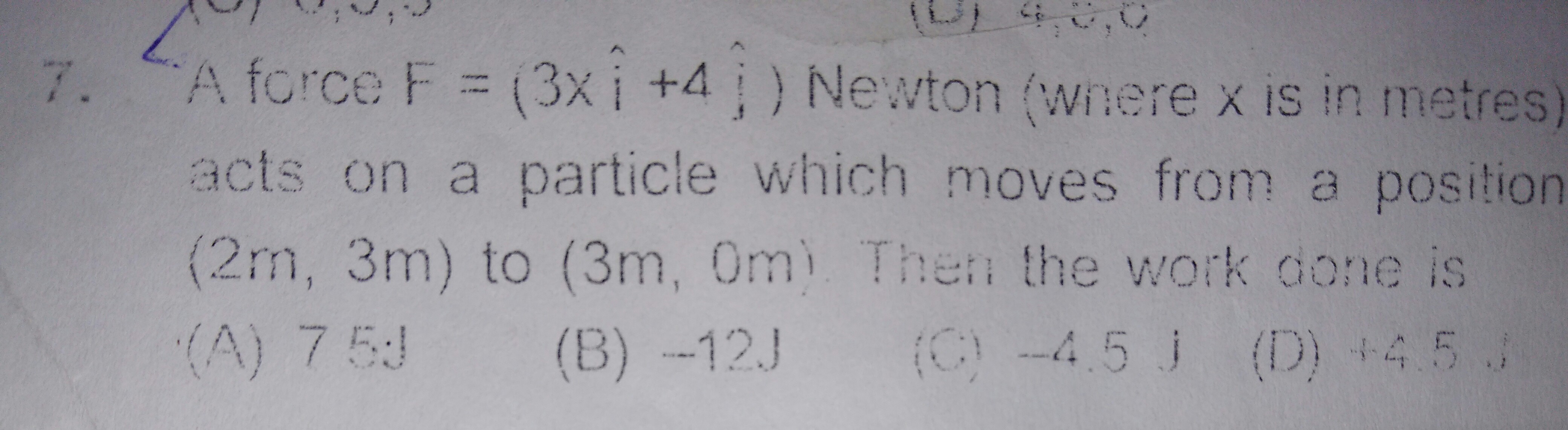
Find the work given in photo F = (3xi^+4j^) x is in meters particle moves from a position (2m,3m) to (3m,0m)


 Approved Tutor Answer1 Year ago
To find the work done by the force field \( \mathbf{F} = (3x \hat{i} + 4 \hat{j}) \) as a particle moves from the position \( (2 \, \text{m}, 3 \, \text{m}) \) to \( (3 \, \text{m}, 0 \, \text{m}) \), we can use the concept of line integrals. The work done by a force along a path is given by the integral of the force along that path. Let's break this down step by step.
The force field is defined as:
F = (3x) i + (4) j
Here, \( x \) is the x-coordinate of the particle's position, and \( \hat{i} \) and \( \hat{j} \) are the unit vectors in the x and y directions, respectively.
The particle moves from the point \( (2, 3) \) to \( (3, 0) \). We can describe this path parametrically. A simple way to do this is to use a linear interpolation between the two points:
Thus, the parametric equations for the path are:
x(t) = 2 + t
y(t) = 3 - 3t
where \( t \) ranges from \( 0 \) to \( 1 \).
The work done by the force along the path is given by the line integral:
W = ∫ F \cdot dr
Here, \( dr \) is the differential displacement vector along the path. We can express \( dr \) in terms of \( dt \):
dr = (dx, dy) = (dx/dt \, dt, dy/dt \, dt)
Calculating the derivatives:
Thus, we can express \( dr \) as:
dr = (1 \, dt, -3 \, dt) = (dt, -3 \, dt)
Now, we substitute \( x(t) \) into the force field:
F(t) = (3(2 + t) \hat{i} + 4 \hat{j}) = (6 + 3t) \hat{i} + 4 \hat{j}
Now we can compute the dot product \( F \cdot dr \):
F \cdot dr = ((6 + 3t) \hat{i} + 4 \hat{j}) \cdot (dt, -3 \, dt) = (6 + 3t) \cdot 1 \, dt + 4 \cdot (-3) \, dt
This simplifies to:
F \cdot dr = (6 + 3t - 12) \, dt = (3t - 6) \, dt
The work done is then:
W = ∫ (3t - 6) \, dt
We evaluate this integral from \( t = 0 \) to \( t = 1 \):
W = ∫ (3t - 6) \, dt = \left[ \frac{3}{2}t^2 - 6t \right]_{0}^{1}
Calculating the limits:
Thus, the work done is:
W = -\frac{9}{2} - 0 = -\frac{9}{2} \, \text{Joules}
The work done by the force field as the particle moves from \( (2 \, \text{m}, 3 \, \text{m}) \) to \( (3 \, \text{m}, 0 \, \text{m}) \) is \( -\frac{9}{2} \, \text{J} \) or \( -4.5 \, \text{J} \). This negative value indicates that the force is doing work against the motion of the particle.

Three identical balls are placed on a frictionless
horizontal surface touching each other. They stick to
each other because of adhesive. Another ball of same
radius and mass m is placed over the void created by
the three balls. Find the forces applied by the balls
kept on the floor to each other if the system remains
in equilibrium.
Last Activity: 10 Months ago
A car loaded with water having total mass 1000 kg moves on a straight horizontal Road starting from rest under the action of a force of 100 Newton. The water spills throw a small hole in the bottom at a rate of 0.1 KG per second the velocity of cart after 300 seconds is nearly.
11
21
31
41
Last Activity: 10 Months ago
Last Activity: 3 Years ago
Last Activity: 3 Years ago