

Grade 11Mechanics
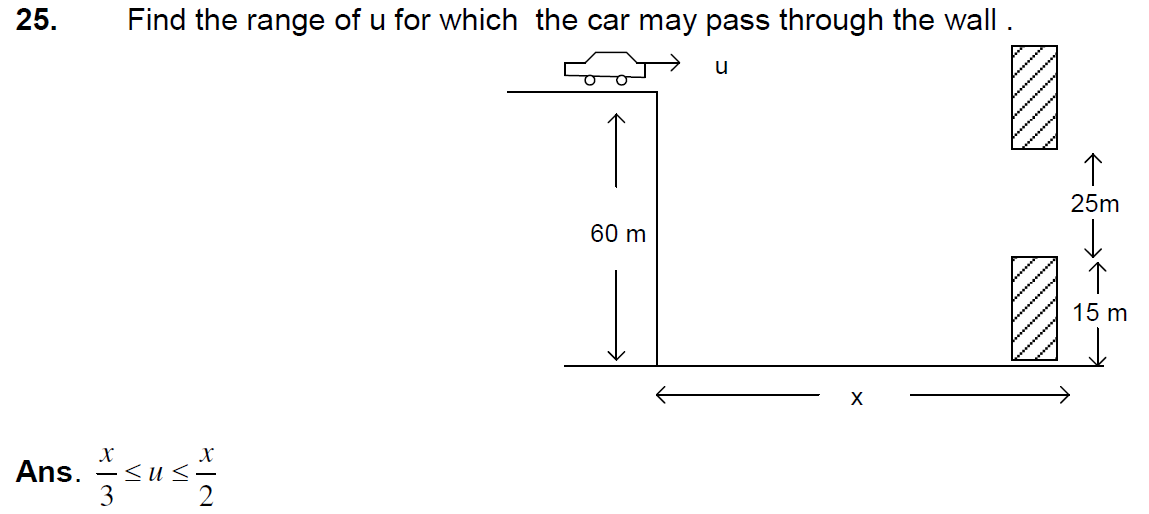
Find the range of u for which the car may pass through the wall .
Find the range of u for which the car may pass through the wall .


 Approved Tutor Answer1 Year ago
To determine the range of the variable \( u \) for which a car can pass through a wall, we need to consider the physics involved, particularly the concepts of motion and collision. This scenario typically involves analyzing the car's speed, the wall's position, and the forces at play during the collision. Let's break it down step by step.
Imagine a car approaching a wall at a certain speed, represented by \( u \). The key factors influencing whether the car can pass through the wall include:
In physics, when we talk about a car passing through a wall, we often refer to the concepts of kinetic energy and momentum. The kinetic energy (\( KE \)) of the car can be calculated using the formula:
KE = 0.5 * m * u²
Where \( m \) is the mass of the car and \( u \) is its speed. For the car to pass through the wall, its kinetic energy must be sufficient to overcome the wall's resistance.
Let’s assume the wall has a certain threshold of force it can withstand before breaking. This threshold can be represented as a force \( F \). The car's momentum, which is the product of its mass and velocity, must be enough to exert a force greater than this threshold upon impact.
The momentum (\( p \)) of the car is given by:
p = m * u
To find the minimum speed \( u \) required for the car to pass through the wall, we can set the momentum equal to the force exerted by the wall:
m * u = F
From this, we can solve for \( u \):
u = F / m
The range of \( u \) will depend on the specific values of \( F \) (the wall's force threshold) and \( m \) (the mass of the car). For example:
This means that the car must travel at a speed of at least 10 m/s to potentially pass through the wall. If the car's speed is less than this, it may not have enough momentum to break through.
In summary, the range of \( u \) for which the car may pass through the wall is determined by the relationship between the car's mass and the wall's force threshold. By calculating the minimum speed required, we can establish a clear understanding of the conditions under which the car can successfully pass through the wall. Always remember that real-world scenarios may involve additional factors such as friction, angle of impact, and material properties, which can further influence the outcome.

Three identical balls are placed on a frictionless
horizontal surface touching each other. They stick to
each other because of adhesive. Another ball of same
radius and mass m is placed over the void created by
the three balls. Find the forces applied by the balls
kept on the floor to each other if the system remains
in equilibrium.
Last Activity: 10 Months ago
A car loaded with water having total mass 1000 kg moves on a straight horizontal Road starting from rest under the action of a force of 100 Newton. The water spills throw a small hole in the bottom at a rate of 0.1 KG per second the velocity of cart after 300 seconds is nearly.
11
21
31
41
Last Activity: 10 Months ago
Last Activity: 3 Years ago
Last Activity: 3 Years ago