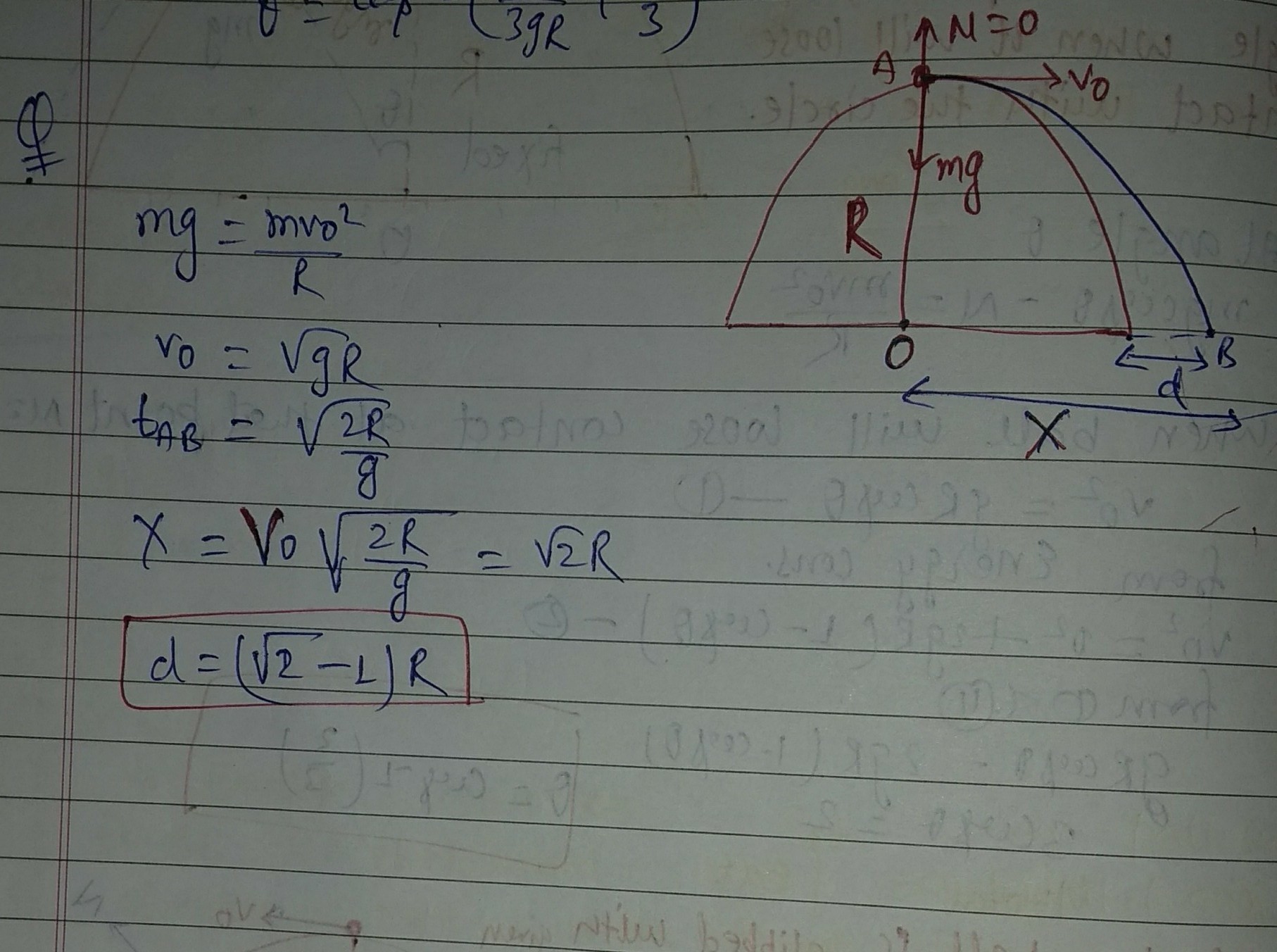
To determine the maximum velocity of a ball when it loses contact at the top of a smooth hemispherical surface, we need to analyze the forces acting on the ball and apply some principles of physics, particularly those related to circular motion and energy conservation. Let's break this down step by step.
Understanding the Scenario
Imagine a ball rolling down a smooth hemispherical surface. The ball starts from rest at the top of the hemisphere and moves down due to gravity. As it descends, it gains speed until it reaches a point where it loses contact with the surface. This point is crucial for our calculations.
Forces at Play
At the top of the hemisphere, the forces acting on the ball include:
- The gravitational force acting downwards (mg, where m is the mass of the ball and g is the acceleration due to gravity).
- The normal force exerted by the surface, which acts perpendicular to the surface.
As the ball moves down, it experiences a centripetal acceleration directed towards the center of the hemisphere. The ball will lose contact with the surface when the normal force becomes zero.
Applying Energy Conservation
We can use the principle of conservation of mechanical energy to find the velocity of the ball at the point of losing contact. The potential energy at the top converts into kinetic energy as the ball descends.
The potential energy (PE) at the top is given by:
PE = mgh
where h is the height of the hemisphere (equal to the radius R of the hemisphere).
The kinetic energy (KE) when the ball is at a height h is:
KE = (1/2)mv²
Setting the potential energy equal to the kinetic energy gives us:
mgh = (1/2)mv²
We can simplify this equation (mass cancels out):
gh = (1/2)v²
Solving for v, we find:
v = √(2gh)
Finding the Height
At the top of the hemisphere, the height h is equal to the radius R. Thus, we can substitute h with R:
v = √(2gR)
Condition for Losing Contact
For the ball to lose contact, the centripetal force required to keep it moving in a circular path must equal the gravitational force acting on it. The condition for losing contact can be expressed as:
mg = mv²/R
Substituting v from our earlier equation:
mg = m(2gR)/R
After simplification, we find that the ball loses contact when:
g = 2g,
which indicates that the ball loses contact at a height of R/2 from the ground.
Calculating Time to Reach the Ground
Now, to find the time it takes for the ball to reach the ground, we can use the equations of motion. The ball falls from a height of R/2 under the influence of gravity.
Using the equation:
h = (1/2)gt²
Substituting h with R/2 gives:
R/2 = (1/2)gt²
Solving for t, we have:
t² = R/g
t = √(R/g)
Final Results
In summary, the maximum velocity of the ball when it loses contact with the surface is:
v = √(2gR)
And the time taken to reach the ground from the point of losing contact is:
t = √(R/g)
This analysis illustrates the interplay between gravitational forces and motion, providing a clear understanding of the dynamics involved in this scenario.