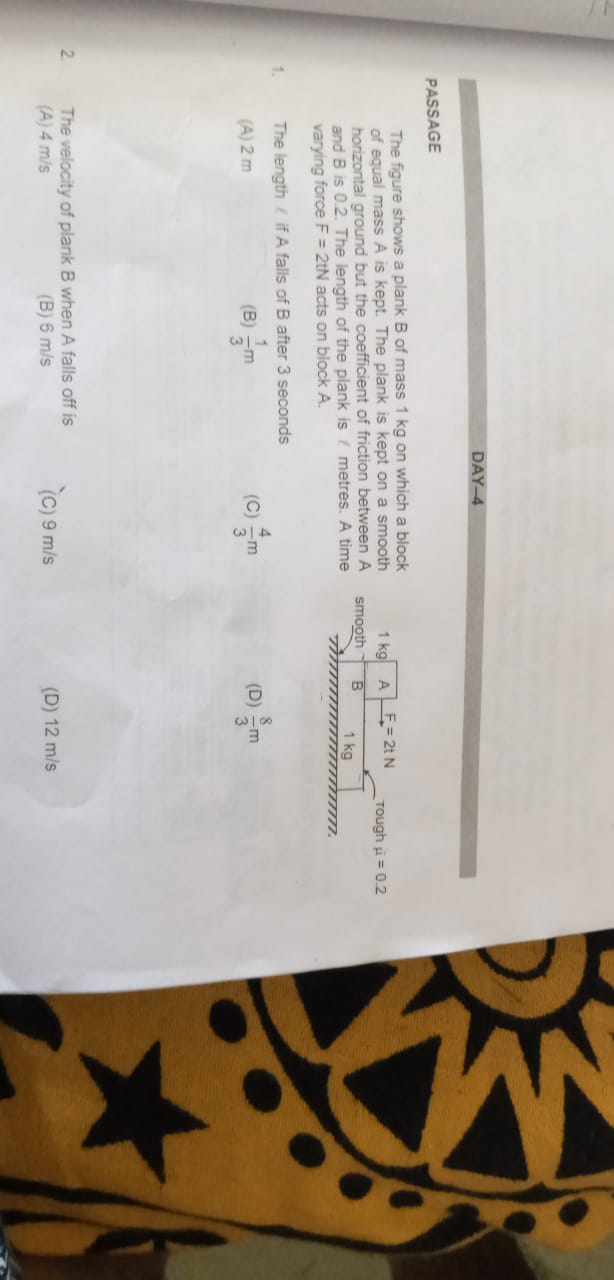
To analyze the situation you've described, we need to consider the forces acting on the block A and the plank B, as well as the effects of friction between them. Let's break it down step by step.
Understanding the Forces Involved
We have two masses here: block A and plank B, both with a mass of 1 kg. The force acting on block A is given by the equation F = 2t N, which means the force increases linearly with time. The coefficient of friction between the two blocks is 0.2, which will play a crucial role in determining whether block A will slide off plank B.
Calculating the Frictional Force
The maximum static frictional force that can act between the two blocks can be calculated using the formula:
- Frictional Force (f_max) = μ * N
Here, μ is the coefficient of friction (0.2), and N is the normal force, which equals the weight of block A (1 kg × 9.81 m/s² = 9.81 N). Thus:
- f_max = 0.2 * 9.81 N = 1.962 N
Determining the Force on Block A
Next, we need to find the force acting on block A at t = 3 seconds:
At this moment, the applied force (6 N) exceeds the maximum static frictional force (1.962 N). This indicates that block A will start to slide over plank B.
Analyzing the Motion
Once block A begins to slide, we need to consider the acceleration of both block A and plank B. The frictional force will now act as kinetic friction, which is generally lower than static friction. The kinetic friction can be calculated as:
Assuming the coefficient of kinetic friction (μ_k) is also 0.2, we have:
- f_kinetic = 0.2 * 9.81 N = 1.962 N
Calculating Accelerations
Now, we can find the acceleration of block A and plank B:
- For block A: F_net = F - f_kinetic
- F_net = 6 N - 1.962 N = 4.038 N
- Acceleration of A (a_A) = F_net / m = 4.038 N / 1 kg = 4.038 m/s²
For plank B, the only horizontal force acting on it is the frictional force:
- F_net_B = f_kinetic = 1.962 N
- Acceleration of B (a_B) = F_net_B / m = 1.962 N / 1 kg = 1.962 m/s²
Finding the Distance Traveled
To find out how far block A travels before it falls off plank B, we can use the equations of motion. The relative acceleration between block A and plank B is:
- a_relative = a_A - a_B = 4.038 m/s² - 1.962 m/s² = 2.076 m/s²
Now, we can use the equation of motion to find the distance traveled by block A relative to plank B in 3 seconds:
Assuming initial velocity (u) is 0:
- s = 0 + 0.5 * 2.076 m/s² * (3 s)² = 0.5 * 2.076 * 9 = 9.324 m
Conclusion on Length of Plank
Since the length of plank B is not specified, we can conclude that if the length of plank B is less than 9.324 m, block A will fall off the end of the plank after 3 seconds. If the plank is shorter than this distance, it will indeed fall off. If it is longer, block A will remain on the plank.